February 2025 - Sorting Through the “Sign Commandments”


John McKee delivers the February 2025 Outreach Israel News update.
The past several decades have witnessed scores of non-Jewish Believers, partaking of their faith heritage in Israel’s Scriptures, and joining Messianic Jewish congregations and synagogues. Some of this has been approached fairly well by Messianic Jewish Believers, but others have approached it with some skepticism, or even outright hostility. Many Messianic Jews genuinely welcome non-Jewish Believers in their midst, as their equal brothers and sisters. But others, as many of us can personally attest, are not so welcoming. Such is part of the ongoing development and maturation process, of the Messianic movement.
Many Messianic Jews are sincerely gratified and overjoyed, when they see non-Jewish Believers enter into their congregations, and partake of their faith heritage in the Scriptures of Israel in tangible ways. They believe that the Messianic movement has indeed been returning people to a First Century faith experience, and that non-Jewish Believers embracing things like the seventh-day Sabbath/Shabbat and appointed times/moedim, are good things. They believe that Jewish and non-Jewish Believers are to be “one new man/humanity” (Ephesians 2:15), and are not offended—provided that non-Jewish Believers are not pretending to be Jewish, but more so are co-laboring with them in the salvation of Israel and the Jewish people.
While many non-Jewish Believers can attest to it taking many years, to cultivate the trust of, often skeptical and curious Messianic Jewish Believers—some unfortunately, can testify how they have been treated with rudeness, been dismissed, and have even encountered forms of prejudice. While everyone’s experience in the Messianic movement is different, it cannot be denied that when witnessing non-Jewish Believers participate in various, outward forms of Torah, how some Messianic Jews have believed that their identity has been stripped or robbed from them. Many think that when non-Jewish Believers remember Shabbat, for example, that their identity as Jewish people has been erased or obliterated.
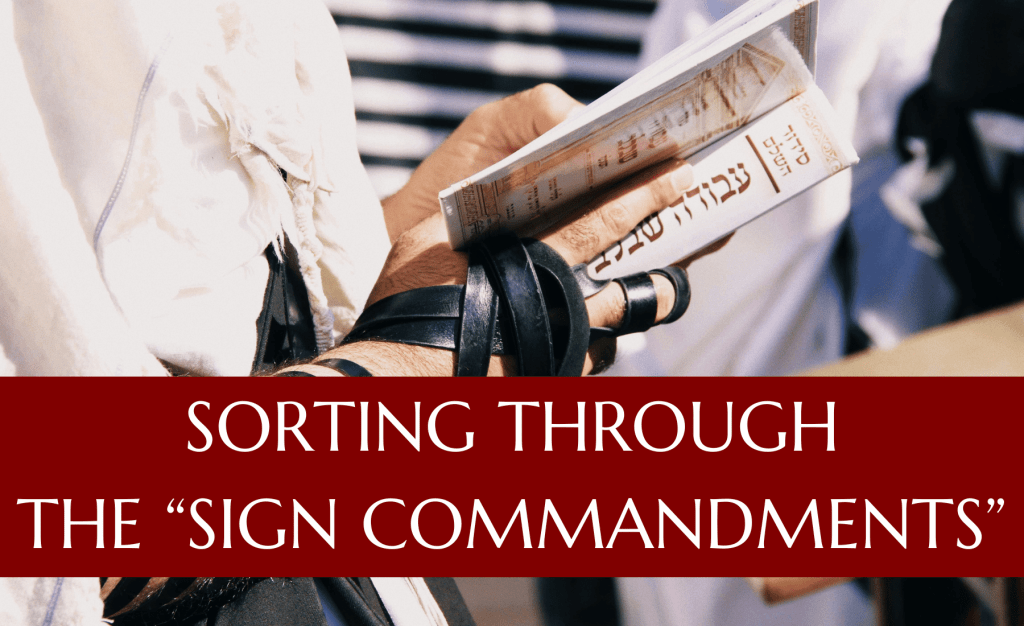
Customarily throughout Jewish history, it has been deduced that there are some major “sign commandments” witnessed in the Torah, intended to make Israel unique and distinct among the nations. These principally include:
- the seventh-day Sabbath/Shabbat
- the appointed times/moedim
- the kosher dietary laws
- male circumcision on the eighth day
- tzitzityot/fringes
- tefillin/phylacteries
- mezzuzah
It is important for each of us to sort through each of these traditionally regarded “sign commandments.” While one can encounter, particularly in Messianic Jewish sectors which avidly promote a bilateral ecclesiology—many protests toward non-Jewish Believers partaking of these outward elements of Torah—there is hardly any uniformity in the Messianic movement, regarding their observance, application, or even non-observance. There are various Jewish and Messianic Jewish sensitivities to be acknowledged, and frequently, Messianic congregations and synagogues do vary in their implementation of these outward practices. At the same time, why have so many non-Jewish Believers been drawn to the Messianic movement, and have taken on some of these things, as an important practice of faith?
Seventh-Day Sabbath/Shabbat
“Then ADONAI spoke to Moses saying, ‘Speak now to Bnei-Yisrael saying, “Surely you must keep My Shabbatot, for it is a sign between Me and you throughout your generations, so you may know that I am ADONAI who sanctifies you. Therefore you are to keep the Shabbat, because it is holy for you. Everyone who profanes it will die, for whoever does any work during Shabbat, that soul will be cut off from the midst of his people. Work is to be done for six days, but on the seventh day is a Shabbat of complete rest, holy to ADONAI. Whoever does any work on the Shabbat will surely be put to death. So Bnei-Yisrael is to keep the Shabbat, to observe the Shabbat throughout their generations as a perpetual covenant. It is a sign between Me and Bnei-Yisrael forever, for in six days ADONAI made heaven and earth, and on the seventh day He ceased from work and rested’” (Exodus 31:12-17, TLV).
While there are theological debates among those who argue for the seventh-day Sabbath/Shabbat being a Creation ordinance—versus those who think that the principle of rest was rooted in Israel’s Exodus from Egypt (Deuteronomy 5:12-15)—there should be no debate that the Sabbath has been uniquely kept by the Jewish people, in history. Throughout the many centuries of exile, especially, the institution of Shabbat, remembered as the pinnacle of week, has surely been able to keep the Jewish people coherent and bonded as a community. Many of the significant traditions and customs, notably those of the Erev Shabbat dinner and synagogue worship, among others, have been able to preserve world Jewry. When outsiders have seen observant Jews remember the Sabbath, especially with many procedures and preparations involved, the distinction of the Jewish people can be legitimately acknowledged.
Yet in the Scriptures, it is witnessed how Shabbat was intended to be an inclusive institution. While intended for the b’nei Yisrael or children of Israel, male and female slaves, sojourners, and animals in the community were also to receive a Sabbath rest (Exodus 20:8-11; 23:12). When non-Jewish people in today’s Messianic movement observe a seventh-day Sabbath, they are often doing so with this concept in mind. Frequently, while they may respect and appreciate many of the significant Jewish traditions and customs, which can be associated with Shabbat—non-Jewish Messianic people may not always be seen to observe them. The traditions of an Erev Shabbat dinner, for example, are certainly very edifying, but my family has not always observed them, unless invited to a Messianic Jewish home. Still, we try to make every Shabbat a holy time, where we abstain from labor to the best of our ability, and not engage in unnecessary commerce. Because we are not always seen to engage in many of the Jewish cultural traditions of Shabbat, it should be clear how we are not trying to replace or displace Messianic Jewish Believers or the historical Jewish people. Although, there are many Messianic Jewish Believers I know, who would not feel their Jewish identity infringed upon or invalidated, if our family chose to observe more traditionally-styled Erev Shabbat meals.
It is unfortunate, however, that many in today’s Messianic Judaism, may be seen to look at Shabbat as simply going to their local congregation, for a service on Saturday morning. For many Messianic Jews (and many non-Jews in the Messianic movement for that matter), Shabbat is effectively “Saturday church.” A Messianic person goes to their congregation or synagogue, attends a semi-traditional Torah service, and then may be seen to go out to eat at a restaurant with fellow congregation members afterward. There might also indeed be further commerce conducted, such as going to the grocery store or a shopping mall. These are definitely things my family did after church, in the 1980s and 1990s. But these are also things which subtract from the sanctity of Shabbat.
Interestingly enough, when you compare the style of Shabbat-keeping, from a wide number of today’s Messianic people—to the “Sunday Sabbath” of some of my grandparents and great-grandparents—their “Sunday Sabbath” was much more strict.
In the future Millennial Kingdom, it is said how “it will come to pass, that from one New Moon to another, and from one Shabbat to another, all flesh will come to bow down before Me” (Isaiah 66:23, TLV). This is commonly regarded how there will unambiguously be a global observance of the seventh-day Sabbath, in the Messianic Age, by both Israel proper and the nations. A huge debate, to be sure, is whether or not this has started to break into the present, via many non-Jewish Believers being drawn into Messianic things. For certain, non-Jewish Believers honoring the seventh-day Sabbath/Shabbat, as a day of rest and refreshment unto the Lord, does not have to mean canceling out or deriding how the institution of the Sabbath has been uniquely and specially kept by the Jewish people for many centuries.
Appointed Times/Moedim
“Then ADONAI spoke to Moses saying: ‘Speak to Bnei-Yisrael, and tell them: These are the appointed moadim of ADONAI, which you are to proclaim to be holy convocations—My moadim” (Leviticus 23:1, TLV).
There is little doubting, how throughout the course of history, whether it be Ancient Israel or the Jewish people in the Diaspora, that honoring the moedim or appointed times has often kept the Jewish community unique and distinct from their neighbors. This would have been especially true, in various Diaspora settings, where the host country would likely have been somewhat hostile to Judaism—imposing laws and restrictions on the Jewish community. Jewish people throughout history have been persecuted for observing the appointed times or moedim, suffering through not just social anti-Semitism, but also various acts of violence and libel. Much of this, lamentably, has been at the hands of institutional Christianity.
When one reviews the instruction of the Torah, many of today’s Messianic non-Jewish Believers, will be keen to point out how it was not only native Israelites, but also welcome sojourners, who were seen observing various appointed times in Ancient Israel. This included: participation in the Festival of Sukkot/Tabernacles and the Festival of Shavuot/Weeks (Deuteronomy 16:11, 14), observance of the Day of Atonement or Yom Kippur (Leviticus 16:29), some expectation to observe the Passover (Exodus 12:49; Numbers 9:14), observance of the Festival of Unleavened Bread (Exodus 12:19), and the option of being circumcised to eat of the Passover, and consequently being regarded as a native (Exodus 12:43-47). So, it can be reasonably deduced how, on the whole, the appointed times or moedim, for Ancient Israel, were inclusive institutions for those within the community.
One of the main reasons why the Messianic movement exploded in the 1990s-2010s, with so many non-Jewish Believers being drawn to its congregations and synagogues, was to better understand “Jesus in the feasts.” Many Messianic Jewish congregations make a point to host Passover seder meals, with an emphasis on both the Exodus and Last Supper, opening it to not only the Jewish public—but the Christian public. When many evangelical Believers have attended such an event, they often have been curious, to understand more about the Jewish Roots of their faith, and the other appointed times. They see remembering the annual Torah moedim, as well as holidays such as Purim and Chanukah, as being more authentic to the practices of the First Century Believers—than traditional Christian holidays, such as Christmas and Easter. The appointed times are believed to contain a prophetic picture of the Messiah’s First and Second Comings (cf. Colossians 2:17). Those, who observe the moedim, will be more in tune with the end-time plan of the Holy One of Israel.
Many Messianic Jewish Believers are quite gratified to see non-Jewish Believers join with them during the appointed times. While it is safe to say, with many of the traditions and customs associated with the moedim throughout Jewish history—that the Jewish people and Messianic Jewish Believers have a natural connection to the appointed times, which non-Jewish Believers do not have—non-Jewish Believers observing the appointed times, with their Messianic Jewish brothers and sisters in Messianic congregations, hardly means that the unique place of the Jewish people is nullified or lessened. Since 1995-1996, our family has observed the appointed times, using the mainstream Rabbinical calendar, and in common cause with the Messianic community. While we would like to see many of our evangelical friends and family partake of these holidays, as we have, non-Jewish Believers participating in the festivals of the Lord, in some way, has become something much more acceptable today, than it was in the mid-1990s.
It has to be noted, that while there will be some Messianic Jews, who are less than pleased when various non-Jewish Believers remember the appointed times or moedim—that there can also be a degree of considerable laxness, among other Messianic Jews, when it comes to them. There are Messianic Jews who are actually seen to observe Christmas in their homes on December 25, even with their tree up before Thanksgiving. (This goes beyond intermarried couples being involved with extended family for the Christmas holiday.) A number of Messianic Jews are seen to observe Valentine’s Day on February 14, and even Halloween on October 31. For sure, all can recognize how Christmas on December 25 is not authentic to Apostolic and post-Apostolic practice. Valentine’s Day and Halloween, however, have many questions surrounding them, which can and do involve various levels of Roman syncretism, and ancient Celtic paganism.
Dietary Laws/Kashrut
“ADONAI spoke to Moses and to Aaron, saying to them, ‘Speak to Bnei-Yisrael, saying: These are the living things which you may eat among all the animals that are on the earth’” (Leviticus 11:1-2, TLV).
The distinctions between clean and unclean meats, witnessed in the Torah, have customarily been interpreted throughout a great deal of Jewish history, as only applying to ethnic Israelites and Jews. It is witnessed how sojourners, in Ancient Israel, could eat an animal which died of natural causes (Deuteronomy 14:21), whereas native born Israelites could not. (This may have been a form of ancient welfare, a reflection on the generally poor economic state of most sojourners.) Both native Israelites and sojourners were given the explicit prohibition of consuming blood, from animals eaten for meat (Leviticus 17:10, 12).
A somewhat perplexing instruction appears in Leviticus 17:13: “Any person from Bnei-Yisrael, or from the outsiders dwelling among them, who hunts as game any animal or bird that may be eaten, must drain its blood and cover it with dust” (TLV). This is describing the catching of wild animals or fowl for food, and how the blood had to be drained. What begs some inquiry, is how it is stated, “Any Israelite or migrant living among you who hunts and animal or birth that may be eaten [asher yei’akeil]” (Koren Tanakh). Seemingly, along with the native born, sojourners in Ancient Israel could only catch what were considered to be clean wild animals or fowl. It would not make any sense, though, for sojourners to only eat clean animals caught from the wild, but both clean and unclean animals which had been domesticated. This would logically suggest that the sojourner in Ancient Israel was limited to only eating from the clean animals listed in Leviticus 11, meaning that the b’nei-Yisrael in view applied to the wider congregation or population.
There can be no dispute how adherence, to the kosher dietary laws, has been monumental, at keeping the Jewish people separate and distinct, throughout a great deal of history. As is evident by the Maccabean Crisis of the Second Century B.C.E., Jewish people were often forced to eat unclean meat, such as pork, if they wanted to avoid death. Forced conversions by Roman Catholicism, often involved Jewish people being forced to eat pork. A great deal of anti-Semitic acts have involved unclean meat, often pork, as a factor.
There is also a great conundrum, when reviewing the modern history of Judaism, regarding why so many Jewish people in the Diaspora do not, actually, keep any form of kosher. Much of this goes back to the 1885 Pittsburg Platform of Reform Judaism, which dismissed what it considered to be outdated Levitical rituals such as kosher, making Judaism much more of a philosophy than not. A wide number of today’s Messianic Jewish Believers, while raised in homes, with a strong Jewish identity, were actually not raised eating kosher.
Some of this has actually passed into today’s Messianic Jewish movement. A wide number of today’s Messianic Jews do not keep kosher, or they only keep kosher during the major holidays. Or, some keep kosher at home, but then eat whatever they want out in the world. I have personally been to various conference level events, where I have seen a number of Messianic Jewish leaders eat shrimp cocktail and escargot.
Abstaining from pork and shellfish would be considered a minimal form of kosher, or kosher style. This is what is adhered to by most in today’s Messianic movement, whether someone is non-Jewish, or even Jewish. It is quantitatively indifferent than adopting one of the many different diets out there (i.e., vegetarian, vegan, pescetarian, Atkins, Keto, low carb, carnivore, etc.). A considerable majority of Jewish people, in North America, do not keep kosher. So, when various non-Jewish Believers, in the Messianic movement, are seen to eat a kosher style of diet—they are a reminder of an area of Torah observance, which is far more natural for Jewish people to observe, and which many in the Jewish community have chosen to eschew.
Circumcision
“Then ADONAI spoke to Moses saying: ‘Speak to Bnei-Yisrael, instructing: If a woman conceives and bears a male child, then she will be unclean for seven days, as in the days of her niddah she will be unclean. In the eighth day the flesh of his foreskin is to be circumcised’” (Leviticus 12:1-3, TLV).
I have never met an intelligent Bible reader, who has ever denied how circumcision on the eighth day, was expected of native born Israelite males. Circumcision was something practiced by various pre-Israelite societies in the Ancient Near East, yet it did distinguish Ancient Israel from its neighbors, such as the Philistines—and notably later the Jewish community set against the Greeks and Romans. Circumcision is something which the Jewish people have not only been persecuted throughout history for observing, but many have fought and died for it. During the Maccabean Crisis of the Second Century B.C.E., there were also Jews who practiced epispasm, a form of foreskin restoration (1 Maccabees 1:15), as part of committing apostasy against the God of Israel.
Were sojourners in Ancient Israel expected to circumcise their male infants on the eighth day? It does not appear so. What sojourners in Ancient Israel were expected to do, was to observe the Festival of Unleavened Bread, abstaining from leaven (Exodus 12:19). They were not permitted to eat of the Passover, though, unless males were circumcised (Exodus 12:48), which would reckon a sojourner with native of the land status. It is logical to assume that every year, when Passover was observed in Ancient Israel, a new group of sojourners had been prompted to be circumcised, so they could fully participate in the Passover.
By the Second Century-First Century B.C.E., mainly as a result of the Maccabean Crisis—where the Jewish community rightfully fought and died for circumcision and their Jewish identity—circumcision became significantly associated with the rite of a non-Jew becoming a proselyte. Many Greeks and Romans, in the broad First Century period, were attracted to the Jewish Synagogue, particularly for its monotheism, and the ethical code of Judaism. These God-fearers took on many aspects of Torah, such as the seventh-day Sabbath, festival observance, and a kosher diet, often stopping short of being circumcised as proselytes. Sometimes circumcision was not observed, as there would be severe, life-threatening consequences. A Roman official being circumcised, for example, might be charged with treason against the state. Within the Apostolic Scriptures, as the good news spread out into the Mediterranean, circumcision of the new Greek and Roman Believers was opposed, mainly because various hyper-conservative Pharisees thought it necessary for their salvation (Acts 15:1).
Circumcision today is still rightly practiced, not only by observant Jews, but even semi– to non-religious Jews. Circumcision should certainly be practiced by Messianic Jews and intermarried couples.
In much of the West, over the past century-and-a-half, circumcision has become a common medical procedure. While non-Jewish male infants do not have to be circumcised per Leviticus 12:1-3, there is nothing which Biblically prohibits a non-Jewish couple, from honoring the spirit of the Torah commandment, by having a medical circumcision. In a Messianic congregation, a non-Jewish couple can have their child dedicated after a hospital circumcision. But, some of the traditional blessings, of the Jewish bris, should probably be reserved for the infant males of Messianic Jews and intermarrieds. These distinct blessings connect one back to the Abrahamic Covenant and Patriarchs, and not only involve naming a male child (Hebrew and English), but will also include a recognition of him among the specific sons of Israel.
It cannot go unnoticed how there is a growing anti-circumcision movement in parts of the West, no doubt fueled by a great deal of anti-Semitism. Non-Jewish families circumcising their infant males, as a medical procedure, is an excellent way to stand with the Jewish community.
Fringes/Tzitziyot
“ADONAI spoke to Moses saying, ‘Speak to Bnei-Yisrael. Say to them that they are to make for themselves tzitzit on the corners of their garments throughout their generations, and they are to put a blue cord on each tzitzit. It will be your own tzitzit—so whenever you look at them, you will remember all the mitzvot of ADONAI and do them and not go spying out after your own hearts and your own eyes, prostituting yourselves. This way you will remember and obey all My mitzvot and you will be holy to your God. I am ADONAI your God. I brought you out of the land of Egypt to be your God. I am ADONAI your God’” (Numbers 15:37-41, TLV).
The instruction for the b’nei Yisrael to wear tzitzityot, fringes or tassels, is something which is seen to have some interesting variance, across religious history. No one denies from reading the Gospels, for example, that Yeshua the Messiah, and His Jewish contemporaries, wore tzitzityot, even with there being some extremes (Matthew 23:5). Throughout a great deal of Jewish history, this Torah instruction has been interpreted as meaning that ethnic Israelite males were to wear fringes on a four-cornered garment. While certainly known to the Second Temple period, the specific dye formula for the techelet, or blue, was believed to be widely lost to history; this is why many religious Jews have only worn all white tzitzityot. Many in the Temple restoration movement in Israel do believe, though, that the specific mollusk used for making the blue thread has resurfaced, perhaps a sign that the Messiah is soon to appear. Fringes with this techelet can be purchased from Israel.
While there have been some variant opinions in Jewish history over the centuries, it was probably not until the emergence of the Reform and Conservative movements, in the late Nineteenth Century, when some alternative approaches to b’nei Yisrael and wearing fringes started to appear on the scene. Are the b’nei Yisrael in view, to be considered ethnic male Israelites, or ethnic male and female Israelites? If it is the latter, then females can certainly wear tzitzityot as well.
Today’s Orthodox Jews are often seen to wear fringes all the time, usually on an undershirt known as a tallit katan, with the fringes displayed from the waist. The larger tallit gadol is worn during traditional times of daily prayer. Within Conservative Judaism, the wearing of fringes tends to be restricted to employing the tallit during times of daily prayer, as well as at the morning Shabbat service. Within Reform Judaism, the wearing of the tallit is usually only observed by rabbis or officiants, similar to how Protestant clergy may wear a stole. Both Reform and Conservative Judaism permit women to wear a tallit.
A considerable part, of today’s Messianic Jewish movement, follows what is seen within Reform and Conservative Judaism. One may attend a Messianic Jewish congregation or synagogue, where the wearing of a tallit is mainly observed by the rabbi, the cantor, and/or those leading the worship service. Most Messianic Jews do not wear fringes all the time, as per Orthodox Judaism. At Messianic congregations, many Messianic Jewish men will be seen wearing a tallit. The issue of Messianic Jewish women, wearing a tallit, tends to be met with controversy, although it can be witnessed from time to time. Unlike traditional Judaism, which generally prohibits the wearing of the tallit in the evening, with the exception of Erev Rosh HaShanah and Erev Yom Kippur, Messianic Jewish congregations which hold Erev Shabbat services, will most always see someone wearing a tallit.
Generally speaking, in a great deal of the modern Jewish experience, wearing tzitzityot or fringes all the times on one’s garments, will identify a person as being an Orthodox Jew, and with Orthodox Jewish values.
While there has been considerable discussion and debate, regarding whether or not the b’nei Yisrael of Numbers 15:37-41, included male and female Israelites, there was no specific direction given to sojourners or gerim in Ancient Israel, regarding this. However, it is to be observed how sojourners in Ancient Israel were instructed to observe the Torah (Deuteronomy 31:11-12), and there are various places in the Torah where the b’nei Yisrael in view, was the broad congregation or population. It is not difficult to deduce how many sojourners, in Ancient Israel, were likely seen wearing fringes, as they were steadily integrated into the community.
The practices of each Messianic Jewish congregation in the West needs to be evaluated on its own merits. Usually though, if a male non-Jewish Believer is seen wearing a tallit during a Shabbat service, in a similar manner to Messianic Jews—themselves often following a Conservative Jewish style of halachah—there will be little issue. As long as a non-Jewish man recognizes that employing a tallit in Shabbat worship, it will not make him ethnically or culturally Jewish, there should be no problem. Many Messianic Jews, in fact, see a non-Jewish man wearing a tallit, to be a sign of unity and reconciliation, per the Ephesians 2:15 “one new man.” Yet, there are non-Jewish Believers, who attend some Messianic congregations, who may feel uncomfortable wearing a tallit in public worship—particularly in that it may draw undue attention to themselves—and they may restrict it to private times of prayer, at home.
More variance is witnessed in the Hebrew Roots movement, regarding the wearing of fringes or tzitziyot. One will frequently witness, some kind of homemade fringes, with a synthetic cord of blue, worn on a person’s beltloops, all the time. Far from being an innovation of just a few, since the turn of the Millennium, this has developed into a huge cottage industry, with multi-colored fringes also witnessed. Many in Messianic Judaism see this as an impediment to Jewish outreach and evangelism, and perhaps even as a form of cosplay. More significant, though, is how the common Hebrew Roots wearing of homemade fringes, is thought to disregard and disrespect mainstream Jewish halachah—even of the Reform and Conservative movements, which do permit females to wear a tallit.
While frowned upon for sure, one cannot avoid attending a Messianic Jewish congregation, synagogue, or conference-level event—and seeing some well-meaning, non-Jewish person, wearing homemade fringes on his (or her) beltloops.
Phylacteries/Tefillin
“Bind them as a sign on your hand, they are to be as frontlets between your eyes” (Deuteronomy 6:8, TLV).
One of the most important Torah instructions, certainly for those in contemporary Orthodox Judaism, is the daily wrapping of tefillin or phylacteries. It is indisputable, from both the Apostolic Writings (cf. Matthew 23:5) and archaeology, that wrapping tefillin was observed by many in Second Temple Judaism. Tefillin are leather boxes, including the parchments containing the specific admonition to bind God’s Word on the hand and forehead (Exodus 13:1-10, 11-16; Deuteronomy 6:4-9; 11:13-21). Tefillin are customarily worn during morning prayers. The specific tradition of wrapping the binding the tefillin to one’s arm, close to the heart, and to one’s forehead, is intended to be a physical reminder of the significance of God’s Instruction. There is little doubting how the practice of wrapping tefillin, whether seen in ancient times, or up until more modern times, has been a very edifying and useful practice, for sincere, pious Jews.
Similar to the employment of the tallit, while Orthodox Judaism has widely looked at wrapping tefillin as limited to Jewish males, both the Conservative and Reform movements are seen to permit Jewish females to wrap tefillin.
How are the instructions, from which the practice of wrapping tefillin is derived, approached in Messianic Judaism? While there is a small number of Messianic synagogues, which will hold a minyan of ten men for regular times of traditional prayer and wrap tefillin—the considerable majority of Messianic Jewish congregations in the Diaspora are not, at least publicly, seen to have anybody wrap tefillin. I have never attended a Messianic congregation, where there was a prayer group which wrapped tefillin. At most, I have known that a few Messianic Jewish individuals, notably rabbis, have wrapped tefillin in private times of prayer, at home. While it is natural to expect various Messianic Jewish men to privately wrap tefillin, if there have been any Messianic Jewish women to also do so, they would similarly be doing it in private. This also involves any non-Jewish Believers in Messianic Judaism.
How have those in the independent Hebrew Roots movement applied the direction involving tefillin? Customarily, the instruction to bind God’s Word on the hand and forehead, has been interpreted entirely as a metaphor, and not literally. While people in the Hebrew Roots movement tend to be insistent that Yeshua’s criticism of the Pharisaical leaders wearing fringes in Matthew 23:5, was focused on their manner of wearing fringes—and not the command itself—this is often not similarly applied to their employment of phylacteries as well. Yet, as many Messianic people rightly conclude, if Yeshua wore fringes, He likely also used phylacteries in various times of prayer. There has never been a huge insistence, among anyone in Hebrew Roots, that physical tefillin or phylacteries need to be employed by today’s Believers. More frequently than not, though, it can be concluded that wrapping tefillin is a tradition of Judaism, a vain “tradition of men,” and error of the Synagogue with little to no value.
Throughout a great deal of today’s Messianic Judaism, wrapping tefillin or phylacteries, is not thought to be a vain tradition which Yeshua opposed. The Torah direction to bind God’s Word, on the hand and forehead, is principally thought to be a spiritual word, to inculcate His Instruction in our thoughts and actions. Yet, it is also believed that wrapping tefillin can be a very useful and edifying employment of this. Those who wrap tefillin during traditional times of prayer, have to surely focus on God and His work! But, given the price of tefillin, as easily ranging in the several thousand dollar range, many who would like to wrap tefillin—and surely see value in it—opt for a metaphorical application on economic grounds.
Mezuzah
“and write them on the doorposts of your house and on your gates” (Deuteronomy 6:9, TLV).
One of the unique features, often identifying a Jewish residence, home, or even place of business, is the small, angled box, usually seen on the outside doorframe. This is a mezuzah, which will include parchments of the key Torah passages (Deuteronomy 6:4-9; 11:13-21), which direct how God’s Word is to be affixed to the entrance of one’s house and gates. Throughout a great deal of Diaspora Jewish history, the mezuzah has been something quickly affixed, with the ability to be quickly removed, given how many Jews have been forcibly relocated or evicted by Gentile authorities.
Throughout today’s Messianic Jewish movement, Messianic Jewish homes and Messianic Jewish synagogues (should a congregation own its own facilities), are definitely going to display multiple mezuzahs. This may not only involve the front door and back door to one’s house, but perhaps the entryway to various, important rooms in the house as well. A wide number of non-Jewish Believers, in today’s Messianic movement, are likewise seen to affix a mezuzah to the front door of their homes.
There can, for certain, be some variance in how this Torah instruction is employed—beyond the many kinds of mezuzahs available on the market. Is it always safe to affix a mezuzah to the outside doorframe of one’s house? Would this not be a public indicator that the domicile is a Jewish home, or at least that the residents are friends of Israel? Some, depending on where they are located, do choose to affix a mezuzah on the inside doorframe of their homes.
While the Hebrew Roots movement has been known to take the instruction to affix God’s Word to one’s doorpost and gates, to various extremes—I have never witnessed those in today’s Messianic Judaism, strongly oppose non-Jewish Messianic people from affixing a traditional, Jewish mezuzah, to their front door. Many know that this identifies the residents of a home as not only worshippers of the God of Israel, but friends and allies of the State of Israel.[1]
Weighing the Future
There are going to be hundreds of millions of people, we meet in the Kingdom, who were legitimately saved by the blood of Yeshua, and never really participated in the outward matters of Torah we have just summarized. But unlike my Reformed and Wesleyan ancestors of a century ago, who certainly believed in following the moral commandments of the Law of Moses and Old Testament—we are living in much different times. We have seen the creation of the State of Israel, according to prophecy (Isaiah 66:8). While it might be met with some bristling from a number of people in Messianic Judaism, it is undeniable that non-Jewish Believers are turning to Zion, to be instructed from Moses’ Teaching (Isaiah 2:2-4; Micah 4:1-3).
The Messianic community has mushroomed in size, over the past two to three decades, because of the involvement of non-Jewish Believers. Hopefully, they have been genuinely called by the Lord, to co-labor in the salvation of the Jewish people and restoration of Israel, alongside of Messianic Jewish Believers. These people have been supernaturally prompted by the Lord, as part of their progression in the New Covenant (Jeremiah 31:31-34; Ezekiel 36:25-27), to consider what the “sign commandments,” mean to them. Many non-Jewish Believers, as a part of Messianic congregations and synagogues, in fellowship with Messianic Jewish Believers, have participated in various outward matters of Torah on different levels, as they have grown in holiness. These people have hardly been responsible for negating or dismissing the unique and valued role of the Jewish people, in salvation history.
Individuals, such as myself, have made the effort to be sensitive to the traditional halachah of much of the Synagogue, in participating in outward matters of Torah. To be sure, I have had to make some adjustments over the years, and I have had to fix a few errors. As a teacher, I have also had to stress how non-Jewish Believers, participating in outward matters of Torah, has to eventually lead to being an active, co-laborer in the salvation of Israel and the Jewish people. It is not enough, for example, to participate in a Passover seder, because it is something which Yeshua did. It is also imperative to testify of the salvation of the Jewish Messiah to His Jewish people!
There can be a heavy price to pay, for many non-Jewish Believers in today’s Messianic movement, who actively participate in Shabbat, the festivals, and the like. This usually involves both eternal and internal factors. Many have not felt welcome in Messianic Jewish congregations and synagogues, and have either returned to their previous Christian settings, or gone into the Hebrew Roots movement. Today, Israel and the Jewish people need all the friends and allies they can get. Time will certainly tell, how many were genuinely called to the Messianic movement, and who can be given great accolades by the Lord when He returns (cf. Isaiah 66:21).
NOTES
[1] See especially actress Patricia Heaton, appealing to the myzuzah.org campaign, and that non-Jewish friends of Israel should order the special mezuzah in solidarity with the 07 October, 2023 hostages, affix it to their front doors, and take a picture in standing against anti-Semitism (14 November, 2024). Available online via <https://x.com/patriciaheaton/status/1857184356697063697?s=46>.