reproduced from Are Non-Jewish Believers Really a Part of Israel?
The Messianic Jewish movement which has grown and been emerging in the late Twentieth and early Twenty-First Centuries, has achieved much for the Kingdom of God, which it should be genuinely proud of and satisfied for. It has made a significant, positive contribution in the lives of many Jewish men and women who have come to saving faith in the Messiah of Israel, giving them a place where they do not have to assimilate and give up their Jewish heritage, traditions, and customs.
Perhaps an unforeseen side-effect, is how the Messianic movement has also made a significant, positive contribution in the lives of many non-Jewish, evangelical Protestant men and women, who have come to know the Jewishness of Jesus and the New Testament in a much more profound and tangible way. Many of these people have entered into the Messianic movement, its congregations and synagogues, and have adopted a Torah obedient lifestyle, as they have sought to emulate Messiah Yeshua. As we continue to see various developments occur within our broad Messianic community, the question of how non-Jewish Believers relate to Israel—especially given the end-time reality of the nations coming to Zion to be taught from Moses’ Teaching (Micah 4:1-3; Isaiah 2:2-4), and those of the nations joining with the Jewish people (Zechariah 8:23)—is undeniably going to increase.
Many of the people who compose and/or encounter the broad Messianic community, are in a state of relative confusion, or at least uncertainness, when it comes to the subject of ecclesiology. Ecclesiology is not a word they tend to hear in their weekly Shabbat teachings, or at their various Bible studies or prayer groups. They certainly do not read about it that much, if their spiritual regimen is mostly constrained to various devotion books. Yet, ecclesiology, the study and identity of God’s elect, is a theological discipline which can draw some heavy lines of demarcation and division among various groups of Messianic people—especially as the Messianic community continues to grow, and more and more non-Jewish Believers, in particular, are convicted by the Holy Spirit that they need to be embracing their faith heritage in Israel’s Scriptures in more real and tangible ways.
Many of you reading this are familiar, but many of you are not familiar, with how there has been a wide amount of literature composed over the past three to four decades—most of it since the late 1990s, though—on the development of contemporary Messianic Judaism. This includes perspectives from Messianic Jews, evangelical Christians, and Jews in general, summarizing some of its different leaders, and the different contours, perspectives, visions present, and experiences.[1] Whether you are aware of it or not, this volume of material has doubtlessly influenced various Messianic Jewish leaders of note, and people within the broad Messianic community, at least in the context of people understanding how modern Messianic Judaism emerged in the late 1960s and early 1970s, and how it has grown and developed to the present.
Concurrent with this, and part of it necessarily geared toward enlisting evangelical Protestant support and understanding for Messianic Jewish ministry, have been a number of books, which have addressed the issue of non-Jewish involvement and participation in the Messianic movement, and/or unity with Jewish Believers. Some of these have principally been focused on Christian support of the Jewish people, the State of Israel, and in countering the evils of anti-Semitism in the post-Holocaust world, and with it some need to understand the Jewishness of Jesus and the New Testament.[2] Other books, which have received wide distribution within the Messianic community, regard concepts such as non-Jews being “grafted-in” to the olive tree (Romans 11:16-17), the Commonwealth of Israel (Ephesians 2:11-13), the Israel of God (Galatians 6:16), as well as understanding various aspects of Torah practice.[3] Some resources and perspectives are inclusive, when it comes to non-Jewish Believers being involved in things Messianic, and others are seen to not be so inclusive. There are those within the Messianic Jewish community, who stress differences among God’s people to be more important than their common faith in the Lord. There are others, though, who are more keen to emphasize how, certainly at this phase of its spiritual and theological development, that non-Jewish Believers have to be specially called by the Lord into the Messianic movement. So, while many may first be intrigued at connecting to things such as the seventh-day Sabbath/Shabbat, the appointed times/moedim, a kosher style of diet, and regular Torah study—this also needs to be joined with participation in the Messianic Jewish mission of Jewish outreach, evangelism, and Israel solidarity.
With a great deal of information out there about Messianic Judaism, non-Jewish Believers connecting to their faith heritage in the Scriptures of Israel, and differing views of ecclesiology—is it fair to say that various sectors of the Messianic community can be in a state of confusion when it comes to the subject of God’s elect. Sadly, it can also be observed how many number accusations and hostile claims can be issued, from multiple sides, as it regards Jewish and non-Jewish Believers and Israel.
If one were to survey the broad Messianic movement, and how it would answer the question Are non-Jewish Believers really a part of Israel?, you are likely to see four main, distinct answers. The following table compiles what I have classified as the Hard No / Hard Yes and Soft No / Soft Yes answers. If you have at all been a part of the Messianic movement for any period of time, or have been exposed to an array of Messianic beliefs and views, you are likely to have encountered answers like the following:
Are Non-Jewish Believers Really a Part of Israel? |
|
| HARD NO: | Gentile Christians are a part of the Christian Church, an entity entirely separate from Israel or the Jewish people |
| SOFT NO: | Gentile Christians are a part of the Christian Church, which along with Israel or the Jewish people and/or Messianic Jewish community, are the two entities which compose the Commonwealth of Israel |
| SOFT YES: | Non-Jewish Believers are a part of an enlarged Kingdom realm of Israel, with a restored Twelve Tribes of Israel at its center, and with the Kingdom reign of Messiah Yeshua expanded to incorporate the righteous from the nations |
| HARD YES: | Non-Jewish Believers are not only a part of the Kingdom of Israel, but most of them are physical descendants of the Ten Lost Tribes of the Northern Kingdom of Israel/Ephraim |
The two main positions which one finds in today’s broad Messianic community, are going to be the Soft No and Soft Yes answers.
The Hard No answer largely represents those Messianic Jewish groups, which would still strongly adhere to some kind of dispensational theology, and the Hard Yes answer is largely found in the Two-House sub-movement.
The Soft No answer, that the Commonwealth of Israel composes Israel/the Jewish people and the Christian Church, has been a position widely held in notable parts of contemporary Messianic Judaism, and now tends to be labeled or defined as a bilateral ecclesiology. The Soft Yes answer, that Jewish and non-Jewish Believers are a part of an enlarged Kingdom realm of Israel, which may also be termed the Commonwealth of Israel, is something you will likely also see present in various parts of Messianic Judaism, particularly within congregations and assemblies which emphasize all Believers composing “one new man/humanity” (Ephesians 2:15).
The position which a ministry like Outreach Israel and Messianic Apologetics believes is the most Biblical, the most provable, and above all the most inclusive for all of God’s people, is the Soft Yes answer.
When we answer the question Are non-Jewish Believers really a part of Israel?, the “Israel” we are talking about is not the modern-day State of Israel, which while reborn through the fulfillment of Bible prophecy (Isaiah 66:8) and a major player in the future via God-ordained prophecy, is obviously not the restored Kingdom of Israel with Yeshua the Messiah ruling and reigning. We are not talking about non-Jewish Believers entering into their local non-Messianic, Jewish synagogue, and somehow expecting to be recognized and fully included as members of the Jewish community, as though they were ethnic Jews. We are certainly not talking about non-Jewish Believers traveling to the modern-day State of Israel and expecting to make aliyah and become citizens, taking up some sort of misguided claim to a piece of the Promised Land.
We are instead talking about non-Jewish Believers being a part of the Kingdom realm the Messiah came to restore, which invites the righteous from the nations into its polity, as brothers and sisters in the Lord of the redeemed, equally from the Jewish people and the world at large. As we will discuss, this is a Kingdom of Israel which has placed at its center a restored Tabernacle of David, and which has enlarged itself, incorporating those of the nations as people who recognize the King of Israel, Yeshua, as their Sovereign (Amos 9:11-12; Acts 15:15-18, MT and LXX). Suffice it to say, there is no separate “Church” entity of which non-Jewish Believers may be regarded as composing.
Understandably, there are many aspects of God’s elect composing this enlarged Kingdom realm of Israel which need to be further explained, defined, and evaluated from the Scriptures. The undeniable distinctiveness of the Jewish people as descendants of Abraham, Isaac, and Jacob, and their great virtues and contributions to both the Kingdom of God and humanity at large, need to be recognized and honored—but along with this the inclusive nature of Israel’s Kingdom to all people needs to be acknowledged. Changes occurring, both positive and negative, throughout the broad Messianic community need to be recognized, so that individual Believers and families of Believers can adequately know what to do as salvation history moves forward.
The Jewish People Are Distinct
That all people on Planet Earth are distinct, is a concept I learned as a small child from one of America’s foremost philosophers. Fred Rogers began or ended his television program with something to the effect: You are special, there has only been one person like you who has ever existed, and there will only be one person like you who will ever exist. Each one of us is not only special, as a human being made in God’s image and who is valued by Him, but we each have unique gifts, talents, and skills. Each one of us, in our different ethnicities and cultural backgrounds, is likewise special and distinct.[4]
In current Messianic discussions and debates over ecclesiology, those who generally want to keep non-Jewish Believers out of, or distant from, the Messianic movement, will make arguments to the effect that the presence of non-Jewish people will either blur distinctions between the Jewish people and the nations, or that such distinctions (which might need to be rigidly maintained) could even be abolished.
Obviously, the Jewish people—even with their broad dispersion to the four corners of the globe—have distinct ethnic, cultural, and personality traits, which while widely appreciated by non-Jewish Believers in the Messianic community, are not always things which they have chosen to integrate into their own experience. Messianic congregations in the Diaspora, tend to be very diverse local communities, with many, if not most, able to easily discern who is Jewish or non-Jewish.
What is most important for the Bible reader and examiner, in considering the current condition of ecclesiology, is in recognizing some of the main traits which make the Jewish people distinct, which no other group of people—even non-Jewish persons who recognize Israel’s Messiah as the Savior of the world, and may even consider themselves a part of Israel’s Kingdom polity through Him—can claim.
What are some of the key traits which make today’s Jewish people distinct, detectable from any basic survey of history?
- The Jewish people are the undeniable physical descendants of the Ancient Israelites who were delivered by God via the Exodus, to Mount Sinai, and later into the Promised Land.
- The Jewish people are descendants of those who lived during the reigns of Kings David and Solomon, when Ancient Israel was at its pinnacle in terms of power and influence.
- The Jewish people are descendants of the survivors of the Assyrian and Babylonian exiles who returned to the Promised Land, those who endured the Maccabean crisis, and who endured the aftermath of the fall of Jerusalem in 70 C.E.
- The Jewish people of today are the descendants of those who have remained resolute to stay true to their heritage, in spite of what occurred to them during the Middle Ages, the pogroms in the Russian Empire, and more recently the Holocaust of World War II, and those who have been able to see the modern-day State of Israel established in spite of the ongoing threats against it.
- The vast and positive array of contributions of the Jewish people to fields such as science, industry, philosophy, and economics are widely unmatched by any other ethnic or cultural group. If there were no Jewish people, there would be no advanced, modern world.
- The Jewish people have an eternal right to the Land of Canaan, the Holy Land, as originally promised to the Patriarch Abraham by God Himself. Even if we regard non-Jewish Believers as being citizens of an enlarged Kingdom realm of Israel, the Holy Land is the ancestral right of only the physical descendants of Abraham, Isaac, and Jacob.
Recognizing these kinds of historical, indisputable facts, is something which is most imperative for each and every one of us. A non-Jewish Believer such as myself, appreciates the historical distinctiveness of the Jewish people, the Jewish struggle throughout history, the contributions Jewish people have made to modern society—and I genuinely want to learn the best I can from it all. Even in spite of a widespread Jewish dismissal of Yeshua of Nazareth throughout history, God has been faithful to bless His chosen people, and Jewish persons who have (at least to mortal knowledge) not made a public declaration of faith in Yeshua, have still contributed vastly to human civilization.
Compiling a list of Biblical distinctives about the Jewish people would fill the pages of another book. From the Apostolic Scriptures, though, Romans 3:1-2 is one specific passage which is quite direct in asserting the uniqueness of the Jewish people, in the course of salvation history:
“Then what advantage has the Jew? Or what is the benefit of circumcision? Great in every respect. First of all, that they were entrusted with the oracles of God” (Romans 3:1-2, NASU; cf. 9:4-5).
Furthermore, even with a widespread Jewish rejection of Yeshua present in the First Century, which was to lead to the good news spreading to the world at large (Romans 11:12a)—the Apostle Paul said, “how much greater riches will their fullness bring?” (Romans 11:12b, NIV), as the restoration of “all Israel” (Romans 11:26) and full arrival of the Messianic Kingdom awaits. Given the warnings to the non-Jewish Believers in Rome about being wild branches in possible danger of being broken off from the olive tree (Romans 11:19-24)—one can argue from Romans chs. 9-11 alone that the Jewish people are distinct and that God is not at all finished with them, even as various natural branches have been broken off. The Jewish people are not to be unfairly derided at every spiritual and theological turn, which may seem to afford itself (to the uninformed layperson). On the contrary, one must be as mortified just as the Apostle Paul was, given a widescale Jewish rejection of Yeshua (Romans 9:3).
Consistent with what has been listed previously, we can all reasonably conclude that while the Hebrew Tanach composes the spiritual heritage of all Messiah followers, the Hebrew Tanach also most especially composes the ethnic and cultural heritage of the Jewish people—and with this there should be an extra impetus by Jews to make sure that its words and instructions are heeded by them. Likewise, only the known physical descendants of Abraham, Isaac, and Jacob, namely the Twelve Tribes of Israel, can make a definite, Biblical claim on living in the Land of Israel (discussed further). While welcome to visit for sure, non-Jewish Messianic people cannot make such a permanent claim on the Holy Land. There are many customs and ceremonies found in Judaism and Jewish culture—principally those seen in life-cycle events which are family oriented (i.e., weddings, funerals) and not necessarily joint congregational activities (i.e., corporate Sabbath worship, the appointed times)—where non-Jewish Messianic people may be more likely to do things more concurrent with their (Protestant) Christian heritage. And while a great concern to many of today’s Messianic Jews, because of the tendencies of generational assimilation—particularly over the past century as seen across much of progressive Judaism for sure—I personally think that intermarriage of Jewish and non-Jewish people is something which should not be entered into lightly or casually, without much thought, prayer, or guidance. In fact, in many cases, intermarriage is something which should be discouraged more than encouraged.[5] (For example, will an intermarriage add to or decrease, the already high percentage of divorce?)
From the perspective of many Jews and Messianic Jews, though, it is Torah observance—and more specifically instructions such as keeping the Sabbath, appointed times, kosher dietary laws, and circumcision—which are what make the Jewish people distinct,[6] and not necessarily the distinct Jewish destiny caught up with a return to the Holy Land, and participation in events leading to the arrival of the Messiah. When Torah observance is stressed as something which all of God’s people might be able to benefit from in their maturation of faith, it can be thought to downplay or dismiss Jewish distinctiveness. Even when Torah observance for non-Jewish Believers, is stressed with an emphasis on the New Covenant (Jeremiah 31:31-34; Ezekiel 36:25-27; cf. Hebrews 8:8-12; 10:16-17), and the nations coming to Zion to be taught Moses’ Teaching (Micah 4:1-3; Isaiah 2:2-4)—and that at this phase of Messianic development, non-Jewish Believers have to be uniquely called in to participate—it can still often be thought to blur distinctions. Even with it to be recognized that within Ancient Israel, the daily, overall Torah adherence of the sojourner or ger, was largely indifferent from that of the native Israelite—because of the complicated history of Jews and Christians since the First Century,[7] a number of Messianic Jewish leaders (although hardly all) still think it best for non-Jewish Believers to be discouraged as much as possible from entering into Messianic congregations and assemblies. If non-Jewish Believers keep the seventh-day Sabbath, for example—even though the ancient ger was to rest on Shabbat (Exodus 20:10; 23:12; Deuteronomy 5:14)—it can be thought by some that this might cancel out or nullify one of the distinct practices of the Jewish people, which has seemingly identified them for centuries.
Is observance of Torah institutions such as the seventh-day Sabbath/Shabbat, the appointed times of Leviticus 23, and kosher dietary laws—certainly adhered to throughout a great deal of history by the Jewish people—what make the Jewish people decisively distinct from the nations?[8] There is no doubting how in history, the Jewish people have principally been those who have observed these things. There is also no doubting the fact that there are various customs or traditions associated with these Torah practices, which are distinctly Jewish, and which are likely to only be followed by Jews and Messianic Jews. In today’s Messianic movement, made of both Jewish and non-Jewish people, there are indeed many distinctions and differences witnessed in terms of Torah application, between both groups of people.
While there has been a great deal of negative energy released over the years, regarding today’s non-Jewish Believers keeping the Torah, in various sectors of the Messianic movement[9]—it cannot be over-emphasized enough how the Torah is a part of a Jewish person’s distinct ethnic and cultural heritage. The Torah is not a part of a non-Jewish Believer’s ethnic or cultural background, but instead only his or her spiritual background (cf. 1 Corinthians 10:1). And the most distinct feature about the Jewish people—which can been found to be greatly under-emphasized in too much of the discussion—is the Messiah’s own claim, “salvation is from the Jews” (John 4:22). Without the Jewish people, those from the nations have no Messiah Yeshua and no salvation. Unfortunately, rather than this being a cause of honor and respect on the part of others, who have received the Jewish Messiah into their lives—toward the Jewish people—it has been too widely ignored. And concurrent with this, there is definitely a need to reverse much of the supersessionist mentality which arose in the Christian Church of the Second-Fourth Centuries.[10]
No Messiah follower who is honest with the Bible or with history can deny how the Jewish people are distinct, and that Jewish distinction should be appropriately recognized and honored. When the Messiah returns, or even now before His return, the vision of the Holy Scriptures is not at all one where there is going to be a single homogeneous people of God, where Messianic Jews are all intermarried and assimilated away into some melting pot of the nations. Without some level of distinction between Jewish and non-Jewish people as recognizable, it does diminish the plan of salvation, in that those from the nations do not have to become ethnic Jews in order to be eternally redeemed (contra: m.Sanhedrin 10:1).[11]
There is, rather, going to be a single, heterogeneous people of God—a people made up of peoples as it were (cf. Revelation 21:3, Grk.), a tossed salad rather than some sort of melting pot. And within such a people, even if we were to conclude that God’s Torah will be something important to all of God’s people, on some significant level—barring the challenge of intermarriage—Jewish men and women are going to be quite distinct and noticeable. The identity and heritage of today’s Jewish people is not at all going to be erased or obliterated by non-Jewish Believers keeping the Sabbath, appointed times, or eating a kosher style of diet—especially as there will be a wide variety of customs and traditions associated with these things, which are not likely to be observed by such non-Jewish Believers. Jews will be quite recognizable, for sure. Yet as the current Messianic community gets bigger, and more and more non-Jewish Believers more consciously embrace their faith heritage in Israel’s Scriptures, claims of Jewish obliteration via non-Jewish participation in the Messianic community and Torah observance, are likely going to be on the increase among a number of leaders and teachers.
Given the widespread complementarianism (“equal but separate”) of the broad Messianic community, though—many cannot see that while distinctions do exist among God’s people, they do get, at least partially, blurred, in view of the overwhelming reality of how every human being is a sinner in need of redemption from their sins. The human distinctions which exist among Jewish and non-Jewish Believers tend to mean far more to the limited mortals who have them, than they do to our Eternal Creator.[12] For a number of today’s Messianic Jewish people you may encounter (but not all), their Jewish distinctions do tend to matter to them more, than the common faith we are to all possess in Yeshua.
Unfortunately, when God sees far too many of His human creations—while still a loving Heavenly Father—He widely sees people who are dead and condemned in their sins. The distinction which we all possess—without salvation in Yeshua—was observed by Paul in Romans 3:9, “What then? Are we better than they? Not at all; for we have already charged that both Jews and Greeks are all under sin[13]” (NASU). If we could understand ourselves more from the perspective of being redeemed sinners, while our many distinctions can indeed be very special, they can also be a cause of concern, limiting our spiritual growth and maturity (cf. Philippians 3:7-10).
A Brief Summary of the Messianic Movement
Many within the broad Messianic movement, including many Messianic Jewish Believers themselves, tend to look at the 1960s and 1970s, and the development of modern Messianic Judaism, thinking that the stages of development and the challenges we are witnessing, are only the result of the past four to five decades. It is true that while the most concentrated growth and development of the Messianic movement, is something which has only really been witnessed in the past half century or so—this had all been preceded by a wide array of developments going back to the Nineteenth Century, with some of the very early Protestant Christian evangelistic outreaches to Jewish people.
The two most familiar stages of development, for many people, are recognizing the emergence of the Hebrew Christian movement in the late Nineteenth Century, which was basically an association of Jewish Believers within non-Jewish, Protestant Christianity, to the transition of Messianic Jewish congregations in the latter third of the Twentieth Century. Previous Hebrew Christian churches were basically associated with mainline Protestant sects, the only major difference being that their main attendees were Jewish people observing mainline Christianity, and any sort of traditional Torah observance was conducted, on the side (perhaps even in privacy), mainly out of cultural identification with Judaism, and not necessarily out of a genuine fidelity to God’s Torah. This resulted in a great deal of intermarriage, assimilation, and with various Christian people today not knowing that they might actually have a Jewish great-grandparent or two.
Messianic Jewish congregations, coming on the scene in the 1960s and 1970s, somewhat contrary to this, stressed greater association with Judaism, the Synagogue, Jewish tradition, and to various degrees, Torah as well. This would also help to prevent intermarriage, assimilation, and provide for Jewish continuance across the generations. Messianic Jewish congregations started popping up, mainly in North America, throughout the 1980s and 1990s, as centers to facilitate the mission of Jewish outreach, evangelism, and Israel solidarity.[14]
In the late Twentieth and early Twenty-First Centuries, wide numbers of non-Jewish, evangelical Protestant Believers, started swelling the Messianic Jewish movement. The most frequent reason for this, was non-Jewish Believers connecting to concepts such as “Jesus in the feasts,” and how the appointed times depicted the plan of the Messiah’s First and Second Comings. Many non-Jewish Believers, including my own family, upon hearing about the Messianic significance of the Passover seder, started attending Messianic Jewish congregations on Shabbat. These were not people who were trying to cancel out the distinctiveness of the Jewish people or Messianic Jews, but instead who wanted to join with them as fellow brothers and sisters in the Lord, and both appreciate and learn from them. Many non-Jewish Believers found themselves welcomed in Messianic Jewish congregations and synagogues, whereas many others did not. Various break away non-Jewish Torah movements emerged around the turn of the Millennium—which now in the mid-2020s tend to carry the general label of “Hebrew Roots.”
Throughout the Messianic Jewish movement, it is commonly, and I think appropriately, stressed how non-Jewish Believers have to be uniquely called by God into this faith community (discussed further). Yet as things stand, there can be a great deal of friction, tension—and even in a few cases outright anger—when the future of the Messianic movement is addressed. There are a number of notable sectors in Messianic Judaism, which want to work toward it being acknowledged as a formal branch of Judaism, alongside of branches such as Orthodox, Conservative, and Reform Judaism, among others.[15] Other sectors of Messianic Judaism, those which focus more on the Jewish evangelism side of things, would rightly recognize some of the potential pitfalls if the Messianic Jewish movement sought out a high degree of human recognition from the Synagogue. These are the sectors which are more open toward non-Jewish participation in things Messianic, and there are indeed Messianic congregations where non-Jewish Believers occupy every level of local leadership, alongside of Messianic Jews. Non-Jewish participation can be limited at various larger, denomination-level associations, though.
There is no doubting the fact that Messianic Judaism has been used mightily by the Lord to see many Jewish people brought to faith in Yeshua, establish the fact that Jewish Believers do not have to give up on their heritage when expressing trust in Israel’s Messiah, and they have served as an important bridge to the evangelical Christian community. When we reflect upon some of the recent development of the Messianic movement, it should not be difficult to detect that the Twenty-First Century presents us all with some options for its next phase of development.
My family got involved in Messianic Judaism in 1995, has been exposed to many of the people in various offshoots to be sure, and has now been in full time Messianic ministry with Outreach Israel for over two decades since 2002 (with the TNN Online website, now Messianic Apologetics, having originally started in 1997). There are two main options for the next phase of Messianic development, which I detect:
- Noted sectors of Messianic Judaism can continue on the course to being recognized as a formal branch of Judaism. The questions this will raise, may regard non-Jewish people becoming some sort of Messianic Jewish “proselytes,” and how matters involving the nature of Yeshua (Christology) should be reviewed or reevaluated, could be rather staggering. Does our Creator God ultimately want the Messianic movement to just be another form of “Judaism,” or a unique and valued spiritual move which can change lives and herald the Messiah’s return? What major changes are also in store for soteriology, the study of the doctrine of salvation, and who needs or who does not need to publicly recognize Yeshua for eternal redemption?
- More and more Jewish and non-Jewish Believers are going to enter into the Messianic movement. As prophecies regarding the salvation of the Jewish people come to pass (i.e., Romans chs. 9-11), so will prophecies regarding the riches of the nations coming to Zion (i.e., Isaiah 45:14; 60:5-17; Micah 4:13), and the nations coming to Zion to be directed from Moses’ Teaching (Isaiah 2:2-4; Micah 4:1-3) and joining with the Jewish people (Zechariah 8:23) also come to pass. Are these people going to be asked to leave Messianic assemblies (the vast majority of which are in the Diaspora), or are they to be welcomed as fellow brothers and sisters, and fellow citizens of the Commonwealth of Israel? Are we going to learn how to emerge into the “one new humanity” (Ephesians 2:15) or not?
There are going to be many individual Messianic Jews, and likely even various Messianic Jewish congregations, who are going to recognize some of the dangers at seeking to be recognized by various religious authorities as another, formal branch of Judaism. It will be enough, on the part of these Messianic Jews, if they are just recognized as still being Jewish, and not faithless to their heritage, from their fellow non-Messianic Jews.
These are the people who will put Yeshua and the plan of God first, and they recognize the great spiritual power which can be unleashed as Messianic congregations have both Jewish Believers and Believers from the nations fellowshipping in one accord, similar to the model which was widely present and most ideal from the First Century C.E. They know that repentance from a complicated, past history, of Christian anti-Semitism and misunderstandings of Judaism—but now a genuine appreciation for them as Jewish Believers—is something they have witnessed in their assemblies. They know that to turn non-Jewish Believers away, might very well be contrary to the will of the Holy One of Israel.
Yet, before we can really hope to address some of these particulars, there are still some significant questions of ecclesiology to be worked through…
Models of Ecclesiology Present in Contemporary Protestantism and the Messianic Movement
What are some of the models of ecclesiology, which each of us have been affected by in some form or fashion, present not only within our contemporary Messianic community, but also a great deal of Protestant Christian thought?
Covenant theology and dispensationalism are the two most widespread models of ecclesiology found in today’s evangelical Protestantism. They widely compose the following, as defined by the Westminster Dictionary of the Theological Terms:
- covenant theology: “A theological perspective most developed by 17th century Reformed theologians. It focuses on the way in which the divine-human relationship has been established by ‘covenant.’ These include God’s covenant of grace and works, though the latter is not recognized by all Reformed theologians.”[16]
- Dispensationalism: “A view of God’s activities in history expounded in The Scofield Reference Bible and traced to John Nelson Darby (1800-1882). Each dispensation is a different time period in which humans are tested in responding to God’s will. Seven dispensations cover creation to judgment.”[17]
The noticeable difference between Reformed Covenant theology, and dispensationalism, is where the two systems often stand in relation to Israel and the Jewish people.
Covenant theology is marked by its widespread adherence to supersessionism—more commonly known in the vernacular as replacement theology—in that Old Covenant Israel is believed to have been superseded by the New Covenant Church. In much of Reformed theology, there is really no place for believing that prophecies in the Tanach (OT) speaking of a restoration of the Kingdom of Israel to the Holy Land, are ever going to take place. All of these promises should be spiritualized and transferred over to the new Christian Church as some New Israel, and interpreted along the lines of the great bounty God has provided those who trust in Christ. Many adherents to Covenant theology do not support the existence of the State of Israel on Biblical grounds. While committed to supersessionism, Covenant theology does tend to have a high view of what it regards to be the “moral law” of the Mosaic Instruction, and does tend rightly to emphasize the whole Bible being relevant instruction for all.
Dispensationalism, while being widely associated with doctrines such as the pre-tribulation rapture, holds to an ecclesiology of God having two groups of elect: Israel/the Jewish people and the Christian Church. Dispensationalists widely adhere to the idea that in the present time, God is mainly working through the Church, which is to be removed at the time of the rapture, and then God will resume working through Israel, with the Messiah returning to Jerusalem at the end of the Tribulation period. A positive feature of dispensational theology, is that there is a commitment to recognizing how Tanach (OT) promises and prophecies regarding Israel and the Jewish people have not been nullified, and that Christians should support the modern-day State of Israel and Jewish causes. A definite weakness of dispensationalism, is the tendency to see not only the people of God, but also the Bible, “split up” and compartmentalized as it were, among those texts which were clearly directed to Ancient Israel, and those believed only for the nations/Gentiles. This basically leaves today’s non-Jewish Believers with some parts of the Book of Acts, and the letters of Paul, as being the only texts which may be thought to speak to non-Jewish issues. Jewish Believers in Yeshua, according to many dispensationalists, are not a part of Israel, but instead the Church.
Ecclesiology, across the broad Messianic community, is still seen to widely be in development. There are older figures, who have strongly adhered to various forms of dispensationalism,[18] but more commonly, Messianic Jewish leaders have tended to widely disparage both Covenant theology and dispensationalism. As David H. Stern says in his work Messianic Judaism: A Modern Movement With an Ancient Past,
“Christian theologians have usually followed one of two approaches in dealing with this subject. The older and better known is generally called Replacement or Covenant theology…Under any name it says that the Church is the ‘New’ or ‘Spiritual’ Israel, having replaced the ‘Old’ Israel (the Jews) as God’s people. In the nineteenth century there arose in Protestant quarters Dispensationalism, which, in its more extreme form, says that the Jewish people have promises only on earth, while the Church has promises in heaven.”[19]
When evaluating where much ecclesiology in the Messianic Jewish movement, at least, can be found, one must recognize how a theologian such as Stern formulated some creative graphics, either based on an olive tree (cf. Romans 11:16-17ff) or what appear to be some Venn Diagrams on the relationship of the Jewish people, Messianic Jewish community, and a widely non-Jewish Christian community.[20] These are definitely charts which, if you have ever attended a class or two at a Messianic Jewish congregation, you are likely to have seen at some point. One diagram, which lays out the relationship of the Jewish people, Christian Church, and the unsaved world at large, is seen on p. 45 of his book Messianic Judaism:
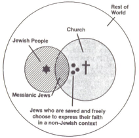
The recognizable feature of this model, as would be inherited from dispensationalism, is that God recognizes two groups of elect. What is different, is that Messianic Jews, because of their faith in Yeshua, actually may be regarded as belonging to both entities, which together constitute the Commonwealth of Israel. What this can perhaps mean, to some at least, is that the Messianic Jewish movement can be regarded as both a part of Judaism, as well as Christianity.
Many of the ideas, such as Messianic Jews composing a middle area between their fellow Jews who do not largely acknowledge Yeshua, and non-Jewish Christians who do acknowledge Israel’s Messiah—but with there still being a wide distinction between Israel and the Church—have been developed further into what is now commonly called bilateral ecclesiology. However one takes it, this belief is that the elect of God are to be decisively composed of two groups: the Jewish people/Messianic Jewish community and the non-Jewish Christian Church. Its acceptance within the mid-2000s to the present can be widely attributed to the release of Post-Missionary Messianic Judaism: Redefining Christian Engagement with the Jewish People (Grand Rapids: Brazos Press, 2005) by Messianic Jewish theologian Mark S. Kinzer.
A major feature of Kinzer’s theology has been to get Messianic Jews and Christians to think beyond the Messianic Jewish movement only being some missionary outreach to see Jewish people brought to salvation in Yeshua. A bilateral ecclesiology of Israel and the Christian Church would be important to see implemented, so that the Messianic Jewish community can fulfill its intended role in bringing about the restoration of Israel.[21]
As bilateral ecclesiology has grown in various sectors of the Messianic Jewish community, so has a rigid emphasis on distinguishing between Israel/the Jewish people and the Christian Church. Concurrent with this has been an emphasis that many non-Jewish Believers who are attracted to Messianic Judaism and a life of Torah adherence, may need to just stay put in their churches and not make any significant lifestyle changes. This has definitely caused a great number of people being hurt, it has helped fuel divisions and resentment, and in some cases a few non-Jewish Believers, who should have found a welcome place in Messianic Jewish congregations, have instead found a welcome place in the Hebrew Roots movement—which in the mid-2020s is conservatively fifty times larger than Messianic Judaism! As bilateral ecclesiology has grown in acceptance in various Messianic Jewish quarters, various non-Jewish Believers, who have been sincerely called by and led by the Lord into the Messianic movement, have found themselves turned away.
While again, it has to be recognized that Messianic ecclesiology is something largely in development—religious politics being what they are—any alternative to the bilateral ecclesiology, is prone to be chastised and labeled as being some form of replacement theology, or at least as some displacement of the Jewish people. For lack of a better description, though, the main alternative to bilateral ecclesiology which can be witnessed, may be frequently labeled as Commonwealth of Israel/Grafted-In. This kind of ecclesiology would affirm that God is not finished with His Jewish people, and He has every plan on seeing His promises to them in the Tanach come to pass. But rather than the nations being a part of a separate entity, they get to join as members of the Commonwealth of Israel (Ephesians 2:11-13), being grafted-in as the wild olive branches to the olive tree (Romans 11:16-17), a real part of Israel’s Messianic Kingdom polity, even though they will not participate in being gathered back physically into the Promised Land.
Various proponents of bilateral ecclesiology can acknowledge how non-Jewish Believers, maintaining a high degree of their own ethnicity (presumably purged of sin and unbiblical practices), can be “joined to an extended multinational commonwealth of Israel and can legitimately identify with Israel’s history and destiny” (Kinzer).[22] But is this Commonwealth of Israel an enlarged Kingdom realm of Israel, or is it a community composed of the two sub-communities of the Jewish people and Christian Church?
If there is one thing which an ecclesiology model labeled Commonwealth of Israel/Grafted-In would not acknowledge, is that there are two separate groups of elect. A bilateral ecclesiology, by its very label, recognizes two separate groups of elect. A Commonwealth of Israel/Grafted-In ecclesiology treats the ekklēsia, or assembly of God, as being an enlarged Kingdom realm of Israel, which welcomes in the redeemed from the nations as equals. While there are going to be natural distinctions between Jewish and non-Jewish people—including a nominal number of Torah commands more applicable to the former than the latter (a point not often noted by adherents of a legalistic One Law/One Torah theology)—they are not to be rigidly separated out or away, and all are to appreciate and bless one another as fellow brothers and sisters in the Messiah. The significant mistake of bilateral ecclesiology is how the Shepherd Messiah who wanted one flock of sheep (John 10:16)—even with such sheep spread over a rather large pasture of Planet Earth—ultimately ends up having two flocks.
Bilateral ecclesiology is not too different from dispensationalism—in fact it may even be described as an unidentical twin to dispensationalism—although a major difference would be a wider emphasis on the need for non-Jewish Believers to take a more active interest in Jewish and Messianic Jewish concerns, and likely a more post-tribulational eschatology.[23] The flaw of dispensationalism, has widely been seen in many today’s evangelical Christians largely having an anemic understanding of a Tanach or an Old Testament, which is to essentially only concern Israel or the Jews. Bilateral ecclesiology would discourage non-Jewish Believers from thinking that they have little connection to the Tanach Scriptures, but would inappropriately encourage them to read it through bifurcated lenses.
As with many of the issues which divide today’s Messianic people, not enough detailed examination of the relevant Biblical passages—in conjunction with the salvation history plan of our Heavenly Father—have been conducted.
The Term Ekklesia
Across the broad Messianic world, regardless of which model of ecclesiology is expressed, there tends to be a widespread amount of annoyance or displeasure when it comes to the term “church.” Even among Messianic Jews who think that the Christian Church is a separate group of elect, there still is not a huge amount of excitement witnessed as it regards the English word “church.”[24] (This especially takes place when Messianic Jewish Believers are asked that ominous question, “Where do you go to church?”)
Contemporary Messianic Bible versions like the Complete Jewish Bible or Tree of Life Version, will invariably have things like “C/community” (Matthew 16:18, CJB/TLV). This is not at all inappropriate, as renderings such as this, do rightly recognize how most usages of the Greek ekklēsia in the Apostolic Scriptures, concern localized fellowships of people, and not the Body of Messiah as a whole.
There are even various Christian teachers and examiners one will encounter, from time to time, who think that it is probably wise to translate ekklēsia as something other than “church,” with a preference often expressed toward “congregation,” but most especially “assembly.”[25] This is because of a widespread, common misconception among many laypeople, that when “church” appears in an English Bible, it is akin to a type of church building, with a cross and steeple, as opposed to a grouping of brothers and sisters in the Lord.
It is useful for examiners of the Holy Scriptures, to conduct their own review of how the Greek word ekklēsia is generally defined by some standard lexicons. These include the entries present in the Liddell-Scott lexicon (LS), principally concerned with classical usages of Greek words[26]; the older although still used, Thayer lexicon, including both classical and theological remarks[27]; and most especially the massive A Greek-English Lexicon of the New Testament and Other Early Christian Literature by Bauer, Danker, Arndt, Gingrich or BDAG, including classical, Biblical, and post-Biblical remarks.[28] (These lexicons can largely, only be accessed by those who have some working ability to read Greek, a skill sadly lacking by many across the Messianic spectrum—because these lexicons include references to materials, both Biblical and extra-Biblical, which the Strongest Strong’s concordance, does not have for ekklēsia.[29])
When some of the main lexical entries for the Greek term ekklēsia are consulted, it is fair for examiners to recognize how there is: (1) a non-religious classical use of ekklēsia, with some sort of assembly in view (perhaps ranging from an unruly mob to the Roman Senate), (2) a Septuagintal usage, in association with the Greek ekklēsia often rendering the Hebrew qahal for the assembly of Ancient Israel, and (3) a usage by the First Century Messiah followers, to either label their congregations and/or their association together.
In discussions and debates over ecclesiology, do the usages of ekklēsia in the Greek Apostolic Scriptures, at all imply that it forms a new group of elect, independent from the congregation or assembly of Israel? Or, is the ekklēsia intended to be representative of the restored, eschatological Kingdom of Israel, which includes the redeemed of the Jewish people and the righteous from the nations together?
Various people within the Messianic movement have had, to be sure, reckon with the data regarding connections between ekklēsia, qahal, and what it may mean regarding the composition of the people of God.
The 2011 Tree of Life—New Covenant, which is part of the Messianic Jewish Family Bible Project, and has on its board of reference fifteen different Messianic Jewish ministries and organizations, included this description for the English term “community” in its glossary:
“community—a formal or informal group of people with shared interests or common beliefs. The first use of the Greek term ‘ekklesia’ in the New Covenant occurs on the lips of Yeshua, who says He will build His community on Peter (Matthew 16:18). But this term was first used in the Septuagint when Moses reveals that God told him ‘gather to Me’ the people, that they might hear My words and teach their children (Deuteronomy 4:10, LXX). The emphasis is on people—a holy community ‘called out’ to be ‘set apart’ for God. As Messiah’s community expanded globally, new groups gathered and the teaching spread through the shlichim [apostles] and their letters of instruction, which were preserved and passed on to us as part of the New Covenant. Starting from the Hebrew kahal…, the Greek word ‘ekklesia’ is also translated assembly, congregation, or church. (Acts 7:38—Israelites; Romans 16:1; 1 Corinthians 16:19; Philemon 2—local gatherings and house groups; Matthew 18:17; Acts 15:22; 1 Corinthians 11:18—gathering to address community concerns; Acts 5:11; 8:3; 9:31—all believers living in a region; Matthew 16:18; 1 Corinthians 12:28; Ephesians 1:22—Messiah’s global community)”[30]
The TLV has offered an extremely useful summarization of the connection between the Greek ekklēsia and Hebrew qahal. In the related, 2012 Messianic Jewish Shared Heritage Bible, Barney Kasdan made the following remarks in the short piece, “The Intertestimental Period (400 BCE-4 BCE)”:
“The Intertestimental Period also saw the development of vitally important Jewish religious literature. The Septuagint (LXX) was an important translation of the Hebrew Scriptures into Greek about two centuries before Yeshua. Since it was the Bible of Jews throughout the Hellenistic Diaspora, the New Covenant writers frequently quoted it and it influenced the way the Greek language was used in the New Covenant. For example, the Septuagint used the word ecclesia (literally ‘called out ones’) to translate the Hebrew word kahal (assembly)—the New Covenant writers used ecclesia to describe the gathered believers, translated as ‘church’ in English Bibles today, but perhaps better rendered as ‘congregation’ or ‘community.’”[31]
These are useful points which have been raised. Yet, what neither of these Messianic Jewish pieces quoted have really done, is specify what such an ekklēsia really is, given its established connection to the qahal of Ancient Israel. Is the ekklēsia as the Body of Messiah, in the Apostolic Scriptures, an entity to be regarded as separate from the Kingdom of Israel? Or, is the ekklēsia, composed of the redeemed from the Jewish people and the nations, representative of the restored Kingdom of Israel, expanding beyond its Jewish center—a Kingdom which will obviously culminate via the return of the Messiah and His reign from Jerusalem?
Even with some of the basic associations between ekklēsia and qahal to be likely acknowledged by various Messianic Jewish leaders and teachers—“the Church” is still probably going to be treated as a separate group of elect, even though it will be viewed as closely related to Israel/the Jewish people. Yet, if the Tanach background of ekklēsia via the Septuagint holds true for the Apostolic Scriptures, then ekklēsia is intended to purposefully direct Bible readers back to the assembly of Ancient Israel at Mount Sinai.
Another perspective to consider, which has made light of the Greek ekklēsia and Hebrew qahal, are the short remarks made in the widely liberal Jewish Annotated New Testament for Matthew 16:18, which in the NRSV appears as, “And I tell you, you are Peter, and on this rock I will build my church, and the gates of Hades will not prevail against it.” Aaron M. Gale notes,
“Gk ‘ekklēsia’ (cf. 18.18), comparable to Heb ‘qahal,’ ‘congregation’ (Deut 4.10; 9.10; 18.16; 31.30; 2 Sam 7; 1 Chr 17; 1QM 4.10).”[32]
Gale directly connects the terms ekklēsia and qahal, and seemingly associates what Yeshua has stated in Matthew 16:18 with a variety of previous Tanach passages, and a statement from the Dead Sea Scrolls. Here are some of them:
“Remember the day you stood before the LORD your God at Horeb, when the Lord said to me, ‘Assemble the people to Me [Heb. MT: haq’hel-li et-ha’am; Grk. LXX: tēs ekklēsias hote eipen Kurios pros me], that I may let them hear My words so they may learn to fear Me all the days they live on the earth, and that they may teach their children’” (Deuteronomy 4:10, NASU).
“The LORD gave me the two tablets of stone written by the finger of God; and on them were all the words which the LORD had spoken with you at the mountain from the midst of the fire on the day of the assembly [Heb. MT: b’yom ha’qahal; Grk. LXX: hēmera ekklēsias]” (Deuteronomy 9:10, NASU).
“This is according to all that you asked of the LORD your God in Horeb on the day of the assembly [Heb. MT: b’yom ha’qahal; Grk. LXX: hēmera tēs ekklēsias], saying, ‘Let me not hear again the voice of the LORD my God, let me not see this great fire anymore, or I will die’” (Deuteronomy 18:16, NASU).
“Then Moses spoke in the hearing of all the assembly of Israel [Heb. MT: qahal Yisrael; Grk. LXX: ekklēsias Israēl] the words of this song, until they were complete” (Deuteronomy 31:30, NASU).
“The Rule of the banners of the congregation: When they set out to battle they shall write on the first banner, ‘The congregation of God,’ on the second banner, ‘The camps of God,’ on the third, ‘The tribes of God,’ on the fourth, ‘The clans of God,’ on the fifth, ‘The divisions of God,’ on the sixth, ‘The congregation of God [qahal El]’” (1QM 4.9-10).[33]
It is not at all inappropriate to see how there are legitimate connections to be made between the terms ekklēsia and qahal, with an intention that the Body of Messiah is not some new phenomenon, but is the continuance of an assembly established at the base of Mount Sinai—indeed the continuing fulfillment of promises given to the Patriarch Abraham and Ancient Israel.
Yet if this really is the case, why do we just not see the redeemed, community of God directly referred to as “Israel” in the Apostolic Scriptures? Obviously, there are some notable places where Israel is mentioned by name, which involve Jewish and non-Jewish Believers in the Kingdom realm of God. But the main thing for each of us to keep in mind, is that many usages in the Apostolic Scriptures regarding “Israel,” are speaking of the ethnic Jewish people, no different than usages in the Tanach itself describing ethnic Israelites.[34] It would be entirely inappropriate for non-Jewish Believers to just be described as “Israel,” without any sort of qualification. They are instead described as being a part of the Commonwealth of Israel (Ephesians 2:11-13), or perhaps also the Israel of God (Galatians 6:16)—likened unto the assembly of Israel which stood before God in the Tanach, composed of both native born and welcome sojourner.
Today, when asking the question Are non-Jewish Believers really a part of Israel?, the statement must be quickly followed by some qualifiers—because the community in view is ultimately not a nationalistic group of people. It is a spiritual community of people, a qahal/ekklēsia who represent the redeemed of the Jewish people and the nations joined together, eagerly anticipating the return of King Messiah.
What do the Apostolic Scriptures say regarding non-Jewish Believers and Israel?
While we can trace and summarize some of the developments present in the contemporary, broad Messianic movement regarding ecclesiology, and note some of the important features of terms like ekklēsia and qahal—the answers regarding the question Are non-Jewish Believers really a part of Israel? can only be answered by turning to a key selection of passages from the Apostolic Scriptures (NT). Many of these are passages which you have heard discussed, taught and preached upon, and perhaps have even sung about in various Messianic praise songs. It long since time for many of us to reevaluate a number of conclusions derived from a number of these passages, as our ecclesiology continues to develop—and with that, hopefully improve.
Matthew 16:18-19
“I also say to you that you are Peter, and upon this rock I will build My church; and the gates of Hades will not overpower it. I will give you the keys of the kingdom of heaven; and whatever you bind on earth shall have been bound in heaven, and whatever you loose on earth shall have been loosed in heaven” (NASU).
Yeshua’s statement, “I also say to you that you are Peter, and upon this rock I will build My church” (NASU), has been traditionally interpreted by Roman Catholicism, that with the Apostle Peter began an unending line of papal succession, with Peter serving as the first bishop of Rome. Protestants, who obviously reject papal claims, tend to offer a variety of other explanations for who or what “this rock” (tē petra) is or represents. Some will adhere to “this rock” still representing Peter, or Peter as the main apostle representative of the other Apostles. Some adhere to “this rock” representing Peter’s confession of faith in Yeshua as the Messiah (Matthew 16:16). And, others think that “this rock” represents the Messiah Himself, per various Tanach passages which describe God as the Rock (i.e., 2 Samuel 22:3).
I personally view “this rock” as being the Messiah Himself, and with authority being granted by Yeshua to His Disciples, as it can be said that the ekklēsia established has “been built on the foundation of the apostles and prophets, Messiah Yeshua Himself being the corner stone” (Ephesians 2:20, NASU). Yeshua is the cornerstone, and the work of God’s vessels in the world continue what He has started for His people.
Messianic examination of Matthew 16:18-19 has often tended to focus more on the issue of binding and loosing—a well-documented Hebraism regarding prohibiting and permitting—and how what is in view pertains to the establishment of halachah or orthopraxy for the faith community.[35] This is an authority which the Messiah granted to the Apostles. As the issue of halachah is considered by today’s Messianic people, there is a delicate balance which is often desired between Apostolic authority in the Messianic Scriptures, and fairly considering many of the perspectives and views of the Sages and Rabbis of Judaism. Yet, to the person interested in ecclesiology and the identity of God’s chosen, more attention should understandably be focused on Matthew 16:18 and not 16:19, and to the assembly Yeshua stated He would establish.
Stern, in his Jewish New Testament Commentary, was only seen to comment on the term ekklēsia, which is rendered as “community” in his JNT/CJB. He made some connections between ekklēsia and qahal:
“Community, Greek ekklêsia, which means ‘called-out ones,’ and is used in the Septuagint to translate Hebrew kahal, ‘assembly, congregation, community.’ The usual English translation of ekklêsia is ‘church’; and from it comes the word ‘ecclesiastical,’ meaning, ‘having to do with the church.’ The JNT sometimes uses ‘Messianic community’ or ‘congregation’ to render ekklêsia. What is being spoken about is a spiritual community of people based on trust in God and his son the Messiah Yeshua. This can be all people throughout history who so commit themselves, or a group of such people at a particular time and place, such as the Messianic community in Corinth or Jerusalem. The phrase, ‘the ekklêsia that meets in their house’ (Ro 16:5), refers to a particular congregation. Unlike ‘church,’ ekklêsia never refers to either an institution or a building.”[36]
While making a connection between the Greek ekklēsia and the Hebrew qahal, as well as some useful observations on the usages of ekklēsia in the Apostolic Scriptures—conspicuously absent from Stern’s remarks on Matthew 16:18, is how, precisely, qahal is used in the Hebrew Tanach. What “community” or “assembly” was being established by Yeshua here?
More recent Messianic Jewish reflection on Matthew 16:18 can be seen in the commentary Matthew Presents Yeshua, King Messiah, by Barney Kasdan (2011):
“Many English Bibles translate the word ekklesia as ‘church’ but this is merely an English adaptation of the Greek which itself is derived from the Hebrew kehilah. Upon this inspired confession of Yeshua’s messianic identity the entire community of New Covenant believers (both the Jewish and Gentile branches) would be built. In fact, the physical setting of this dialogue strongly confirms this view. One can imagine Yeshua standing at the foot of the massive cliff at Caesarea Philippi and bending down to pick up one of the many stones. It would have been a graphic object lesson as he quite logically held up a small stone as a symbol of Peter and then pointed to the massive cliff as symbolic of the foundational confession of Yeshua’s messiahship.”[37]
Kasdan interjects his own observations here: the community which Yeshua came to establish has two branches, or is composed of two sub-communities. Yet, other than making some kind of connection between ekklēsia and kehilah, we do not see that much more we can really evaluate regarding what congregation or assembly Yeshua was intending to establish.
It might be that the answer, of what assembly Yeshua intended to establish, can be easily deduced by conducting one of the most basic parts of Inductive Bible Study: seeing where the verb “build” appears elsewhere, either in the Apostolic Scriptures or Septuagint. This is one important feature of the discussion over “upon this rock I will build My community” (Matthew 16:18, TLV), which I have yet to really see any Messianic examiner consider in detail.
The verb translated as “will build” in most English Bibles, is the Greek future active indicative oikodomēsō. Here are some key places where oikodomēsō appears in the Greek Septuagint (LXX), which need not escape an examiner’s notice:
“Lord Almighty, God of Israel, you have revealed to the ear of your servant, saying, ‘I will build a house for you [LXX: oikon oikodomēsō soi; MT: bayit ebeneh-lakh].’ Because of this your servant found his own heart to pray to you this prayer” (2 Samuel/2 Kingdoms 7:27, LES).
“It will be that if you watch everything, whatever I command you, and you walk in my ways and you do the right thing before me by keeping my commands and my ordinances just as David my servant did, then I will be with you. I will build for you a faithful house [LXX: oikodomēsō soi oikon; MT: u’baniti lekha bayit] just as I built for David” (1 Kings/3 Kingdoms 11:38, LES).
“Forever I will provide offspring for you and will build [LXX: oikodomēsō; MT: u’baniti] your throne for generation and generation” (Psalm 89:4, NETS).
“For I will build you, and you will be built [LXX: oikodomēsō se kai oikodomēthēsē; MT: eb’neikh v’niv’neit], O virgin Israel! You will seize your tambourine, and you will come out with an assembly of people playing” (Jeremiah 31:4 [38:4], LES).
“And I will return the exile of Judah and the exile of Israel, and I will build them [LXX: oikodomēsō autous; MT: u’benitim] just as also the former time” (Jeremiah 33:7 [40:7], LES).
When Bible readers encounter these varied usages of oikodomēsō, they all pertain to either the establishment of the Davidic monarchy, the building up of the Temple of God, or even the end-time restoration of Israel. It also appears in Mark 14:58, in reference to the work of Yeshua: “We heard Him say, ‘I will destroy this temple made with hands, and in three days I will build [oikodomēsō] another made without hands’” (NASU).
Two notable definitions of the verb oikodomeō, provided by BDAG, include “to construct a building, build” and “to help improve ability to function in living responsibly and effectively, strengthen, build up, make more able.”[38] AMG offers the definition “to rebuild or renew a building decayed or destroyed,”[39] which is something that surely fits the context of the restoration of God’s people in the eschaton.
With some of these passages in view—notably Jeremiah 31:4 and 33:7—it legitimately sits within the semantic range of definitions to render Matthew 16:18 as “upon this rock I will rebuild My assembly.” And, the assembly which Yeshua came to build/rebuild was hardly a new ekklēsia of chosen, but rather a restored Kingdom of Israel brought to fruition via His work, and certainly enlarged to incorporate the righteous from the nations.
If Matthew 16:18 can be directly associated with various Tanach promises about God restoring, i.e., rebuilding Israel—then what does this do to a number of the claims from either dispensationalism or bilateral ecclesiology, about “the Church” being a separate entity, perhaps related to but ultimately separated from, Israel? It severely weakens, if not demolishes, such a claim. The assembly in view, in Matthew 16:18, is none other than an explicit claim from the Messiah to restore Israel upon the work of Himself, and subsequently the Apostles. The assembly of Israel He came to rebuild (oikodomēsō) surely involves the fulfillment of the many promises of regathering and the end of exile for the Jewish people and the Twelve Tribes at large—but also the expansion of Israel to include the righteous of the nations into an enlarged Kingdom realm.
There is not a huge surprise in my mind, why some of the finer details of Matthew 16:18—beyond ekklēsia and qahal being somehow related—have not really been explored by a number of today’s Messianic Jewish leaders and teachers. No different than the Christian teacher who wants to dismiss Matthew 5:17-19, affording a degree of continuity and validity to the Torah of Moses—so does Matthew 16:18 not affirm the establishment of a new entity of elect, but instead affirms how the Messiah’s mission was to restore Israel. This is not just an anticipated national restoration of Israel, but is a spiritual entity incorporating far more than just ethnic Jews or Israelites into its Kingdom polity.
Sadly, there is rhetoric present in a few parts of today’s Messianic Judaism, where if non-Jewish Believers get to be incorporated into Israel’s Kingdom realm—which has been expanded and enlarged—that one might as well be guilty of promoting replacement theology. Yet, interpreters such as myself have not denied the Jewish right to the Holy Land, nor have we denied the promises to the physical descendants of the Patriarchs; I am not going to be making aliyah to Eretz Yisrael. I am simply one who considers himself as a citizen of Israel’s Kingdom (Ephesians 2:11-13), a realm whose rule reaches beyond the Holy Land. As a non-Jewish Believer, I am a part of the righteous remnant from humanity which has sought the Lord (Acts 15:15-18; Amos 9:11-12), and I surely get to participate in Israel’s restoration and expansion, without expecting to live in territory only specifically promised to Israel’s Twelve Tribes.
John 10:14-18
“I am the good shepherd, and I know My own and My own know Me, even as the Father knows Me and I know the Father; and I lay down My life for the sheep. I have other sheep, which are not of this fold; I must bring them also, and they will hear My voice; and they will become one flock with one shepherd. For this reason the Father loves Me, because I lay down My life so that I may take it again. No one has taken it away from Me, but I lay it down on My own initiative. I have authority to lay it down, and I have authority to take it up again. This commandment I received from My Father” (NASU).
Yeshua’s words pertaining to, “I am the good shepherd…,” are those which have had a tendency to speak very deeply into the hearts of many of His followers. In addition to the statements which Yeshua made about being the Good Shepherd who would lay down His life for His sheep, Bible readers should also be reminded of how the Lord said,
“For the Son of Man has come to save that which was lost. What do you think? If any man has a hundred sheep, and one of them has gone astray, does he not leave the ninety-nine on the mountains and go and search for the one that is straying? If it turns out that he finds it, truly I say to you, he rejoices over it more than over the ninety-nine which have not gone astray. So it is not the will of your Father who is in heaven that one of these little ones perish” (Matthew 18:11-14, NASU; cf. Luke 15:3-7).
Bringing a single sheep of His into His fold, is something very special to the Lord. Likewise, bringing groups of sheep together is not to be dismissed or downplayed as unimportant. An individual’s salvation is to naturally be followed by an understanding of the corporate redemption which is to come to all of God’s own.
John 10:14-18, delivered during Yeshua’s time at the Portico of Solomon during the Festival of Lights (Chanukah), were extremely significant words when it came to the mission He was to fulfill from the Father. Of importance regarding the people of God, is the Messiah’s assertion, “I have other sheep which are not from this pen; I need to bring them, and they will hear my voice; and there will be one flock, one shepherd” (John 10:16, CJSB). It is widely recognized by interpreters across the spectrum that these other sheep were intended to be non-Jewish followers of Israel’s Messiah. At the time of Yeshua making this statement, the principal flock of sheep He was serving were His own Jewish people in Judea. He anticipated, resultant of His coming sacrifice, how sheep from the nations would be gathered in as well—and that together the Jewish sheep and those sheep from the nations would become “one flock,” mia poimnē.
In his Jewish New Testament Commentary, Stern offers the following general remarks on John 10:16:
“I have other sheep which are not from this pen, namely, Gentiles, whom Yeshua says he will combine with the Jews into one flock under himself, the one shepherd. Although at first he sent his talmidim only to ‘the lost sheep of the house of Israel’ (Mt 10:5) and spoke of his own commission in the same way (Mt. 15:24), this limitation applied only to his life before resurrection. Moreover, he intimated the coming inclusion of Gentiles when he healed the Roman army officer’s orderly (Mt. 8:5-13) and the daughter of the woman from Cana’an (Mt 15:22-28), ministered to the woman at the well in Shomron (4:1-26), and prophesied that many would come from the east and the west to sit down with the Patriarchs (8:11) and that some nations (or Gentiles; see Mt. 5:46N) would be judged favorably (Mt. 25:31-46&N).”[40]
It is to be properly recognized how Yeshua’s function as the Good Shepherd, involved His salvation reaching out beyond Israel proper, and how there was to be one flock of sheep, from both the Jewish people and the nations. They are to find their unity, in the fact of how their common, sinful humanity, has required the same redemption: the Good Shepherd laying down His life for them. Many people across today’s contemporary Messianic community, indeed recognize how Jewish and non-Jewish Believers are members of this one flock of sheep, clear beneficiaries of the single sacrifice of the Good Shepherd on the tree.
As various developments emerge in Messianic ecclesiology, with examiners having to consider the intention of John 10:14-18, what could we anticipate? That John 10:14-18 envisions unity among all of God’s people in Messiah as composing “one flock,” is an undeniable claim of the text. However, because of religious politics being what they are, it is possible that some may conclude—that while indeed Jewish and non-Jewish Believers are to be regarded as “one flock” of sheep—that they still need to be (rigidly) sub-divided out into two separate pens of sheep. While a single flock, some may claim that there is to be (a) a Jewish pen of sheep, and (b) a non-Jewish pen of sheep.
Given some of the ongoing matters of the growth, expansion, and maturation of today’s Messianic Jewish movement—it is understandable how many of today’s Messianic Jewish leaders stress how non-Jewish Believers, need to be specially called by God into this. These are non-Jewish Believers, who need to be very sensitive to the many matters of the Jewish experience throughout history, the negative impact of anti-Semitism, and various in-process matters of the ongoing growth and maturation of the contemporary Messianic movement. But, it is entirely inappropriate and unjustified for Yeshua’s explicit claim to bring together “one flock” of sheep, to ultimately be subverted into “one flock, two pens.” While Jewish and non-Jewish Believers are hardly to be homogenized together, “one flock, two pens” in practice will, in a majority of circumstances, end up as being “two flocks.”
Yeshua’s declaration that He came to bring forth one flock of sheep, from both His Jewish people and the nations, has to be understood in light of the level of unity further required by His prayer of John 17:11. This presents a goal which is likely never going to be entirely reached by any His followers, this side of His return: “…that they may be one even as We [Father and Son] are…” (NASU).
Acts 1:6
“So when they had come together, they were asking Him, saying, ‘Lord, is it at this time You are restoring the kingdom to Israel?’” (NASU).
The Apostles’ question, “Lord, are you restoring the kingdom to Israel at this time?” (Acts 1:6, TLV), apokathistaneis tēn basileian tō Israēl, is obviously most important to consider in the scope of salvation history. Not only would this have involved, for the Apostles, but more so their contemporaries living in Judea, a defeat of its Roman occupiers and total expulsion of paganism from the region—but it would have also involved a regathering of the exiles of Israel, a restoration of the Twelve Tribes to their home country, and a permanent sovereignty over the Promised Land. Obviously when reading Acts 1:6-11 fully, something a bit different—and much bigger—from what the Apostles originally thought, was planned:
“So when they had come together, they were asking Him, saying, ‘Lord, is it at this time You are restoring the kingdom to Israel?’ He said to them, ‘It is not for you to know times or epochs which the Father has fixed by His own authority; but you will receive power when the Holy Spirit has come upon you; and you shall be My witnesses both in Jerusalem, and in all Judea and Samaria, and even to the remotest part of the earth.’ And after He had said these things, He was lifted up while they were looking on, and a cloud received Him out of their sight. And as they were gazing intently into the sky while He was going, behold, two men in white clothing stood beside them. They also said, ‘Men of Galilee, why do you stand looking into the sky? This Yeshua, who has been taken up from you into heaven, will come in just the same way as you have watched Him go into heaven’” (Acts 1:6-11, NASU).
More obviously had to transpire—such as the good news of the Messiah’s salvation, going out to the entire Earth—before the total restoration of Israel could be accomplished.
The CJSB rendered Acts 1:6 with the view that what was being described, was perhaps only the defeat of the Ancient Romans and the restoration of Jewish autonomy: “Lord, are you at this time going to restore self-rule to Isra’el?” Stern details in his Jewish New Testament Commentary about some views of Acts 1:6, which appear less concerned about the Biblical setting, events, and associated events with Israel’s restoration—and more about the problem of replacement theology in various Christian sectors:
“[T]here is a different point which many Christians need to learn from Yeshua’s answer, namely, that God will indeed restore self-rule to Israel. There is an ancient, widespread and pernicious Christian teaching that the Church is the ‘New’ or ‘Spiritual’ Israel, having replaced the Jews as God’s people. In this view…God’s promises to Israel were nullified when ‘the Jews’ refused to accept Jesus (never mind that all the first believers were Jews). This false theology, impugning the character of God by suggesting that he will welch on his promises, has provided apparent justification for many antisemitic acts in the Church. It also lies behind most Christian protestations that the present-day regathering of the Jewish people to the Land of Israel is without theological or biblical significance.”[41]
No Messianic person can deny the validity of Stern’s rightful protests against replacement theology, but what else might have been in view, in the larger scene of Acts 1:6-11? In Post-Missionary Messianic Judaism, Kinzer actually offers a wider salvation history perspective on Acts 1:6 and the intentions of the Book of Acts.[42] Among his suggestions, it is seen how there is intertextual reliance here on Zechariah chs. 12-14, something which may even concern not only Israel proper but also the involvement of the nations in the restored Messianic Kingdom subsequent to the Second Coming. Of particular importance of the theme here in Acts, involves Zechariah 14:2-5 and 14:9, 16:
“For I will gather all the nations against Jerusalem to battle, and the city will be captured, the houses plundered, the women ravished and half of the city exiled, but the rest of the people will not be cut off from the city. Then the LORD will go forth and fight against those nations, as when He fights on a day of battle. In that day His feet will stand on the Mount of Olives, which is in front of Jerusalem on the east; and the Mount of Olives will be split in its middle from east to west by a very large valley, so that half of the mountain will move toward the north and the other half toward the south. You will flee by the valley of My mountains, for the valley of the mountains will reach to Azel; yes, you will flee just as you fled before the earthquake in the days of Uzziah king of Judah. Then the LORD, my God, will come, and all the holy ones with Him!…And the LORD will be king over all the earth; in that day the LORD will be the only one, and His name the only one…Then it will come about that any who are left of all the nations that went against Jerusalem will go up from year to year to worship the King, the LORD of hosts, and to celebrate the Feast of Booths” (Zechariah 14:2-5, 9, 16, NASU).
Acts 1:6-11, and its notable claim of how “This Yeshua, who was taken up from you into heaven, will come in the same way as you saw Him go into heaven” (Acts 1:11, TLV), is definitely to point Bible readers in the direction of the future, and with what is to take place via the consummation and arrival of the Messianic Kingdom. While surely involving the restoration of Israel proper, this is something which is involve much more. Kinzer himself acknowledges “the final harvest and Israel’s redeemed life (with the nations) in the world to come,”[43] with Zechariah 14:16 notably in view, a prophecy detailing how the nations will stream to Jerusalem for the Feast of Booths/Tabernacles in the Millennium.
Even though supporters of a bilateral ecclesiology would assert that God’s Kingdom is to be regarded as composing Israel/the Jewish people and the Christian Church—the nations being involved in the restored Kingdom of Israel in the Messianic Age is nevertheless present. Interpreters such as myself, in association with other passages (discussed further), would see God’s Kingdom not via some model of a bilateral ecclesiology, but instead via an enlargement model of Israel’s Kingdom realm. The survivor nations (not separate independent states/kingdoms, but instead ethnic/people groups incorporated into Israel’s Kingdom polity) in the future Millennium, will have no choice but to keep the Feast of Tabernacles, lest they not have any rain (Zechariah 14:17). This is a definite indicator of how Israel’s King Messiah is the One who is to rule the whole of Planet Earth with a strict rod of iron.[44]
Acts 2:36-39
“‘Therefore let all the house of Israel know for certain that God has made Him both Lord and Messiah—this Yeshua whom you crucified.’ Now when they heard this, they were pierced to the heart, and said to Peter and the rest of the apostles, ‘Brethren, what shall we do?’ Peter said to them, ‘Repent, and each of you be baptized in the name of Yeshua the Messiah for the forgiveness of your sins; and you will receive the gift of the Holy Spirit. For the promise is for you and your children and for all who are far off, as many as the Lord our God will call to Himself’” (NASU).
Individual Messianic people are generally astute enough to (1) recognize that the Holy Spirit being poured out to those gathered at Pentecost, was in actually a major prophetic fulfillment of the Torah-prescribed festival of Shavuot, and that (2) this hardly constitutes the birth of some second group of elect known as “the Church.”
The main audience which was targeted with Peter’s dynamic preaching in Acts 2:36, was stated to be his own fellow Jews, gathered in Jerusalem to commemorate the appointed festival: “Therefore, let the whole house of Isra’el know beyond doubt that God has made him both Lord and Messiah—this Yeshua, whom you executed on a stake!” (CJSB). The message of salvation in Yeshua, as Peter further specified, “is for you, for your children, and for those far away—as many as ADONAI our God may call!” (Acts 2:39, CJSB). Regardless of whether the “children” specified were considered to be the children not in attendance here in Jerusalem, or the succeeding generations, the message which Peter declared was one which was inclusive. Peter’s message also involved “all who are far off,” most probably a reference to members of the Jewish Diaspora, as well “as many as the Lord our God will call to Himself” (Acts 2:39, NASU), meaning anyone else who was to encounter the good news or gospel.
That the good news of salvation in Israel’s Messiah is to be universally declared to the entire world, is not something which any rationally thinking Messianic person today disagrees with. Obviously, there are many dynamics of the good news or gospel message, beyond that of personal redemption—particularly as they pertain to further growth in holiness and sanctification, and the good works of grace and mercy which are to manifest in a heart and mind changed by the Messiah—which may not be emphasized enough in contemporary evangelicalism. Yet, failing to recognize that early on in Acts 2:36-39, that the good news of salvation declared to the House of Israel, was also intended by Peter for everyone on Planet Earth, is something which can be witnessed, at times, by a few in today’s Messianic Jewish community.
I have definitely witnessed some inappropriate ways Acts 2:39 has been applied, and whether or not Peter’s statement was inclusive of more than just his fellow Jewish kinfolk. There is little problem recognizing “For the promise is for you and for your children and for all who are far off” as speaking to Jewish hopes of redemption. It would not be incorrect to conclude how “all who are far off” were Diaspora Jews who were unable to attend Shavuot/Pentecost at the time. But Peter also referred to “everyone whom the Lord our God calls to himself” (ESV), hosous an proskalesētai Kurios ho Theos hēmōn.
Peter’s statement in Acts 2:39 involving “all who are far off—for all whom the Lord our God will call” (NIV), is widely recognized recognized—by two study Bibles I am sure many of you are familiar with, the Hebrew-Greek Key Study Bible[45] and the venerable NIV Study Bible[46]—to have some kind of intertextual relationship with Ephesians 2:12-13, and the salvation of the nations as those who “formerly were far off.” Even if a concentrated declaration of the good news to the nations did not really begin until around Acts ch. 10, Peter’s message declared at Shavuot/Pentecost was not one exclusively to his own Jewish people, especially given Yeshua’s own instruction to the Apostles earlier (Acts 1:8). The salvation of Israel proper is hardly something isolated unto itself.
While replacement theology has condemnably dismissed the centrality of Israel in our Creator’s plan, today’s Messianic people must not ever be seen to make any reverse error—especially when the text of Acts 2:39 actually does associate the salvation of Israel proper and the nations together. As The Interpreted New Testament appropriately paraphrases Acts 2:39,
“For the Lord, our God, promised to give his Spirit to all those he calls to be his own people, including you and your descendants and even the Gentiles” (Acts 2:39, The Interpreted New Testament).[47]
Acts 15:15-18
“With this the words of the Prophets agree, just as it is written, ‘AFTER THESE THINGS I will return, AND I WILL REBUILD THE TABERNACLE OF DAVID WHICH HAS FALLEN, AND I WILL REBUILD ITS RUINS, AND I WILL RESTORE IT, SO THAT THE REST OF MANKIND MAY SEEK THE LORD, AND ALL THE GENTILES WHO ARE CALLED BY MY NAME,’ SAYS THE LORD, WHO MAKES THESE THINGS KNOWN FROM LONG AGO [Amos 9:11-12, LXX]” (NASU).
The statements made by James the Just, half-brother of Yeshua the Messiah, at the Acts 15 Jerusalem Council, were squarely intended to place the salvation of the nations within the context of the final restoration of Israel. The Apostolic assembly had been gathered to address a tenuous situation which had arisen in Antioch, where various hyper-conservative Jewish Believers, who were Pharisees, had insisted that the new, non-Jewish Believers be circumcised as proselytes and be ordered to keep the Torah of Moses for eternal salvation (Acts 15:1, 5). The Apostle Peter testified before the representatives that to do so would be tantamount to tempting God, as Jewish people and those of the nations were saved equally the same way, by the grace of Yeshua (Acts 15:7-11).
James the Just, who would issue the Apostolic Decree (Acts 15:19-21, 29)—which would mandate the new, non-Jewish Believers to adhere to four, non-negotiable essentials in order to have fellowship with Jewish Believers, beginning their path of discipleship—was the one who made the connection between the salvation of the nations and Tanach prophecy taking place. He indicated, “Simeon has related how God first concerned Himself about taking from among the Gentiles a people for His name” (Acts 15:14, NASU). It cannot be overlooked here that as God’s intention was to bring forth “a people” or laos, ex ethnōn or “out of the nations,” how there was some important background behind this associated with Israel. The Greek term laos is quite loaded, because in the Septuagint it frequently translated the Hebrew am. “In the LXX laós occurs some 2,000 times, seldom in the plural, and with a specific reference to Israel as God’s people. In most instances the Hebrew original is ‘am” (TDNT).[48]
The Greek term laos or “people” is frequently seen in the Septuagint as a reference to the people of Israel (i.e., Exodus 6:7; Deuteronomy 4:20, 14:2; 26:18-19; 32:9). Deuteronomy 14:2 from the LXX affirmed, “For you are a people holy [laos hagios] to the Lord your God, and it is you the Lord your God has chosen to be an exceptional people to him out of all the nations on the face of the earth” (NETS). The thrust of Zechariah 2:11 is often thought to be behind what James was claiming of the nations’ salvation in Acts 15:14:
“Many nations will join themselves to the LORD in that day and will become My people [v’hayu li l’am]. Then I will dwell in your midst, and you will know that the LORD of hosts has sent Me to you” (Zechariah 2:11, NASU).
In the Hebrew MT, this prophecy employed the term am, and in the Greek LXX it was translated by the term laos. Stern, as a Messianic Jewish commentator, actually did note in his Jewish New Testament Commentary,
“Although at [Acts] 10:2 and [Acts] 10:42 [laos] refers to the Jewish people…here the implication is that Gentiles do not have to become Jews in order to be included in the laos, because God is now doing something new.”[49]
The viewpoint of James was how the non-Jewish Believers coming to faith in Israel’s Messiah, were going to be incorporated into the am Yisrael, as anticipated by the Prophets (Acts 15:15). But this would surely not be represented as somehow replacing or displacing James’ own Jewish people—rather, as is seen in the prophecy of the Tabernacle of David, the borders of the people of God, indeed Israel itself, would be enlarged.
Anticipating people coming from the nations and joining with the Jewish people, was not something unexpected, but was something anticipated by the Tanach Scriptures. Before referencing Amos 9:11-12—and certainly to discount the meddling nature of those who wanted to demand that the non-Jewish Believers become proselytes—James placed all attention on the responsibility to heed the Prophets. He said, “With this the words of the Prophets agree” (Acts 15:15, NASU), hoi logoi tōn prophētōn, with both “words” and “prophets” in the plural. This indicates that while Amos 9:11-12 may be quoted, James would by no means have limited the inclusion of the nations, or the scope of events to be anticipated, to this single Tanach (OT) prophecy. (A short list of prophecies, which have been proposed by various examiners, include: Isaiah 2:2; 19:18-25; 45:20-23; Jeremiah 12:15-16; Hosea 3:4-5; Zephaniah 3:9; Zechariah 2:11; 8:22; 9).
It is easy to detect from English Bibles, when consulting Amos 9:11-12 and Acts 15:16-18, that there appear to be some differences between what Amos prophesied and what James stated. It has long been recognized among expositors that what appears in Acts 15:16-18, is actually from the Greek Septuagint.[50] Other than the fact that Amos 9:11-12 in the LXX does represent some ancient Jewish views of the restoration of David’s Tabernacle (or Tent), it should not be surprising why James appealed to the LXX, as what he would be ruling would have a decisive influence on how the good news was communicated to ancient people in the Mediterranean basin.
The table below compares and contrasts the readings of Amos 9:11-12, from both the Hebrew MT and Greek LXX:
AMOS 9:11-12 (MT) |
AMOS 9:11-12 (LXX) |
| “‘In that day I will raise up the fallen booth of David, and wall up its breaches; I will also raise up its ruins and rebuild it as in the days of old; that they may possess the remnant of Edom and all the nations who are called by My name,’ declares the Lord who does this” (NASU). | “On that day I will raise up the tent of Dauid that is fallen and rebuild its ruins and raise up its destruction, and rebuild it as in the days of old in order that those remaining of humans and all the nations upon whom my name has been called might seek out me, says the Lord who does these things” (NETS). |
| [11] b’yom ha’hu aqim et-sukkat David ha’nofelet v’gadar’ti et-pir’tzei’hen v’harisotayv aqim u’benitiyha k’ymei olam [12] l’ma’an yirshu et-sh’eirit Edom v’kol-ha’goyim asher-niqra shemi alei’hem ne’um-ADONAI oseh zot
|
[11] en tē hēmera ekeinē anastēsō tēn skēnēn Dauid tēn peptōkuian kai anoikodomēsō ta peptōkota autēs kai ta kateskammena autēs anastēsō kai anoikodomēsō autēn kathōs hai hēmerai tou aiōnos [12] hopōs ekzētēsōsin hoi kataloipoi tōn anthrōpōn kai panta ta ethnē eph’ hous epikeklētai to onoma mou ep’ autous legei Kurios ho Theos ho poiōn tauta |
The main difference which one should be able to immediately notice between the MT of Amos 9:11-12, and what appears in both the LXX and James’ quotation, is the usage of “THE REST OF MANKIND” (Acts 15:17, NASU) instead of “the remnant of Edom.” Here, the MT reading of sh’eirit Edom was rendered by the LXX as hoi kataloipoi tōn anthrōpōn. This difference can be explained on the basis of how Edom is closely connected to adam, which is not only the name of the first person in the Bible, but also means “mankind, people” (HALOT).[51] The interpretation of “the remnant of man” simply passed into the LXX, which employed anthrōpos, itself meaning “the human race” (BDAG).[52]
A second difference which appears between the MT and LXX is less easy to spot. The MT reads with “That they may possess the remnant of Edom” (Amos 9:12, NASU), whereas the LXX has the totally different “SO THAT THE REST OF MANKIND MAY SEEK THE LORD” (Acts 15:17, NASU). Aside from the LXX’s theological value judgments, the MT of Amos 9:12 uses the verb yarash, meaning “take possession of, inherit, dispossess” (BDB),[53] speaking of the restored Tabernacle of David taking a hold of Edom. Contrary to this, the LXX uses ekzēteō, “to exert effort to find out or learn someth., seek out, search for” (BDAG),[54] speaking of this remnant of humanity trying to find the Lord as a major result of the restored Tabernacle of David.
In addition to any theological opinion interjected by the Septuagint’s Jewish translators, it might also be that the verb darash, “resort to, seek” (BDB),[55] could have been the original reading.[56]
The main point of drawing the attention of the Jerusalem Council to Amos 9:11-12, was to emphasize how a restored Tabernacle of David (Heb. sukkat David; Grk. tēn skēnēn Dauid)—representative of a united Kingdom of Israel of all Twelve Tribes at its center—would expand beyond itself. If one follows the Hebrew MT, this is represented by how during the reigns of David and Solomon, not only was the Kingdom of Israel at its height of power, but Edom was annexed by it (2 Samuel 8:14). Or, if one follows the Greek LXX, God’s faithful remnant from among humanity would seek Him, come to a knowledge of Messiah Yeshua, and be a part of the Messianic Kingdom with Him as the Greater David. Either way, a larger restoration of Israel is in view, and there are worthwhile reasons for Bible readers to consider both the MT and LXX to have prophetic validity. There will be a decisive enlargement of Israel’s Kingdom realm, of which those from the nations get to be citizens. Gary Gilbert, in The Jewish Annotated New Testament, concurs,
“The Hebrew version speaks of Israel’s possessing other nations. The Septuagint, which in Luke’s version here is what James quotes, refers to God’s act of restoration of all peoples, Jews and Gentiles.”[57]
James placed the nations’ coming to faith within the prophecies of the restoration of the Tabernacle of David and Israel’s Kingdom. The imagery of David, representing King Messiah, rules over the Kingdom of Israel, and His reign obviously affects not only the Jewish people—but most especially the whole world. Isaiah 49:6, a rather general word, detailed how the restoration of Israel via the Messiah, would involve the tribes of Israel and the nations both being impacted with His light:
“It is too small a thing that You should be My Servant to raise up the tribes of Jacob and to restore the preserved ones of Israel; I will also make You a light of the nations so that My salvation may reach to the end of the earth” (Isaiah 49:6, NASU).
James knew that the restoration of Israel had started with King Messiah’s reign having begun, and not only with many of his fellow Jews having acknowledged Yeshua, but also with people from the nations coming to faith in Him. A long, hard process had started. So, James’ attestation in Acts 15:19, prefacing the Apostolic Decree, “wherefore I judge: not to trouble those who from the nations do turn back to God” (YLT), was a wise word. Requiring the new, non-Jewish Believers, to become instantaneous proselytes to Judaism, keeping the Torah to be saved (Acts 15:1, 5), was surely contrary to the will of God’s Spirit. The New Covenant enacted by God’s Spirit, however, would write the Torah onto the hearts of His people (Jeremiah 31:31-34; Ezekiel 36:27)—something which would take place at His pace, not the pace of any demanding mortal. According to Tanach prophecy, the nations were to come to Zion and be instructed from Moses’ Teaching, as the word of the Lord went forth (Micah 4:1-3; Isaiah 2:2-4).
James emphasized that since the nations coming to faith was something prophesied in the Tanach, that those who were turning to the God of Israel need not be troubled. The Greek verb epistrephō, employed in Acts 15:19, mainly means “to cause a pers. to change belief or course of conduct, with focus on the thing to which one turns” (BDAG).”[58] It is notable, though, how it appears in a prophetic word like Amos 9:14: “Also I will restore [Heb. MT: shuv; Grk. LXX: epistrephō] the captivity of My people Israel…” (NASU).[59] With the very verb describing Israel proper’s return, applied to the salvation of the nations, this should be taken as a good indicator of how the Apostles not only recognized that the salvation of the nations signaled a major step forward in Israel’s ultimate, corporate redemption—but they really did consider the non-Jewish Believers coming to faith, to be participants within such a restoration, along with them (Acts 15:14; cf. Zechariah 2:11). Jewish and non-Jewish Believers were all going to be involved, and all were to be brothers and sisters in the Lord. It was/is to all culminate, in what is embodied by the promise,
“My servant David will be king over them, and they will all have one shepherd; and they will walk in My ordinances and keep My statutes and observe them” (Ezekiel 37:24, NASU).
Even today, we have still not witnessed the complete restoration of David’s Tabernacle. Many of today’s Messianic people are of the conviction that the very reason our faith community has been growing in significant numbers, the past several decades, is indeed to see Israel’s restoration completely come to fruition in the not-too-distant future. Although many things will need to be sorted out by God’s sovereign hand, it is something which involves more than just Jewish people coming to faith in Israel’s Messiah; it will affect the whole world and people from all nations who call upon Yeshua for salvation.
If we interpret Amos 9:11-12 and Acts 15:15-18 from the perspective of representing an enlarged Kingdom realm of Israel—with a restored Twelve Tribes at its center, King Messiah’s reign extending beyond itself, and the righteous from the nations likened unto those annexed territories like Edom—then obviously, non-Jewish Believers are not a part of some separate “Church” entity per dispensationalism or bilateral ecclesiology.
The expectation of Amos 9:11-12, referenced by James the Just in Acts 15:15-18, with the restoration of the Tabernacle or Tent of David, does not at all envision the Jewish people or a restored Twelve Tribes of Israel, as being displaced by those of the nations. It is more appropriately concluded that an enlarged Kingdom realm of Israel, or a Super-State of Israel, as it were, will ultimately emerge, with Yeshua the Messiah Himself as its Sovereign Monarch. The Jewish people surely do not stop being “the people” (cf. Acts 26:23), but the Kingdom of God does receive many new citizens—citizens which only the work of the Messiah Himself could see enter in.
None of today’s Messianic people should deny the fact of how there are finer details regarding the restoration of the Tabernacle/Tent of David, which are likely only going to be known as the Messiah’s return draws nearer in future time. The reality is, though, when Amos 9:11-12 and Acts 15:15-18 are read in concert with other passages—the impetus witnessed is one where the righteous of the nations move toward the Jewish people and toward Israel. They might not be physical Israel, but by having sought Israel’s Messiah, they do get incorporated into Israel’s Kingdom realm. Most importantly, such non-Jewish Believers need to join with their fellow Jewish Believers, with both working together as co-laborers in the restoration of Israel, heralding the return of King Yeshua!
Romans 2:28-29
“For he is not a Jew who is one outwardly, nor is circumcision that which is outward in the flesh. But he is a Jew who is one inwardly; and circumcision is that which is of the heart, by the Spirit, not by the letter; and his praise is not from men, but from God” (NASU).
Romans 2:28-29 is a place where it is commonly asserted that non-Jewish Believers can possibly be viewed as some sort of “spiritual Jews.” Even though not born Jewish in the flesh, or perhaps even physically circumcised, such people may be perceived as having a “Jewish heart” via their faith in the Jewish Messiah.
It is difficult to avoid how there is obviously a connection made in the text, where the Greek Ioudaios serves to represent the Hebrew Yehudah, which on the basis of Genesis 29:35[60] and 49:8,[61] is widely regarded to mean “to give thanks, laud, praise” (TWOT).[62] The true “Jew,” is one who can have praises issued from the God of Israel, the Creator, and not other mortals:
“For one is not a Jew who is one outwardly, nor is circumcision something visible in the flesh. Rather, the Jew is one inwardly, and circumcision is of the heart—in Spirit not in letter. His praise is not from men, but from God” (Romans 2:28-29, TLV).
Interpreters, whether lay readers or even some professional expositors, tend to be divided, as to whether or not the person who is Ioudaios in view in Romans 2:28-29, is simply among the many Jewish people who constituted the community of Messiah followers in Rome—or how any person regardless of ethnicity, who trusts in the Jewish Messiah, may be regarded as “Jewish,” likely via some sort of connection to Him. Not surprisingly, both views of Romans 2:28-29, can be detectable within our contemporary Messianic movement.
In his Jewish New Testament Commentary, Stern actually devoted several pages to Romans 2:28-29 (1995: pp 336-340), which in the CJSB is rendered as:
“For the real Jew is not merely Jewish outwardly: true circumcision is not only external and physical. On the contrary, the real Jew is one inwardly; and true circumcision is of the heart, spiritual not literal; so that his praise comes not from other people but from God” (Romans 2:28-29, CJSB).
In reviewing some of Stern’s remarks, it is not quite clear where he stands on the audience being addressed in these verses. He first makes the attestation that these statements by Paul should be read with people who are actually Jewish in mind, but then wavers a bit:
“It is obvious that in v. 28 the people spoken of as not real Jews are in fact born Jews, for no one needs to be told that Gentiles are not Jews. But in this passage, exactly who is a real Jew? Is Sha’ul talking about born Jews who are also born again (Yn [John] 3:3), that is, about Messianic Jews? Or is he making a radical and dramatic assertion that some Gentiles (as well as some born Jews) are actually Jews in God’s sight by virtue of being Jews inwardly, having circumcised hearts that offer praise to God? In other words, is he saying that both Messianic Jews and Gentile Christians are Jews?”[63]
As he deliberates on the various options presented to the interpreter, Stern bears a reliance on the Medieval Jewish PaRDeS hermeneutic, thinking that while literally it is impossible for non-Jewish Believers in Israel’s Messiah to be regarded as “Jewish,” spiritually it is something possible to consider:
“Carrying many new ideas in his head, Sha’ul could produce a sentence that had both a simple sense (p’shat) and a hint (remez) of something more profound; furthermore he would not be averse to making an allegorical or homiletical application (drash) of his own words or looking in them for a secret meaning (sod); because these four ways of interpreting texts were well known among educated Jews…
“Thus a born-again Gentile, one who has come to faith in the God of Israel through trusting Yeshua the Messiah, is indeed a Jew inwardly; his heart is circumcised even though his flesh is not; he is a true God-praiser, whose praise comes from God and not from other people—in many senses a real Jew…”[64]
Stern takes some liberties, such as assuming that the PaRDeS hermeneutic was even in usage in the First Century C.E., when by all accounts while midrash was, PaRDeS was not.[65] Furthermore, this part of the Epistle to the Romans is plainly, by the text of the letter itself, mainly directed to a sub-audience: “if you bear the name ‘Jew’ and rely upon the Law and boast in God” (Romans 2:17, NASU). The Apostle Paul communicated to a broad and mixed Jewish and non-Jewish audience in Rome, and there should be no doubt that certain parts of his message concerned more Jewish matters, while other parts concerned more localized Roman issues. Reading Romans as an ancient letter, with parts of Romans more concerned with specific groups or sub-groups among its original recipients, is not often taken into consideration to the degree which it should be.
While there are those who think that non-Jewish Believers in Yeshua, being some sort of “spiritual Jews,” was in view for Romans 2:28-29—there are others, recognizing the mixed audience of Jewish, Greek and Roman Messiah followers among the assemblies in Rome—who think that the Jewish Believers in Rome were specifically being addressed here. This is a sub-group in Paul’s letter which Paul specifically admonished, as he emphasized that personal “Jewishness,” including the distinction of being physically circumcised from the time of birth, is not enough for them to be regarded highly by God. This is especially true when the tenor of Romans 2:14-16 is considered, and how various people from the nations—and some think even pagans who have sought God only via His natural revelation in Creation at large (cf. Romans 1:19-20)—are shown to be more obedient to His Instruction than various Jewish people might be at times:
“For when Gentiles who do not have the Law do instinctively the things of the Law, these, not having the Law, are a law to themselves, in that they show the work of the Law written in their hearts, their conscience bearing witness and their thoughts alternately accusing or else defending them, on the day when, according to my gospel, God will judge the secrets of men through Messiah Yeshua” (Romans 2:14-16, NASU).
Jewish people must possess a stellar personal character—one which is embodied by the proper name Yehudah/Ioudaios—and receive accolades not from any of their fellow human beings because they are Jewish and circumcised, but from God Himself.
Mark D. Nanos’ statements in The Jewish Annotated New Testament, approach Romans 2:28-29 not from the perspective of a non-Jewish Greek or Roman Messiah follower actually being a “spiritual Jew”—but instead how Paul’s words were directed to admonish the Jewish Messiah followers in Rome. He first comments on Romans 2:28, “For a person is not a Jew who is one outwardly, nor is true circumcision something external and physical” (NRSV),[66]
“Paul refers to the ideals to which circumcised flesh for Jewish males bears witness: For a person is not a Jew who is one outwardly, lit., ‘for the Jew is not (ultimately) the one conspicuously known to be (a Jew)’; nor is true (Gk. lacks ‘true’) circumcision something external and physical, lit. ‘nor is the one known to be circumcised in the flesh thereby necessarily the ideal Jew.’”[67]
Nanos goes on, in commenting on Romans 2:29, “Rather, a person is a Jew who is one inwardly, and real circumcision is a matter of the heart—it is spiritual and not literal. Such a person receives praise not from others but from God” (NRSV),[68] how true Jewish character is expressed from the heart:
“Paul’s point is not that Gentiles are the true Jews, or that the foreskinned are the true or real circumcision; quite the opposite: the terms ‘Jew’ and ‘circumcision’ are reserved for Israelites. Real circumcision (Gk lacks ‘real’); it is spiritual and not literal, lit., ‘by spirit (made manifest in the way one lives), not by inscription (i.e., not [merely] by a cut into the flesh).’ Thus this verse could be translated: Rather, the deepest character of the Jew, even the purpose of circumcision, is about the spirit, the intentions of the heart (at work through the way one lives who is so marked), not (merely) inscribed (in flesh) (as if a mark alone fully defined who one is).”[69]
While the circumcision of the heart (Deuteronomy 10:16; 30:6; cf. Ezekiel 36:26), is surely something which is universal—not only to Jewish, Greek, and Roman males, but also to females—to assert from Romans 2:28-29 that non-Jewish people can be “spiritual Jews,” is to misapply the text. The purpose of Paul, at this point in his letter, was to actually issue some admonitions to various Jewish Messiah followers in Rome, who may have looked at their circumcision status as one of superiority, pride, and false confidence. To the Apostle Paul, a true Jewish person was one who could receive praise from God, and should rightly not take any accolades from mortals—who may be prone to fawn over them for being Jewish and circumcised from birth—because Paul himself certainly did not (Philippians 3:5), as his status was based firmly in what the Messiah had accomplished for him.
Romans 2:28-29 is not a text which directly concerns the question Are non-Jewish Believers really a part of Israel?, given the ancient audience of the Epistle to the Romans. This is a question which more concerns the salvation-historical narrative provided by Paul in Romans chs. 9-11 (discussed further), the great agony he had for his fellow First Century Jews who rejected Yeshua as Messiah, and the place which the redeemed from the nations were to play in helping to see salvation brought to the Jewish people. However, Romans 2:28-29, when examined properly, does speak to a negative spiritual dynamic present where various Jewish people will seek recognition via their heritage—and will not always represent the foundational ethics which their heritage should convey to the world at large.
Romans 9:3-6
“For I could wish that I myself were accursed, separated from Messiah for the sake of my brethren, my kinsmen according to the flesh, who are Israelites, to whom belongs the adoption as sons, and the glory and the covenants and the giving of the Law and the temple service and the promises, whose are the fathers, and from whom is the Messiah according to the flesh, who is over all, God blessed forever. Amen. But it is not as though the word of God has failed. For they are not all Israel who are descended from Israel” (NASU).
Romans chs. 9-11 are some of the most important Scripture passages for the entire Messianic movement, as they convey a largely salvation historical narrative to what God is doing with His Jewish people, the nations, and the final restoration of Israel. It is no surprise at all, that Romans chs. 9-11 need to be considered when asking the question, Are non-Jewish Believers really a part of Israel?, as there are multiple places of importance which appear in this section, needing to be evaluated. As this vignette of Paul’s letter opens, there should be no doubting how the Apostle was absolutely distraught at the widescale, First Century rejection, committed by a great many of his fellow Jews toward Yeshua:
“I am telling the truth in Messiah, I am not lying, my conscience testifies with me in the Holy Spirit, that I have great sorrow and unceasing grief in my heart. For I could wish that I myself were accursed, separated from Messiah for the sake of my brethren, my kinsmen according to the flesh” (Romans 9:1-3, NASU).
Whether you look at Paul’s statement, “I could wish myself actually under God’s curse and separated from the Messiah, if it would help my brothers, my own flesh and blood” (CJSB), as literal or metaphorical—Paul was that heartbroken over many of his fellow Jews not wanting anything to do with Yeshua. Yet he was clear to acknowledge that, in spite of a widescale rejection of their Messiah, these were people who were still to be honored, as they were the original recipients of God’s Torah, His covenants, promises, and things such as the Temple worship—and the natural distinction which went along with them:
“[They] are Israelites, to whom belongs the adoption as sons, and the glory and the covenants and the giving of the Law and the temple service and the promises” (Romans 9:4, NASU).
Paul would later make a remark, which has confused a number of Christian, and even Messianic Bible readers, at times: “But it is not as though the word of God has failed. For they are not all Israel who are descended from Israel” (Romans 9:6, NASU). What is this to mean? Some have taken Romans 9:6, “For not all who are descended from Israel are Israel” (NIV), as meaning that Paul has non-Jewish Believers, who have placed their trust in Israel’s Messiah, as being regarded as a part of Israel’s polity as well. While there are other Pauline passages worthy of note in Romans chs. 9-11, where non-Jewish Believers somehow being joined to Israel are in view (Romans 9:24-26; 11:16-25), this is not what was being described in Romans 9:6, when the surrounding cotext is adequately considered. What was actually being considered, is how if Jewish people rejected Yeshua, they would be cut off from Israel’s Kingdom.
The clause which can confuse many is ou gar pantes hoi ex Israēl houtoi Israēl, “for~not all the ones of Israel – [are] Israel” (Brown and Comfort).[70] Messianic versions like the TLV render Romans 9:6b as, “For not all those who are descended from Israel are Israel,” with The Messianic Writings having, “not all who are from Israel are Israel.” The NRSV actually has a fair extrapolation: “For not all Israelites truly belong to Israel.” The point being made by Paul here—which was quite painful for him to admit—was that even though physically Israelites, many of his own Jewish people would not belong to Israel in the end. Such an “Israel” should be regarded as the restored, Messianic Kingdom, ruled by Yeshua the Messiah. And Paul substantiated this, by emphasizing that simply because there were many physically descended from Abraham, that did not automatically make them children of promise:
“[N]or are they all children because they are Abraham’s descendants, but: ‘THROUGH ISAAC YOUR DESCENDANTS WILL BE NAMED’ [Genesis 21:12]. That is, it is not the children of the flesh who are children of God, but the children of the promise are regarded as descendants” (Romans 9:7-8, NASU).
The issue of various Jewish people—who are without question physical descendants of Abraham, Isaac, and Jacob—not truly being considered of “Israel” in the end, is most unsettling and uncomfortable. In his Jewish New Testament Commentary, Stern had to recognize the reality of how the Tanach does detail various instances of where God’s chosen people can be cut off from Him:
“Here, where his focus is on the Jewish nation as a whole, in its capacity as God’s people, Israel…he introduces the concept of the faithful ‘remnant,’ an idea which pervades the Tanakh (see vv. 27-28&N, 11:1-6&NN). In fact, the Tanakh warns that in certain cases of disobedience a person may be ‘cut off from among his people’ (see Ac 13:38-39N). That the notion was accepted in non-Messianic Judaism can be inferred from the fact that in the Mishna the well-known statement, ‘All Israel has a place in the world to come,’ (Sanhedrin 10:1, quoted more fully at 11:26aN) is immediately followed by a list of Israelites who have no place in the world to come.”[71]
Stern goes on to describe, “It should not be thought that God is quick to cast away his sons, meaning the Jewish people (Exodus 4:22).”[72] He makes light of a discussion to this effect in the Talmud:
“R. Judah says, ‘If you conduct yourselves in the way good children do, then you are children, and if not, you are not children [of the Lord your God].’ R. Meir says, ‘One way or another, “You are children of the Lord your God.”’ And so Scripture says, ‘Yet the number of the children of Israel shall be as the sand of the sea…it shall be said to them, “You are the children of the living God”’ (Hos. 2: 1) [B.’s version: ‘They are sottish children’ (Jer. 4:22); ‘They are children in whom is no faith’ (Deu. 32:20), ‘A seed of evil doers, sons that deal corruptly’ (Isa. 1: 4), then Hos. 2: 1] [Sifré Deu. XCVI:IV.1]. Why all these further verses? If you should reply, then only when they are foolish are they classified as sons, but not when they lack faith, come and take note: ‘They are children in whom is no faith’ (Deu. 32:20). If you should reply, then only when they have no faith they are classified as sons, but when they serve idols they are not classified as sons, then come and hear: ‘A seed of evil doers, sons that deal corruptly’ (Isa. 1: 4). And should you say, well, they’re called sons that act corruptly, but not good sons, then come and hear: ‘Yet the number of the children of Israel shall be as the sand of the sea…it shall be said to them, “You are the children of the living God”’ (Hos. 2:1)” (b.Kiddushin 36a).[73]
It is useful for us to keep these Talmudic sentiments in mind—lest any non-Jewish Believers in today’s Messianic sphere of influence, at all choose to gloat or be prideful of the fact that various Jewish people might not be considered to be a part of “Israel,” meaning the restored Messianic Kingdom, in the world to come (cf. Romans 11:19-21). This is something which the Sages surely wrestled with, as here they offered a wide selection of Tanach Scripture passages, to prove—however desperate it may seem—to offer a status of “Israel” to the most sinful of chosen people.
As Messianic ecclesiology continues to develop, Romans 9:3-6 is a passage which non-Jewish Messianics, when considering its implications, need to be absolutely distraught over. It is entirely incorrect to interpret, “they are not all Israel who are descended from Israel” (Romans 9:6, NASU), as regarding non-Jewish inclusion in the polity of Israel. The exact opposite here is true: the exclusion of various Jewish non-Believers from the polity of Israel. The Apostle Paul himself was mortified over the fact that a great number of his own people would be eternally condemned. If non-Jewish Believers consider themselves a part of Israel’s polity or Messianic Kingdom, this should only stir within them a greater need to see Yeshua’s own Jewish people brought to Him—and with it, them never being discounted from being a part of the polity of Israel!
Romans 9:23-29
“And He did so to make known the riches of His glory upon vessels of mercy, which He prepared beforehand for glory, even us, whom He also called, not from among Jews only, but also from among Gentiles. As He says also in Hosea, ‘I WILL CALL THOSE WHO WERE NOT MY PEOPLE, “MY PEOPLE,” AND HER WHO WAS NOT BELOEVED, “BELOVED.”’ ‘AND IT SHALL BE IN THE PLACE WHERE IT WAS SAID TO THEM, “YOU ARE NOT MY PEOPLE,” THERE THEY SHALL BE CALLED SONS OF THE LIVING GOD’ [Hosea 2:23; 1:10]. Isaiah cries out concerning Israel, ‘THOUGH THE NUMBER OF THE SONS OF ISRAEL BE LIKE THE SAND OF THE SEA, IT IS THE REMNANT THAT WILL BE SAVED; FOR THE LORD WILL EXECUTE HIS WORD ON THE EARTH, THOROUGHLY AND QUICKLY’ [Isaiah 10:22-23]” (NASU).
There should be little doubting the fact, that even with a salvation historical motif present for Romans chs. 9-11, and the Apostle Paul having surveyed a history of Ancient Israel and his First Century Jewish people—that Romans 9:23-29, vs. 24-26 in particular, stands out as being a little strange. There are surely controversies present in the intertexutal references of Hosea 2:23 and 1:10 and the salvation of the nations, followed by Isaiah 10:22-23. What are these things supposed to mean? How do they affect Messianic ecclesiology, and in particular whether or not non-Jewish Believers are part of a separate entity called “the Church,” or whether they are a part of an enlarged Kingdom realm of Israel?
When reading Romans 9:23-29, it is not difficult to recognize how Paul had two groups of people in view: those being brought to saving faith in Yeshua from among the nations, and his own Jewish people.
HOSEA 2:23; 1:10 |
ROMANS 9:24-26 |
| “I will sow her for Myself in the land. I will also have compassion on her who had not obtained compassion, and I will say to those who were not My people, ‘You are My people!’ And they will say, ‘You are my God!’” (Hosea 2:23, NASU).
“Yet the number of the sons of Israel will be like the sand of the sea, which cannot be measured or numbered; and in the place where it is said to them, ‘You are not My people,’ it will be said to them, ‘You are the sons of the living God’” (Hosea 1:10, NASU). |
“Even us He called—not only from the Jewish people, but also from the Gentiles—as He says also in Hosea, ‘I will call those who were not My people, “My people,” and her who was not loved, “Beloved.” And it shall be that in the place where it was said to them, “You are not My people,” there they shall be called sons of the living God’” (TLV). |
ISAIAH 10:22-23 |
ROMANS 9:27-29 |
| “For though your people, O Israel, may be like the sand of the sea, only a remnant within them will return; a destruction is determined, overflowing with righteousness. For a complete destruction, one that is decreed, the Lord GOD of hosts will execute in the midst of the whole land” (NASU). | “Isaiah cries out concerning Israel, ‘Though the number of B’nei-Israel be as the sand of the sea, only the remnant shall be saved. For ADONAI will carry out His word upon the earth, bringing it to an end and finishing quickly.’ And just as Isaiah foretold, ‘Unless ADONAI-Tzva’ot had left us seed, we should have become like Sodom and resembled Gomorrah’” (TLV). |
The second set of quotations, where Isaiah 10:22-23 appears in Romans 9:27-29, is much easier for readers to reckon with. As painful as it was for Paul to recognize how many of his fellow Jews had rejected Yeshua, and hence were going to be cut off from Israel (Romans 9:6), it is not as though there was no Biblical precedent for this. The stark word of Isaiah 10:22 is, “For, although your people, Isra’el, are like the sand of the sea, only a remnant of them will return” (CJSB). While in this case, along with the themes of Isaiah ch. 11 following, a return from the exile and the establishment of the Messianic Kingdom were foretold for physical people—Paul was looking at things principally from a spiritual vantage point, as presumably only redeemed persons get to really enter into the Messianic Age, hence participating in Israel’s restoration and its culmination.
A spiritual dynamic was afforded to him by how the Hebrew sh’ar yashuv, was rendered by the Greek LXX, as to kataleimma autōn sōthēsetai. The verb shuv, appearing in the Qal stem (simple action, active voice), “turn back, return” (BDB),[74] was actually translated with sōzō, “to save or preserve from transcendent danger or destruction” (BDAG),[75] relating to either physical salvation or spiritual salvation. Here, the latter is what was emphasized by Paul—because even with a sizeable enough number of physical Israelites, only a small amount would be saved/rescued and return as is anticipated by the Prophets.
The first set of quotations, where Hosea 2:23 and 1:10 are quoted in Romans 9:24-26, can really catch some readers off guard. Here, the Apostle Paul has claimed, “he called us, not only from Jews, but also from Gentiles” (Brown and Comfort),[76] ekalesen hēmas ou monon ex Ioudaiōn alla kai ex ethnōn. In asserting that God has called people ex ethnōn or “from the nations,” as well, Paul was speaking here in terms of how these people were called to salvation. Yet, rather than quoting a general passage, such as Isaiah 49:6, which emphasized both the restoration of Israel’s tribes and salvation going out to the whole world—a specific prophecy regarding Israel’s restoration was associated with the salvation of the nations. And, not only was a specific prophecy of Israel’s restoration applied to the nations; the declarations of Hosea 2:23 and 1:10 principally concerned those of the Northern Kingdom of Israel/Ephraim being restored to God in the eschaton. So, not only is it important for Bible readers to find a fair answer for how Romans 9:24-26 is involved with the question Are non-Jewish Believers really a part of Israel?, there are some additional factors also in play, which have not always been approached too well.
Stern recognizes in his Jewish New Testament Commentary how Hosea 2:23 and 1:10 are quoted in Romans 9:24-26, and drew the conclusion that Paul had to have been speaking midrashically—obviously via some kind of allegory—when it came to applying a prophecy regarding Israel’s restoration to those from the nations:
“Sha’ul uses these texts from Hoshea midrashically. Hosea was not referring to Gentiles but to Israel itself; he meant that one day Israel, in rebellion when he wrote, would be called God’s people. Sha’ul’s meaning, which does not conflict with what Hosea wrote but is not a necessary inference from it, is that ‘God’s people’ now includes some Gentiles.”[77]
Stern appears to admit, a bit reluctantly, that those to be regarded “My people,” as stated in Hosea 1:10, may include non-Jewish Believers.
Within today’s Two-House sub-movement, it is extrapolated that the non-Jewish Believers being referred to in Romans 9:24-26, via the appeal to Hosea 1:10 and 2:23, were most probably descendants of the exiled Northern Kingdom of Israel/Ephraim. Whether or not those from the nations, ex ethnōn, in Romans 9:24-26, may be regarded as distant descendants of the exiled Northern Kingdom or not, must be viewed as making some assumptions—assumptions which require empirical evidence not often provided by Two-House advocates.
All readers should be able to recognize the fact of how the God of Israel is a loving and gracious Heavenly Father, who desires to show mercy toward all of His human creations. Yet, some questions of logic are necessarily raised when looking at Hosea 1:10 and 2:23 and Romans 9:24-26.
We should not take issue with how there are a series of Tanach (OT) prophecies involving the descendants of the exiled Northern Kingdom of Israel/Ephraim, which are unfulfilled at present, and involve their reunion with the Southern Kingdom of Judah (i.e., Isaiah 11:12-16; Jeremiah 31:6-10; Ezekiel 37:15-28; Zechariah 10:6-10). These are prophecies which need to be considered in relation to the Second Coming of Yeshua and the Messianic Age. But who are these descendants, mainly? There are pockets of people in remote corners of places like Southeast Asia, Southern Asia, the Middle East, the Eastern Mediterranean basin, and the environs of Central Africa, who claim to be descendants of the exiled Northern Kingdom via some kind of oral tradition, and/or what can appear to be Jewish-style customs—and most probably are. (Sometimes this has been enjoined with some credible DNA analysis, confirming distant Semitic descent.) These are the areas which generally fall within the sphere of influence of the old Assyrian, Babylonian, and Persian Empires, and where the exiles of the Northern Kingdom could have been legitimately deported, scattered, and/or assimilated (cf. Jeremiah 31:10; Hosea 8:8-9; Amos 9:8-9).[78] The problem is that many Two-House advocates assume that the descendants of the exiled Northern Kingdom are in every corner of Planet Earth today, and they really do not take into consideration the steadfast Torah word: “Then you shall be left few in number, whereas you were as numerous as the stars of heaven, because you did not obey the LORD your God” (Deuteronomy 28:62, NASU).
Any assumption that all, or even most, of the non-Jewish Believers in Yeshua from the First Century were some sort of “Ephraimites,” as Two-House proponents widely think, draws a conclusion which not only an Apostle like Paul did not make—it is something which someone like him could not have humanly known, in the event there were a few descendants of the Northern Kingdom “swallowed up” (Hosea 8:8) and assimilated within small parts of his First Century world in the Mediterranean basin. If very few of the non-Jewish Believers in the First Century world of the Apostles were indeed descendants of the exiled Northern Kingdom of Israel/Ephraim—then not unlike the true identity of the Unknown Soldier, such knowledge would have only been known to an Eternal God.
It is safe to conclude that those in passages like Romans 9:24-26 were genuinely people of the nations at large. At the same time, it can be said that a kind of entirely spiritualized or typological application of restoration of Israel passages to the nations, such as Hosea 1:10 and 2:23 quoted in Romans 9:24-26, does not do enough. A general word like Isaiah 49:6 is clear to explain, “It is too small a thing that You should be My Servant to raise up the tribes of Jacob and to restore the preserved ones of Israel; I will also make You a light of the nations so that My salvation may reach to the end of the earth” (NASU). The salvation of the nations, generally, is a part of the grand restoration of Israel. Isaiah 49:6 is appealed to, for certain, concerning the nations’ redemption, in the Apostolic Writings (Luke 2:32; Acts 13:47; 26:23). If Paul wanted to emphasize to his mixed Roman audience how God was calling people to salvation from both his own Jewish people and the nations, this is the kind of passage which one would expect to see quoted.
When all is considered, the safe—and most provable approach—is that the nations are participants in a larger restoration of Israel.[79] Whatever main substance is represented by Hosea 1:10 and 2:23, is something which the redeemed from the nations are beneficiaries of as well. Obviously, this would regard those non-Jewish Believers in Paul’s day, mainly Greeks and Romans, who had acknowledged Israel’s Messiah, and were surely to be reckoned among God’s people along with Jewish Believers who had likewise recognized Israel’s Messiah. Surely, if the Lord can demonstrate mercy and grace to the descendants of the exiled Northern Kingdom—whose ancestors once lived in the Promised Land, saw the Temple of Solomon and God’s presence within it, and then fell into gross idolatry—would He not also be compelled to save those of the nations at large, who were just flat turned over to sin and their lusts (cf. Romans 1), welcoming them as participants in Israel’s restoration?
It is witnessed in Romans 9:24-26 how prophetic passages regarding Israel’s restoration are applied to the nations—with non-Jewish Believers from the nations participating in Israel’s restoration. With concepts such as Hosea 1:10 and 2:23 applied to non-Jewish Believers and their salvation—such people were hardly part of some separate “Church” entity.
Romans 11:16-24
“If the first piece of dough is holy, the lump is also; and if the root is holy, the branches are too. But if some of the branches were broken off, and you, being a wild olive, were grafted in among them and became partaker with them of the rich root of the olive tree, do not be arrogant toward the branches; but if you are arrogant, remember that it is not you who supports the root, but the root supports you. You will say then, ‘Branches were broken off so that I might be grafted in.’ Quite right, they were broken off for their unbelief, but you stand by your faith. Do not be conceited, but fear; for if God did not spare the natural branches, He will not spare you, either. Behold then the kindness and severity of God; to those who fell, severity, but to you, God’s kindness, if you continue in His kindness; otherwise you also will be cut off. And they also, if they do not continue in their unbelief, will be grafted in, for God is able to graft them in again. For if you were cut off from what is by nature a wild olive tree, and were grafted contrary to nature into a cultivated olive tree, how much more will these who are the natural branches be grafted into their own olive tree?” (NASU).
Romans 11:16-24 is one of the most important parts of not only the Epistle to the Romans, but of the entire New Testament, for today’s Messianic movement. It is in Romans 11:16-24 where the common description of non-Jewish Believers being “grafted-in” originates.
What are non-Jewish Believers, who have recognized Israel’s Messiah, grafted-in to? What does it mean to be broken off? And, what would some of this have meant per the Apostle Paul’s ongoing anguish over his fellow Jews largely rejecting their Messiah?
Paul prefaced his discussion of the olive tree, with the following statements:
“I say then, they did not stumble so as to fall, did they? May it never be! But by their transgression salvation has come to the Gentiles, to make them jealous. Now if their transgression is riches for the world and their failure is riches for the Gentiles, how much more will their fulfillment be! But I am speaking to you who are Gentiles. Inasmuch then as I am an apostle of Gentiles, I magnify my ministry, if somehow I might move to jealousy my fellow countrymen and save some of them. For if their rejection is the reconciliation of the world, what will their acceptance be but life from the dead?” (Romans 11:11-15, NASU).
Few of today’s Messianic people should deny the fact that the discussion of the olive tree in Romans ch. 11, affects one’s ecclesiology. There are finer details, of course, in Romans chs. 9-11 in total, which our analysis here will be unable to fully probe. Yet, one of the major positive thrusts of Paul’s words in Romans 11:11-15, preceding his description about non-Jewish Believers being “grafted in,” is how “If their trespass means riches for the world, and their impoverishment means riches for the nations, how much more will their fullness mean!” (Romans 11:12, Kingdom New Testament). If something miraculous—“the reconciliation of the world” at large (Romans 11:15)—has come about via a widescale Jewish rejection of Yeshua, what on Heaven or Earth will come about via a widescale Jewish acceptance of Yeshua?
The horticultural example provided of the people of God, is as an olive tree with natural branches of the Jewish people, and wild branches of the nations. While there is some debate and discussion as to whether the olive tree represents God, the Messiah, or the Patriarchs of Israel—it cannot be avoided that a Kingdom of Israel needing to be restored, presumably via the work of the Messiah, is described as being an olive tree in the Tanach:
“The LORD called your name, ‘A green olive tree, beautiful in fruit and form’; with the noise of a great tumult He has kindled fire on it, and its branches are worthless. The LORD of hosts, who planted you, has pronounced evil against you because of the evil of the house of Israel and of the house of Judah, which they have done to provoke Me by offering up sacrifices to Baal” (Jeremiah 11:16-17, NASU).
“Return, O Israel, to the LORD your God, for you have stumbled because of your iniquity. Take words with you and return to the LORD. Say to Him, ‘Take away all iniquity and receive us graciously, that we may present the fruit of our lips. Assyria will not save us, we will not ride on horses; nor will we say again, “Our god,” to the work of our hands; for in You the orphan finds mercy.’ I will heal their apostasy, I will love them freely, for My anger has turned away from them. I will be like the dew to Israel; he will blossom like the lily, and he will take root like the cedars of Lebanon. His shoots will sprout, and his beauty will be like the olive tree and his fragrance like the cedars of Lebanon. Those who live in his shadow will again raise grain, and they will blossom like the vine. His renown will be like the wine of Lebanon” (Hosea 14:1-7, NASU).
Suffice it to say, the idea that non-Jewish Believers get grafted-in to the Kingdom of Israel, via their Messiah faith, is one which has a basis in the Tanach. They get to participate in the restoration of Israel, along with Jewish Believers.
What is the process of being grafted-in? Obviously, given the description of non-Jewish Believers as “a wild olive” (Romans 11:17, 24), they are transplanted from one sphere of influence, to another sphere of influence. And this is a good thing, because God is the One who grafts in branches to the tree, as well as removes them (Romans 11:21-23). Appearing in Romans 11:17, 19, 23, 24, the verb egkentrizō means, “to cause (a shoot or bud: scion) to unite with the stock of a growing plant, graft of trees” (BDAG).[80] Obviously, in this case, when a wild olive branch is grafted-in to a different olive tree, the wild olive branch will continue to produce the same kind of olives it produced on the previous olive tree. So, if non-Jewish Believers are grafted-in to the olive tree of Israel, it may be said that they do preserve a noticeable degree of their own ethnic and cultural distinctiveness. The olive tree hardly becomes homogenized with the same type of olives, but is rather diversified among a variety of olives, with distinct but overall consistent olive flavors. Yet, whether one is a natural or wild branch, they are all to be regarded as olives, i.e., of the human race. This is not like grafting pear branches onto an apple tree, nor is it like grafting apple branches onto a plum tree.
Also not to be overlooked, are some slight differences in the verbs rendered as “broken off” (Romans 11:17, 19, 20) and “cut off” (Romans 11:22, 24). The natural olive branches, those of the Jewish people, are said to have been “broken off.” This is a very serious negative action, as ekklaō means, “to separate someth. from someth. with force, break off” (BDAG).[81] However, whether it is the wild olive branches, those of the nations, being taken away from their previous olive tree, or being threatened with being removed from the tree they are grafted-in to, they are said to have been “cut off.” This is actually an even more serious action, as ekkoptō means, “to cut so as to sever, cut off/down,” or “to do away with, exterminate” (BDAG).[82] While the wild olive branches being cut off from a worthless, relatively dead tree of the sinful world is a good thing (Romans 11:24), being cut off from Israel’s olive tree after being grafted-in is a bad thing (Romans 11:22).
The main purpose of the Apostle Paul describing non-Jewish Believers being grafted-in to Israel’s olive tree, obviously does have a major component of ecclesiology to it—but it was specifically intended to stop any non-Jewish arrogance toward Jewish rejection of Yeshua, and included the threat of such people being cut off from the tree. If non-Jewish Believers are indeed grafted-in to Israel’s olive tree as wild branches, and are experiencing the blessings intended for natural branches—should this not cause the natural branches, having been broken off, to be jealous (Romans 11:11)? This is entirely contingent on the proper behavior of the wild branches (Romans 11:17-18). As Paul observed, “Behold then the kindness and severity of God; to those who fell, severity, but to you, God’s kindness, if you continue in His kindness; otherwise you also will be cut off” (Romans 11:22, NASU). The only major way the natural Jewish branches can be grafted-back-in to their olive tree (Romans 11:23-24), is for the wild branches to demonstrate God’s kindness and grace in Yeshua to them (Romans 11:31). Unfortunately for far too many throughout religious history since the First Century C.E., what Paul intended was never truly attempted. Craig S. Keener observes in the book Awakening the One New Man,
“Paul’s vision of Gentile believers provoking Israel’s turn to the Messiah did not fail in principle; it was simply never tried the way Paul articulated it. Paul’s appeal to Israel involved repentant Gentiles turning to the God and Messiah of Israel; what arose instead was a Gentile church that conveniently forgot from whom they learned about God and the Messiah. Note what Paul wrote to Gentiles grafted in as wild branches to the olive tree: Do not be arrogant against the natural branches; God could graft back in the fallen natural branches more easily than he grafted you in to begin with. Moreover, if you are arrogant, God can cut you off as he cut off the natural branches (see Rom. 11:17-24). What Paul warned Gentiles against doing is precisely what subsequent generations proceeded to do, ignoring his warning.”[83]
Obviously, our Eternal God, as the Master Arborist, is the only One for certain who knows those who have been decisively cut off from Israel’s olive tree. The direction, for non-Jewish Believers, is to “maintain yourself in [God’s] kindness” (Romans 11:22, CJSB).
Romans 11:16-22 is quite important for today’s Messianic movement, not only for non-Jewish Believers being grafted-in as wild olive branches—but most especially also for new Jewish Believers being grafted-back-in as natural olive branches. How these concepts inform discussions of ecclesiology among some in today’s Messianic Judaism, needs to be recognized.
Stern makes some keen remarks on Romans 11:18, “don’t boast as if you were better than the branches! However, if you do boast, remember that you are not supporting the root, the root is supporting you” (CJSB). He summarizes in his Jewish New Testament Commentary,
“…[T]o make Sha’ul’s point as clear as it can be, whether the root is Yeshua, Avraham, the Patriarchs, the Messianic Jews or all the Jews (see v. 16N), it is a Jewish root, and don’t you forget it!….[N]otice that Sha’ul is reminding Gentile Christians that trusting God also means joining God’s people. It is no different now than it was with Ruth: ‘Your people shall be my people and your God my God’ (Ruth 1:16). Gentile Christians have joined Israel, not the reverse…For a Gentile Christian to look down on the people he has joined is not only chutzpah and ingratitude but also self-hate.”[84]
Not surprisingly, Stern makes some negative statements against replacement theology in his evaluation of Romans 11:19-24,[85] and how it has been responsible for anti-Semitism throughout Christian history, and about the problems of dispensationalism and how it rigidly divides God’s people too much into widely unrelated spheres. At the same time, stating the importance of the olive tree discussion in Romans 11:17-24, Stern is forced to recognize the importance of an “olive tree theology” for contemporary Messiah followers, but one which still needs to be developed a great deal:
“The ‘olive tree’ analogy of vv. 17-24 casts new light on the important theological question, ‘Who are God’s people?’ The most common theology in non-Messianic Judaism would answer this question, ‘The Jews.’ The most common theology in Christendom answers, ‘The Church.’ But from the olive tree we learn that there are three distinct groups at present who are all in some sense part of God’s people, and no proper theology can ignore any of them.
“(1) Messianic Jews, who are the natural branches that are part of the cultivated olive tree.
“(2) Gentile Christians, the wild olive branches which have been grafted into the cultivated olive tree.
“(3) Non-Messianic Jews, the natural branches which have fallen off the cultivated olive tree but can easily be grafted back in again.
“What I call ‘olive tree theology’ must take into account all three groups, all three kinds of ‘branches,’ in defining and describing the past, present and future of God’s people
“….
“…[L]et theology picture God as a juggler. Traditional Jewish theology sees God as throwing one ball into the air, the Jews. Christian Replacement theology sees him as having thrown the Jewish ball into the air in the past, but now he has let it fall and is juggling the Christian ball. Two-Covenant theology and Dispensationalism see God as somewhat more coordinated—he can juggle two balls at a time, both the Jews and the Christians. But only ‘olive tree theology’ credits God with being able to juggle all three balls at once, Gentile Christians, Messianic Jews and non-Messianic Jews, without letting any of them drop to the ground.
“At this point ‘olive tree theology’ is relatively undeveloped. But it is in ferment: theologians are proposing solutions to the problem of who is God’s people that include all three groups and allow for both universal personal salvation and Jewish national salvation only through Yeshua—although no one of these solutions is widely known and taught.”[86]
One of the main reasons why there continues to be an amount of tension present in various sectors of the Messianic movement, when the subject of “olive tree theology” is brought up, is because it requires one to recognize the stark reality that there are going to be some natural branches which will be permanently broken off of the tree. This means that there are going to be Jewish people to be regarded as unredeemed, and consigned to eternal punishment—presumably along with those from the wild olive tree, of the nations at large, who were not grafted-in. Likewise, for those wild olive branches grafted-in to Israel’s olive tree, to what tangible degree does it mean that they have become fellow citizens and heirs (Ephesians 3:6), along with the natural olive branches not broken off?
It should be noted that even with some limitations, Russell L. Resnik can still properly acknowledge, in his book The Root and the Branches: Jewish Identity in Messiah, how the olive tree represents a Kingdom of Israel enlarged to welcome in the righteous from the nations. He even observes how this does not constitute an obliteration of the Jewish people:
“…Paul dealt in depth with this issue {the people of God} in Romans 11, where he portrays the people of God as an Olive Tree made up of Jewish and gentile branches. In Paul’s vision there is one people of God, and one ultimate purpose for Israel and the Church in Messiah. Israel is not obliterated, but is expanded to embrace all who become children of God through faith in Messiah.”[87]
At least with this quote, the only issue I would take, is that an expanded Kingdom of Israel does not manifest in the expanded component being known as “the Church”; the expanded component is simply the righteous from the nations as co-heirs with the Jewish people. These people are obviously going to have their own ethnic and cultural distinctions to many degrees, and they should not at all anticipate a tribal inheritance in the Land of Israel. But, they will also bear a significant degree of commonality to their Jewish brothers and sisters, as they worship and serve the God of Israel together, and co-labor together in heralding the Kingdom.
Paul asserted the reality, “And they also, if they do not continue in their unbelief, will be grafted in, for God is able to graft them in again” (Romans 11:23, NASU). Jewish people who have been severed from their own tree, can be grafted back in—and this is something which non-Jewish Believers are to definitely work toward, as a way to hasten the return of the Messiah. Paul’s warning to the non-Jewish Believers about being arrogant toward the natural branches (Romans 11:18), can only be remedied by wild branches from the nations, taking a great concern for the well being of the natural branches of the Jewish people.
It is probably safe to say, looking forward to additional developments in Messianic ecclesiology and Romans 11:16-24, that there will be some leaders and teachers, who will be elusive about what it means for non-Jews to be “grafted-in”—and then others who will be somewhat assertive about the olive tree representing the restored Kingdom of Israel in Messiah, with mixed natural and wild branches. Why there will be some elusiveness might have less to do with non-Jewish Believers, who have recognized Israel’s Messiah, being grafted-in as wild olive branches—and even Jewish Believers being grafted-in as natural olive branches. It likely has to do with how there will be natural branches of Israel’s olive tree which remain permanently broken off because of unbelief. This is why Paul was so insistent that those of the wild olive branches, non-Jewish Believers, not become arrogant. Not only has it been a considerable challenge—and in far too many cases, near impossibility, to see Christians throughout history not harboring arrogance toward Jews who have rejected Yeshua—it can even be a challenge today to see non-Jewish Messianic persons from not having some degree of arrogance toward Jewish people, even Messianic Jews.
Romans 16:4
“[W]ho for my life risked their own necks, to whom not only do I give thanks, but also all the [assemblies] of the Gentiles” (NASU).
Romans ch. 16, the closing greetings of Paul’s letter to the Roman Believers, is often overlooked by many readers, but it actually contains important demographic details about the composition of Paul’s Roman audience, as well as the composition of the First Century Body of Messiah. This can aid readers of the Epistle to the Romans a great deal, especially in terms of the Jewish Believers, Greek and Roman Believers, those from the higher or lower classes, and even those from different home fellowships which might be spoken to in his letter. There is a huge amount of debate over Romans 16:7 and the gender of the apostle named Iounias, which a wide, growing number of scholars will rightly admit is the female apostle named “Junia” (CJSB/TLV).
One verse, which one is likely to hear invoked in future Messianic discussions regarding bilateral ecclesiology, can be Romans 16:4. In this single salutation, the Apostle Paul made a reference to “the churches of the Gentiles” (ESV). To various advocates of bilateral ecclesiology, “the congregations of the Gentiles” (The Messianic Writings) must be a separate grouping of Messiah followers, independent of other assemblies and fellowships of Jewish Believers.
What is interesting to be aware of, about the clause hai ekklēsiai tōn ethnōn, is how it is actually translated in two Messianic Jewish Bible versions of note. The Complete Jewish Study Bible has, “the Messianic communities among the Gentiles,” and the Tree of Life Version has, “Messiah’s communities among the Gentiles.” Rather than translating the genitive (case indicating possession) tōn ethnōn as just “of the Gentiles/nations,” a preference toward “among the Gentiles/nations” is definitely seen.
There are a variety of potential types of genitives which tōn ethnōn could belong to, as classified by Daniel B. Wallace’s Greek Grammar Beyond the Basics. These include: a genitive of material [made out of, consisting of],[88] a genitive of content [full of, containing],[89] a genitive of source (or origin) [out of, derived from, dependent on],[90] a genitive of place/space [where or within which],[91] a genitive of association [in association with],[92] or perhaps a genitive of destination (a.k.a. direction) or purpose [destined for, toward].[93]
In reviewing Wallace’s categories here, in my evaluation, the closest to be considered, allowing for tōn ethnōn to be translated as “among the Gentiles/nations,” would appear to be the genitive of association. As he defines it,
“The genitive substantive indicates the one with whom the noun to which it stands related is associated. This usage is somewhat common, but only in certain collocations.”[94]
Wallace goes on to indicate how within a genitive of association, one should expect a rendering along the lines of: “For of supply with, or in association with.”[95] One example that he lists, which should pique the attention of today’s Messianics, is Ephesians 2:19: “you are fellow citizens with the saints” (NASU), tōn hagiōn. If, as a genitive of association, tōn hagiōn were rendered as “among the saints,” the same intention would be conveyed: non-Jewish Believers get to be a part of the same community as Jewish Believers, the saints. However, in the case of tōn ethnōn being rendered as “among the Gentiles/nations” in the JNT/CJB and TLV, the intention of being “among” takes on a definite locational quality.
An important sentiment to be aware of, is probably witnessed in the book To The Ends Of The Earth: How the First Jewish Followers of Yeshua Transformed the Ancient World, by Messianic Jewish teacher Jeffrey L. Seif. He makes the important conclusion,
“Paul is observed making his way around the Greco-Roman world, where he frequents synagogues and tells of the life and teachings of Yeshua. He advocates for a community of Jews and Gentiles together. He makes friends and enemies in the process.”[96]
If a wide variety of today’s Messianic Jewish leaders and teachers, such as those who have participated in the Tree of Life, Messianic Jewish Family Bible Project (notably including Seif)—really wanted to emphasize bilateral ecclesiology and force it upon Messianic people—then why does a Bible version like the TLV have “Messiah’s communities among the Gentiles,” for Romans 16:4? Unlike the JNT/CJB by Stern, which is largely the product of a single expositor—the TLV has over fifteen different Messianic Jewish ministries and organizations on its board of reference! And, this does include those who (strongly) adhere to a bilateral ecclesiology of the Commonwealth of Israel being composed of the Jewish people/Messianic Jewish community and the Christian Church.
A rendering like that seen in the TLV, “Messiah’s communities among the Gentiles,” actually provides more support for mixed assemblies and fellowships of non-Jewish and Jewish Messiah followers, than two sub-communities of Messiah followers separated out. Taking tōn ethnōn to mean “among the nations,” of course, makes this being a locational setting, perhaps as a genitive of association, within the Mediterranean basin outside of the Land of Israel/Roman province of Judea.
1 Corinthians 10:1-11
“For I do not want you to be unaware, brethren, that our fathers were all under the cloud and all passed through the sea; and all were baptized into Moses in the cloud and in the sea; and all ate the same spiritual food; and all drank the same spiritual drink, for they were drinking from a spiritual rock which followed them; and the rock was Messiah. Nevertheless, with most of them God was not well-pleased; for they were laid low in the wilderness. Now these things happened as examples for us, so that we would not crave evil things as they also craved. Do not be idolaters, as some of them were; as it is written, ‘THE PEOPLE SAT DOWN TO EAT AND DRINK, AND STOOD UP TO PLAY’ [Exodus 32:6]. Nor let us act immorally, as some of them did, and twenty-three thousand fell in one day. Nor let us try the Lord, as some of them did, and were destroyed by the serpents. Nor grumble, as some of them did, and were destroyed by the destroyer. Now these things happened to them as an example, and they were written for our instruction, upon whom the ends of the ages have come” (NASU).
The Epistle of 1 Corinthians certainly presents many challenges to readers, particularly in terms of the composition of the epistle as the likely second, in a series of at least three, directed to the Corinthians (cf. 1 Corinthians 5:9), the factionalism in Corinth, the libertinism practiced by many, and generally a disregard for authority and acceptance of sin. Much of what Paul had to argue to the Corinthians in this letter, was done widely on the basis of logic alone, and whether their current course of action and behavior was at all profitable and constructive. In 1 Corinthians 10:1-11, a definite appeal was made to the example of Ancient Israel, and the incident of the golden calf, of an idolatrous event which should never be repeated by any succeeding generation of God’s people. So significant is this, that it cannot be ignored how tupikōs, in 1 Corinthians 10:11, is rendered by a version like the RSV as “warning.” It is not just enough to take instruction from Ancient Israel’s indiscretions; there are warnings in them to be strongly heeded.
No reader of 1 Corinthians denies how a significant part of the audience of this letter was non-Jewish, as Ancient Corinth was a metropolitan city of Greeks, Romans, and many Easterners. This afforded a community of Messiah followers in Corinth composing Jewish Believers, and those from Greek, Roman, and other backgrounds. Paul actually told this mixed audience of Jewish and non-Jewish Believers, “For I do not want you to be unaware, brethren, that our fathers were all under the cloud and all passed through the sea” (1 Corinthians 10:1, NASU). In referencing the Exodus generation, Paul could have spoken in terms of “those from ancient times,” “those in the wilderness” (cf. 1 Corinthians 10:5) or “at the mountain,” or even just the obvious, “my fathers.” But Paul did not do this. To a mixed Corinthian audience, he labeled those of the Exodus generation hoi pateres hēmōn, or “our ancestors” (1 Corinthians 10:1, NRSV/TNIV). The reference to the Exodus generation as the ancestors of the Jewish and non-Jewish Corinthian Messiah followers—needing critical instruction—is something which surely plays some role in ecclesiology.
There is no comment in a resource such as Stern’s Jewish New Testament Commentary, per what “our fathers” (1 Corinthians 10:1, CJSB) is to mean. Shira Lander, in The Jewish Annotated New Testament, simply identifies those in view as, “Ancestors, Israelites, the Corinthians’ spiritual forebears (Gal 3.7).”[97]
Obviously, a majority of the people in the Corinthian assembly were not physical descendants of the Exodus generation. But, with Paul having referenced them as “our ancestors,” this was something which seemingly invited the non-Jewish Believers to tangibly view themselves, as though they had experienced the Exodus. If they were to learn lessons from the Exodus generation—not to be repeated—then what other lessons, from the same Exodus generation, were not to be repeated? And certainly to be considered, if Paul referred to the Corinthians’ “ancestors” as those of the Exodus generation, could he actually have perceived of the non-Jewish Believers being a part of some separate “Church” entity, as opposed to an enlarged Kingdom realm of Israel, welcoming in those of the nations?
1 Corinthians 10:1-11, while being used to chastise the behavior of the Corinthians, made the claim that the Ancient Israelites of the Exodus were their “ancestors.” The best way this is to be understood, is that both Jewish and non-Jewish Believers are, together, part of an enlarged Kingdom realm of Israel, which welcomes in those from the nations who recognize Messiah Yeshua. This hardly makes Jewish and non-Jewish Believers one-hundred percent identical. While for non-Jewish Believers, the Ancient Israelites of the Exodus may be regarded as their spiritual ancestors—for Jewish Believers in Yeshua, the Ancient Israelites of the Exodus are both their spiritual as well and genetic ancestors.
Galatians 2:7-10
“But on the contrary, seeing that I had been entrusted with the gospel to the uncircumcised, just as Peter had been to the circumcised (for He who effectually worked for Peter in his apostleship to the circumcised effectually worked for me also to the Gentiles), and recognizing the grace that had been given to me, James and Cephas and John, who were reputed to be pillars, gave to me and Barnabas the right hand of fellowship, so that we might go to the Gentiles and they to the circumcised. They only asked us to remember the poor—the very thing I also was eager to do” (NASU).
Adherents to a bilateral ecclesiology, of the Commonwealth of Israel composing the Jewish people/Messianic Jewish community and the Christian Church, will often make some kind of appeal to the meeting held between Paul, and the pillars Peter, John, and James, in Galatians 2:7-10. It needs to be recognized how there is no agreement among interpreters, as to whether the Galatians 2:7-10 meeting was actually the Jerusalem Council of Acts 15, or was Paul’s relief mission of Acts 11:28-30. If it is the former, then it presents some issues pertaining to the incident with Peter in Antioch, which followed in Galatians 2:11-21, where what the Apostolic Council agreed upon would have been immediately put into jeopardy by some hypocritical actions of a main leader in the Body of Messiah, Peter himself. If it is the latter, and Galatians 2:7-10 was a relatively private meeting between Paul and the Jerusalem assembly leaders, then the Epistle to the Galatians largely helped resolve issues, which would have been finally handled at the Jerusalem Council, regarding the inclusion of the nations in the Body of Messiah.
No reader of Galatians 2:7-10 denies how the Apostle Paul and the Apostle Peter, both had some distinct vocational ministry callings, upon them from the Lord, to proclaim the good news of Yeshua. Paul asserted how, “the same God who was at work in Peter as a shaliach to the Jews, also was at work in me as a shaliach to the Gentiles” (Galatians 2:8, TLV). This was preceded by the claim, “they saw that I had been entrusted with the Good News for the uncircumcised just as Peter was for the circumcised” (Galatians 2:7, TLV).
Were the ministry duties of the Apostle Paul going to the nations, and the Apostle Peter going to the Jewish people—to be reckoned on the basis of their unique gifts, talents, skills, and most of all, their specializations? Or, were the ministry duties of the Apostle Paul going to the nations, and the Apostle Peter going to the Jewish people—to be reckoned on the basis of a distinct message of salvation going to the nations, and another distinct message going to the Jewish people?
In the view of a Messianic Jewish teacher and leader like Kinzer, Galatians 2:7-10 and the ministry activities of Paul and Peter, should be taken as clear evidence of a bilateral ecclesiology. He views “the circumcised” (Jews) and “the uncircumcised” (the nations) as two widely separate communities of Messiah followers, even though they are to recognize some degree of relation to one another. He summarizes the following in Post-Missionary Messianic Judaism:
“The agreement demarcates two distinct corporate spheres of responsibility: the circumcision (the Jewish people) and the uncircumcision (the non-Jewish nations). It implies, not only two distinct missions, but also two distinct networks of communities resulting from those missions and two distinct leadership structures overseeing those missions and communities….The one ekklesia of Messiah Yeshua is not made of individual Jews and Gentiles, mixed together in an undifferentiated collective, but of two distinct corporate entities joined in what should have been an indissoluble bound of love and mutual commitment.”[98]
There is no question how Kinzer’s model of a bilateral ecclesiology, with Galatians 2:7-10 offered as proof, is something which has found support in various sectors of the contemporary Messianic Jewish movement (although it is hardly universal). There are a number of Messianic Jewish individuals (and even some non-Jewish individuals engaged with Messianic Jewish issues), who have been led to think that from this, that there are perhaps even two different gospel messages: one for the uncircumcised, and one for the circumcised. While there should be no doubting the fact that some ancient Jewish people, who were a part of the Body of Messiah, may have likely believed that the good news was a bit different for them, Paul’s own words to the Corinthians should be seriously considered:
“[E]ach one of you is saying, ‘I am of Paul,’ and ‘I of Apollos,’ and ‘I of Cephas,’ and ‘I of Messiah.’ Has Messiah been divided? Paul was not crucified for you, was he? Or were you baptized in the name of Paul?” (1 Corinthians 1:12-13, NASU).
While some who adhere to a bilateral ecclesiology may claim that there is a distinct “gospel for the uncircumcised” and another distinct “gospel for the circumcised”—Paul made it clear that there was only one people of God, who were to be found in the Messiah. Paul being widely entrusted with a ministry calling and responsibility of declaring the Messiah of Israel to the nations, would obviously have meant that there would be some different emphases or approaches in his declaration of the message, as the needs of people in the Ancient Mediterranean world were considered. Yet the basic message of salvation via God’s grace and mercy were the same. Peter acknowledged it as such: “God, who knows the heart, testified to them giving them the Holy Spirit, just as He also did to us; and He made no distinction between us and them, cleansing their hearts by faith” (Acts 15:8-9, NASU).
Even with Paul having a specific commission to go to the nations, and Peter having a specific commission to go to his fellow Jews—no honest Bible reader can deny how Paul did declare the good news to his fellow Jews, and Peter declared the good news to Greeks and Romans. Shaye J.D. Cohen observes, in The Jewish Annotated New Testament, “Acts 10 depicts Peter as bringing the Gospel to Gentiles (cf. Mt 28.19), and Acts 13 depicts Paul as first evangelizing Jews.”[99] To also be considered, if the Epistles of 1&2 Peter are properly recognized as having a mixed Jewish and non-Jewish Diaspora audience, is how Peter would reach out to those of the nations in later ministry service, following the Galatians 2:7-10 meeting.
Paul’s vocational ministry calling as given to him by the Lord was, “for he is a chosen instrument of Mine, to bear My name before the Gentiles and kings and the sons of Israel” (Acts 9:15, NASU). The primary people grouping mentioned by Yeshua was enōpion ethnōn, “before nations” (YLT). To some degree this was much more difficult than Peter’s vocational ministry calling to simply proclaim that the Messiah of Israel had come to his fellow Jews. Peter would not have had to largely understand the pagan religions and customs of the time, and somehow hope that his audience would understand their need for redemption in the Holy One of Israel.
Paul wrote the Galatians, “For God, who was at work in the ministry of Peter as an apostle to the Jews, was also at work in my ministry as an apostle to the Gentiles” (Galatians 2:8, NIV). Paul recognized how Peter had been chosen by God for a unique mission, just as he had also been chosen by God for a unique mission (cf. Romans 11:13). The primary vocational calling upon the Jerusalem Apostles was to reach out to their fellow Jews, but Paul’s visit here was to discuss how that calling was expanding beyond Jerusalem just as Yeshua had said (Acts 1:8). Paul recognized and blessed the unique diversity in specific calling for service which existed.
Anyone in ministry today should not only recognize what God has called them to do in service to Him, but recognize God’s ministry vocational calling upon others who have been called to do different things. With that, different people are often called upon by God, because of the unique specializations and gifts they possess to do so. The key is that we all recognize how He is at work in each other. This was the issue of Galatians 2:7-10, not that of a bifurcated Body of Messiah, of two sub-communities to be (rigidly) separated out from one another.
Galatians 6:15-16
“For neither is circumcision anything, nor uncircumcision, but a new creation. And those who will walk by this rule, peace and mercy be upon them, and upon the Israel of God” (NASU).
In contemporary discussions of Messianic ecclesiology, a great deal of importance will often be attributed to a closing remark made by the Apostle Paul, in his letter to the Galatians. He informs his audience, “And as many as order their lives by this rule, shalom upon them and mercy, and upon the Isra’el of God!” (Galatians 6:16, CJSB).[100] There is much debate surrounding the identity of the group classified as “the Israel of God.” Many view this as a reference to either the Jewish people, or at least the First Century Messianic Jewish Believers. Others, in past history, have identified “the Israel of God” as being the New Testament Church, which has apparently superseded or replaced Old Testament Israel as the new people of God. In today’s Messianic community, we encounter those who interpret “the Israel of God” as either composing the Jewish people and/or Messianic Jewish Believers, or as those who possess membership in the restored Messianic Kingdom of Israel, be they Jewish or non-Jewish.
To consider what Galatians 6:16 communicates, much is actually contingent on how one chooses to approach the clause eirēnē ep’ autous kai eleos kai epi ton Israēl tou Theou, and specifically the placement of the conjunction kai. Although there are many exceptions in the Apostolic Scriptures (and Septuagint) to be sure, each contingent on contextual usage, the conjuction kai is most often rendered as “and.”[101] Those who might choose to see the “Israel of God” as something separate, could offer the placement of the conjunction kai in kai epi ton Israēl tou Theou, “and upon the Israel of God,” as evidence of their view.
Alternatively, a common usage of the conjunction kai can regard how it is “explicative; i.e., a word or clause is connected by means of [kai] w. another word or clause, for the purpose of explaining what goes before it and so, that is, namely” (BDAG).[102] The Brown and Comfort interlinear actually renders eirēnē ep’ autous kai eleos kai epi ton Israēl tou Theou along these lines: “peace upon them and mercy, even upon the Israel of God.”[103] The NIV, which one may be more common to encounter, has “Peace and mercy to all who follow this rule, even to the Israel of God.”
Another alternative, as provided by Word Studies in the New Testament by Vincent, is that the conjunction kai is to be viewed as connective:
“The [kai] and may be simply connective, in which case the Israel of God may be different from as many as walk, etc., and may mean truly converted Jews. Or the [kai] may be explicative, in which case the Israel of God will define and emphasise as many as, etc., and will mean the whole body of Christians, Jewish and Gentile. In other words, they who walk according to this rule form the true Israel of God. The explicative [kai] is at best doubtful here, and is rather forced, although clear instances of it may be found in 1 Cor. 3:5; 15:38. It seems better to regard it as simply connective. Then [hosoi] will refer to the individual Christians, Jewish and Gentile, and Israel of God to the same Christians, regarded collectively, and forming the true messianic community.”[104]
Linguistically, it should be observed how the presence of the conjunction kai, in the clause kai epi ton Israēl tou Theou, can relate to the whole community in view. And with this conclusion, “and upon the Israel of God,” such a community would compose Jewish and non-Jewish Believers who are fellow citizens of the Messianic Kingdom of Israel.
It is notable, that if the Greek of Galatians 6:16b read with ekklēsia, producing a rendering such as, “And those who will walk by this rule, peace and mercy be upon them, and upon the church/assembly/congregation of God,” there would be absolutely no debate as to whether or not “the ekklēsia of God” were a separate entity, to be differentiated from those who walk by “this rule” (Galatians 6:15-16a). In such a case, “the ekklēsia of God” would be viewed as a description of the entire community of redeemed, with a specific blessing for those who were seen to walk by “this rule.” Only because some group of people, is defined as “the Israel of God,” with the proper name Israel employed, is there even a debate over ecclesiology. Could the Apostle Paul at all have been altering the commonly perceived parameters as to who did, or did not, compose a group labeled with and associated with the name “Israel”?
What have some within our contemporary Messianic community, specifically said about Galatians 6:16? It cannot be avoided that is has been acknowledged how “the Israel of God” may include some kind of mixed faith community of both Jewish and non-Jewish Believers. Stern, who is notably committed to a form of bilateral ecclesiology model in his works, still had to reluctantly conclude in his Jewish New Testament Commentary,
“[H]e is indeed talking about genuine believers, both Jewish and Gentile—the Messianic Community—but polemically (not didactically), as a concerned pastor writing against the Judaizers who threaten his work for the Gospel…Believers are the Israel of God, God’s people, God’s ‘Israel,’ so to speak.”[105]
Stern went on to conclude, though, “Nevertheless, ‘Israel’ refers to the Jewish people, not the Church.”[106]
Cohen, in the rather liberal Jewish Annotated New Testament, is a bit more honest than Stern, in assessing the people who compose “the Israel of God.” He concludes that it really does involve both Jewish and non-Jewish people who have recognized Jesus as the Messiah:
“This is the first time Galatians uses Israel, and the only time anywhere that Paul qualifies Israel with of God, a locution never found in the Hebrew Bible. Elsewhere Paul argues that ‘not all Israelites truly belong to Israel’ (Rom 9.6); ‘Israel according to the flesh’ (Gk, 1 Cor 10.18) is not the same as the ‘real’ Israel, what Paul here calls the Israel of God. Presumably Paul’s opponents argued that if the Galatian Christians wished to be part of God’s chosen, the people Israel, they need to be circumcised and observe the Torah. Paul argues that the old distinction between circumcision and foreskin, between ethnic Israel and ethnic Gentile, no longer obtains (3.28), because the true Israel, the Israel of God, consists of all those who are a new creation in Christ (cf. Rom 2.29; Phil 3.3).”[107]
Obviously, today’s Messianics might not totally agree with all of the specific details stated by Cohen, but he does conclude that “the Israel of God” composes a mixed group of Jewish and non-Jewish people.
Paul’s reference to the “Israel of God” really is a reference to all of those who are redeemed—both Jewish and non-Jewish—but who are most especially truly accomplishing the mission which God originally gave to Ancient Israel. They are the ones who recognize themselves as composing the new creation (Galatians 6:15), and are those who should not only have grace and mercy issued to them—but should be about seeing grace and mercy issued to all in the world who need the salvation of Yeshua.
In the case of the First Century Galatians, they were a small group of the many more who would come to redemption in the Messiah of Israel, which will eventually culminate in how “all Israel will be saved” (Romans 11:26), involving the resolution of some important Tanach prophecies (Romans 11:27-28; cf. Isaiah 59:20-21; 27:9; Jeremiah 31:33-34). Most imperative, for today’s non-Jewish Messianic people to consider here, is how those from the nations, who have received the salvation of Israel’s Messiah, are to be vessels of mercy and grace to the Jewish people who have widely rejected Him (Romans 11:31).
There is valid reason to think that when Paul issued eirēnē…kai eleos or shalom v’chesed (Salkinson-Ginsberg),[108] that this was actually his adaptation of a Jewish blessing which would later be integrated into the traditional Shemoneh Esrei prayer.[109] This blessing, repeated in countless synagogues and many Messianic congregations, should be very familiar: oseh shalom bimromav, hu ya’ase shalom aleinu, v’al kol Yisrael, v’imru: Amein, “He Who makes peace in His heights, may He make peace upon us, and upon all Israel. Now respond: Amen.”[110]
Of course, Paul’s wish of “peace and mercy” upon Israel could also have been easily derived from Psalm 125:5 and 128:6:
“But as for those who turn aside to their crooked ways, the Lord will lead them away with the doers of iniquity. Peace be upon Israel [shalom al-Yisrael]” (Psalm 125:5, NASU).
“Indeed, may you see your children’s children. Peace be upon Israel! [shalom al-Yisrael]” (Psalm 128:6, NASU).
In the future, as discussions and debates over Messianic ecclesiology become more pronounced, the terminology “Israel of God” is likely to be thrown around as a talking point, by those of multiple sides. Those who adhere to a bilateral ecclesiology, will likely insist that “the Israel of God” only composes the Jewish people and/or Messianic Jewish community. Those who adhere to an ecclesiology of an enlarged Kingdom realm of Israel, composing a restored Jewish people and the righteous from the nations, may instead stress how “the Israel of God” represents the redeemed Messianic Kingdom ruled by Yeshua.
Suffice it to say, even with there being strong support for the latter being what is in view, the fact that “the Israel of God” (Galatians 6:16) is mentioned in a closing salutation, should indicate that this expression should never be used isolated by today’s Messianic Believers. If people choose to refer to members of Yeshua’s Messianic Kingdom of Israel as “the Israel of God” from Galatians 6:16, it should be quickly joined with concepts such as “grafted-in” (Romans 11:16-17) and “the Commonwealth of Israel” (Ephesians 2:11-13).
Ephesians 2:11-13; 3:6
“Therefore remember that formerly you, the Gentiles in the flesh, who are called ‘Uncircumcision’ by the so-called ‘Circumcision,’ which is performed in the flesh by human hands—remember that you were at that time separate from Messiah, excluded from the commonwealth of Israel, and strangers to the covenants of promise, having no hope and without God in the world. But now in Messiah Yeshua you who formerly were far off have been brought near by the blood of Messiah…[T]he Gentiles are fellow heirs and fellow members of the body, and fellow partakers of the promise in Messiah Yeshua through the gospel” (NASU).
Ephesians 2:11-13 and 3:6 are some of the most important verses for people in today’s broad Messianic movement, and no one from any side denies how they definitely play a role in understanding ecclesiology. There are some notable interpretations present in contemporary Messianic Judaism as they concern what “the Commonwealth of Israel” actually is (Ephesians 2:12), and what it means for non-Jewish people to be fellow heirs along with the Jewish people (Ephesians 3:6). There are methods of interpretation and application which tend to be inclusive, welcoming of non-Jewish Believers into Messianic congregations and assemblies as fellow brothers and sisters—and then others which are more exclusive. How are these verses to be approached?
Given the complexity of the issues present, and important points to consider, I thought it best to go ahead and adapt much of the examination here for Ephesians 2:11-13 and 3:6 from my commentary Ephesians for the Practical Messianic. While I believe that the concept of “the Commonwealth of Israel” speaks to an enlarged Kingdom realm of Israel, there are others who will disagree with this.
Paul’s words in Ephesians 2:11 were directed to non-Jewish Believers in Asia Minor, by him saying, “remember that formerly you, the Gentiles in the flesh” (NASU). What this specifically means has been disputed among many non-Jewish people in today’s independent Hebrew/Hebraic Roots movement, who often make a strong point to claim that they are “former Gentiles.” The clause under close scrutiny is pote humeis ta ethnē en sarki, “once you the nations in [the] flesh” (my translation), and specifically what pote relates to. Pote has a variety of lexical definitions, including “once, formerly, at one time; ever, at any time” (CGEDNT).[111]
Some would actually conclude that pote relates to these people no longer being “the nations in the flesh,” meaning that their ethnicity or race has somehow changed after receiving salvation. This would be a problem, because one’s ethnicity in the flesh certainly does not change because of a proclamation of faith in Yeshua; Paul’s principal audience still remained “Gentiles by birth” (NIV), and they could certainly not change who their immediate parents were. One’s status in regard to the corporate people of God, however, does change because of a proclamation of faith in Yeshua, as those without the God of Israel and Yeshua the Messiah, do experience a different spiritual status and quality (cf. Ephesians 2:12; Galatians 6:16).
Recognizing the impossibility of no longer being “nations in [the] flesh,” the only other option is to connect pote with the following words in Ephesians 2:12: hoti ēte tō kairō ekeinō, “once…that you were [at] that season” (my translation).[112] Any issue of these people regarding “formerly you,” relates to their separation from Israel from the time of birth now having been rectified via salvation, not their DNA being rewritten once they received Yeshua. One’s race, ethnicity, or gene pool should never, ever be grounds for inclusion or non-inclusion within the Kingdom of God! And, if non-Jewish Believers are indeed a part of the Messianic Kingdom of Israel via their faith in Yeshua, it should be noted how this does not automatically make them culturally Jewish.
Paul’s principal point in Ephesians 2:11-12 was to focus on the condition of his largely non-Jewish audience prior to knowing Yeshua, and their condition after knowing Yeshua. A status of being removed from Israel’s Messiah, Israel’s polity, Israel’s covenants, and being without the hope and knowledge of the Creator God—was what was really considered to be the former status for the non-Jewish Believers addressed in Ephesians. This was a status which had been fully reversed. The non-Jewish Believers in Asia Minor now knew Israel’s Messiah, they were a part of Israel’s polity, they benefitted from Israel’s covenants, and they were truly known by the Creator God. This was a condition connected to the concept of the Commonwealth of Israel.
Paul’s own Jewish kinfolk often had some negative things to say about those of the nations. He indicated how the nations were “called ‘Uncircumcision’ by the so-called ‘Circumcision’” (NASU). One status was akrobustia or “foreskin” (LS),[113] when compared to peritomē or “circumcision.” “Foreskin” was used as a derogatory term, when compared to “circumcision” as a self-inflated covenantal term. That Paul had “circumcision” as a reference to status in mind, as opposed to a physical procedure, is easily seen by his description of it as en sarki cheiropoiētou. F.F. Bruce renders this clause as “the so-called man-made external circumcision” (NICNT),[114] and Ben Witherington III has “the circumcision handwrought in the flesh.”[115] This is to be understood in light of Paul’s parallel remarks in Colossians 2:11, where “in Him you were also circumcised with a circumcision made without hands, in the removal of the body of the flesh by the circumcision of Messiah” (NASU). The circumcision requirement for inclusion among the people of God in Paul’s teachings was emphasized to be the circumcision of the heart (Deuteronomy 30:6; cf. Romans 2:29; Philippians 3:3),[116] something enacted by one’s faith or trust in Yeshua via the good news.
The adjective cheiropoiētos, “made by human hands” (BDAG),[117] is used most frequently throughout the Greek Septuagint in relation to idol-making.[118] The styled label of “circumcision,” described by Paul in Ephesians 2:11, regarded what his own Jewish kinfolk often called themselves when compared/contrasted against the nations. Paul in no uncertain terms considered this “Circumcision in the flesh made by hands” (KJV) to be akin to those in rebellion to God making idols. Did this ritual procedure as offered by the religious authorities enhance or retard Israel from being a light to the nations?
This was not a remark made against the value of circumcision as a physical procedure, or even as the memorial sign of the Abrahamic Covenant—but would have had more to do with circumcision as the ritual of a proselyte being the only entryway for those of the nations to have membership among God’s people, perhaps made more important to faith or belief in God. And as it can be validly pointed out, if circumcision and removal of foreskin is really the only way to enter among God’s people, what then did the women have to distinguish them?[119] Such a circumcision had become a symbol of significant pride and thus also of problems.
Being circumcised was the pinnacle of a great deal of Jewish identity in the First Century. T.R. Schreiner indicates, “in the intertestimental period circumcision was typically required for one to become a proselyte to Judaism…any diminution of the rite would naturally inflame both the cultural and religious passions of the Jews” (Dictionary of Paul and His Letters).[120] In Romans 4:9-10, the Apostle Paul made it clear how the Patriarch Abraham was in righteous covenant status with God while in uncircumcision, in that it was his faith in God which accorded him such righteousness (Genesis 15:6), something which many Jewish people of his time had forgotten. He received circumcision at a later time at the age of ninety-nine (Genesis 17:23-24) as a seal or physical reminder of his faith (Romans 4:11). Much of the First Century Jewish handling of “circumcision” was certainly to be expected given the onslaught of Hellenism and of uncircumcision imposed by the tyrannical reign of Antiochus Ephinanes during the Maccabean crisis (1 Maccabees 1:15), as it became more of a national sign of identity, than a simple affirmation of the Abrahamic promise (Genesis 17:4-5).
Circumcision construed as a strong national sign for the Jews of the First Century is seen in both Jewish and classical sources. The Jewish historian Josephus expressed the opinion that the reason God gave Abraham circumcision was “in order to keep his posterity unmixed with others” (Antiquities of the Jews 1.192).[121] The Roman historian Tacitus said, “They have introduced the practice of circumcision to show that they are different from others,” specifically as something “Proselytes to Jewry adopt” (The Histories 5.5).[122] This was a circumcision which kept, perhaps a majority of the Jewish people separate from the nations—often impeding Israel from being a light to the nations (Isaiah 42:6)—and was something which Paul himself likely advocated prior to encountering Yeshua (cf. Galatians 5:11). The proselyte conversion “circumcision” caused a great number of problems, putting the proverbial cart before the horse in many cases, as a ritual procedure for membership in Israel could widely have been given precedence over one’s trust in the God of Israel. Such a practice was not that unlike fashioning a god of human hands, and Paul implied that this kind of circumcision drove a wedge between the Jewish people and the nations which needed to be removed.
The former status which Paul directed his audience to remember, was specified: “remember that at that time you were separate from Christ, excluded from citizenship in Israel and foreigners to the covenants of the promise, without hope and without God in the world” (Ephesians 2:12, NIV). These “nations in the flesh” (Ephesians 2:11, YLT) were once “alienated” (RSV) or “estranged” (CJSB) from the Messiah in their previous condition. The verb apallotrioō is only used one other time in the Apostolic Scriptures, in Colossians 1:21 where fallen humanity is “alienated [apallotrioō] and hostile in mind, engaged in evil deeds” (NASU). Paul would later say in Ephesians 4:18 that the world was “darkened in their understanding, excluded from the life of God because of the ignorance that is in them, because of the hardness of their heart” (NASU).
Because of not knowing Yeshua as Savior, the nations were “excluded from the commonwealth of Israel” (NASU). As previously stated, Jews in the First Century did admit non-Jewish proselytes via ritual circumcision, but it was not an easy process by any means. Those undergoing this ritual procedure were often made to take vows “to keep the whole Law” (Galatians 5:3; cf. Nehemiah 10:28-29),[123] being subject to extreme scrutiny by the community they were entering into. This was not the Lord’s original intention when He told Abraham “in you all the families of the earth will be blessed” (Genesis 12:3, NASU; cf. Galatians 3:8). He desired a community which would fulfill a mandate of being a blessing, not being grossly suspicious of its members!
Without Israel, salvation cannot be brought to the nations. Yeshua Himself was undeniably clear that in His day, “salvation is from the Jews” (John 4:22, NASU). People who are outside of this Israel have no Messianic expectation, they do not know of the blessings of being Israel and of the promises made to Israel (i.e., Genesis 15:18; 17; Exodus 19:5-6), and most significantly they do not know the One True God.[124] From the status of being atheos or “godless” (Lattimore), one from the nations was separated from the promises of Israel’s God and the promises of a Redeemer to come. These people were truly “alienated” from the blessings available in Israel.
So what has the nations’ acceptance of Yeshua brought to them? Previously, the non-Jewish Believers had a status which was tantamount to being “dead” (Ephesians 2:1-2)—yet an issue to which the good news or gospel so profoundly provided an answer for. Witherington’s opinion is to the point: “in light of v. 13 it is reasonably clear that Paul is saying that Gentiles have become a part of the community of God’s people through Christ.”[125] But what is this community? A valid question should be asked when interpreters such as Ralph P. Martin conclude, “Paul sees these covenant promises fulfilled in Christ in the church.”[126]
Paul used ancient political terms to describe what his largely non-Jewish audience had been separated from. Prior to their faith in the Messiah, they were removed from tēs politeias tou Israēl. The key term here is politeia, “the right to be a member of a sociopolitical entity, citizenship” (BDAG).[127] Yet, now having access to this citizenship, they would have to start considering another part of politeia: “behavior in accordance with standards expected of a respectable citizen, way of life, conduct” (BDAG),[128] something which surely dominates Ephesians chs. 4-6.
Many of today’s Messianic Jewish leaders and teachers do not at all deny how non-Jewish Believers in Israel’s Messiah are indeed a part of “the Commonwealth of Israel.” But how they have approached and defined such a Commonwealth of Israel, can be a bit varied.
A rather general definition for “commonwealth” is encountered in the 2011 Tree of Life—New Covenant glossary:
“a community founded for the common good of its members. Israel enjoys the privileges of being God’s nation, called to covenant relationship at Sinai. In Ephesians 2:11-14, Paul tells his Gentile readers that they have joined the commonwealth of Israel as fellow citizens through the reconciling work of Yeshua. (Ephesians 2:12)”[129]
In his Jewish New Testament Commentary, Stern remarks how non-Jewish Believers being part of the Commonwealth of Israel, “implies an obligation to observe a godly life that has its origin in God’s relationship with the Jewish people. More than that, it implies an obligation to relate as family to the Jewish community to whom their faith has joined them…”[130] He considers Ephesians 2:12 to relate to the inclusion of individuals like Ruth (Ruth 1:16) among Israel, and that it requires non-Jewish Believers “being involved with the Jewish people, both Messianic and non-Messianic.”[131] It would imply that non-Jewish Believers should have a relationship not only with their fellow Jewish brothers and sisters who have acknowledged the Messiah, but that they should take a keen interest in the well being of those Jews who have not yet acknowledged Yeshua.
Stern is absolutely right to say that non-Jewish Believers “who regard Jewish Christians as the strangers and themselves as the rightful possessors and those who accept Jewish believers but reject nonbelieving Jews, are not submitting to the message of these verses.”[132] Non-Jewish Believers, as made clear by Paul’s words, had no hope and were without God in the world without Israel. As the origin of their salvation is Israel, when bad things happen to the Jewish people, bad things happen to all of those who believe in Israel’s Messiah. When good things happen to the Jewish people, non-Jewish Believers should rejoice with their Jewish brothers and sisters. Non-Jewish Believers are called to befriend the Jewish people and be grateful to them, not only because of the spiritual heritage they have in the Synagogue, but also for the great contributions the Jewish people have made to the world.
Stern is proper to emphasize that non-Jewish Believers should not regard the Jewish people as alien or strange. But what might happen when Jewish Believers treat non-Jewish Believers, who desire to grasp hold of their place as members of Israel’s Commonwealth and join with them, as strange or second class? This is a great dilemma, and one which is certainly present in various parts of today’s Messianic Jewish movement. Taking hold of their faith heritage in Israel’s Scriptures, many non-Jewish Believers in the Messianic movement have not always been treated with respect, as the equals of Messianic Jews. Is this appropriate? While non-Jewish Believers are to surely respect and support the Jewish people, what if Jewish people who claim to know Messiah Yeshua, and presumably have been transformed by His love, do not treat them with such respect in return? Why at times do some Messianic Jews not recognize them as a part of or even related to the “community of Israel” (NEB)?
While the spiritual roots of why some Messianic Jews might not always recognize non-Jewish Believers in their midst as their equals is a complicated, and rather difficult subject to diagnose—the theological roots can actually be quite easy to diagnose. There is often a large misunderstanding and application of the term politeia, as employed in Ephesians 2:12. Throughout various Messianic Jewish theological materials, it is taught that the Commonwealth of Israel is actually to be viewed as something similar to the post-World War II, Twentieth Century and post-Imperial, British Commonwealth of Nations—a Commonwealth of Israel made up of two sub-groups: the ethnic Jewish people and the Church.[133]
Whether or not the Commonwealth of Israel can actually be likened to the British Commonwealth of Nations—where those who recognize the British monarch are still relatively independent states which share a common head of state (i.e., Canada, Australia, New Zealand, Jamaica, Bermuda, the Bahamas)—would principally regard uses of the Greek term politeia and its cognates, as seen in Scripture and ancient Jewish and classical literature. Messianic Jewish scholar David Rudolph is one who has claimed that politeia “in the first-century Greco-Roman context could mean a community of nations or ethnic groups sharing a common allegiance to a monarch.” He considers the Commonwealth of Israel to be a broad federation or confederation made up of two groups: Israel and “the Church,” and that “commonwealth” is an ideal rendering of politeia, being “a relatively simple way of describing the relationship between the Church and Israel.”[134] This is representative of the bilateral ecclesiology approach toward Commonwealth of Israel from Ephesians 2:12.
While the English term “commonwealth” may allow at times for one thinking of the people of God as akin to a British Commonwealth of Nations,[135] with multiple independent states, the Greek term politeia in its classical usage does not easily allow for this. The Liddell-Scott lexicon, chiefly interested in classical Greek, defines politeia with:
- the condition and rights of a citizen, citizenship
- the life of a citizen, civic life
- as a concrete, the body of citizens
- the life and business of a statesman, government, administration
- civil polity, the condition or constitution of a state
- a republic, commonwealth[136]
While these definitions surely do allow for an internally diverse community of people who should contribute to the well being of all, they do not lend support for a collection of multiple, largely autonomous and independent communities which make up a broad “commonwealth.” Consider the following examples from ancient classical and Jewish sources, which employ the term politeia. You will not see a single monarch ruling over a collection of separated, largely independent states implied:
POLITEIA IN ANCIENT USAGE |
|
EPHESIANS 2:12 |
CLASSICAL REFERENCES[137] |
| “remember that you were at that time separate from Messiah, excluded from the commonwealth of Israel, and strangers to the covenants of promise, having no hope and without God in the world” (NASU). | “He was one of the souls who had come from heaven, having lived his previous life in a well-governed state [en tetagmenē politeia], but having owed his goodness to habit and custom and not to philosophy…” (Plato Republic 10.619c).[138]
“A constitution [or politeia] may be defined as ‘the organization of a city [or polis], in respect of its offices generally, but especially in respect of that particular office which is sovereign in all issues’. The civic body is everywhere the sovereign of the city; in fact the civic body is the constitution itself [to politeuma tēs poleōs, politeuma d’ estin hē politeia]” (Aristotle Politics 3.1278b).[139] “The term ‘constitution’ [politeia] signifies the same thing as the term ‘civic body’ [politeuma]. The civic body in every city [polis] is sovereign [to kurion]…” (Aristotle Politics 3.1279a).[140] |
JEWISH REFERENCES |
|
| “And to set before their eyes the injury that they had unjustly done to the holy place, and the cruel handling of the city, whereof they made a mockery, and also the taking away of the government of their forefathers [tēs progonikēs politeias]” (2 Maccabees 8:17, KJV).
“Among other things, we made known to all our amnesty toward their compatriots here, both because of their alliance with us and the myriad affairs liberally entrusted to them from the beginning; and we ventured to make a change, by deciding both to deem them worthy of Alexandrian citizenship [politeia] and to make them participants in our regular religious rites…[T]hey not only spurn the priceless citizenship [politeia], but also both by speech and by silence they abominate those few among them who are sincerely disposed toward us; in every situation, in accordance with their infamous way of life, they secretly suspect that we may soon alter our policy” (3 Maccabees 3:21, 23, RSV). “The Jews also obtained honours from the kings of Asia when they became their auxiliaries; for Seleucus Nicator made them citizens [politeia] in those cities which he built in Asia, and in the Lower Syria, and in the metropolis itself, Antioch; and gave them privileges equal to those of the Macedonians and Greeks, who were the inhabitants, insomuch that these privileges continue to this very day” (Antiquities of the Jews 12.119).[141] |
|
The classical Greek meaning of politeia (which I was certainly taught at the University of Oklahoma as a political science undergraduate), also witnessed in ancient Jewish works, does not imply a kind of citizenship where a single monarch rules over a collection of separate states—but rather speaks of either a single government or a way of conduct within a society (sometimes within the context of a city). Of critical importance should be those notable places where politeia, and a related term like politeuma,[142] appear in the Apostolic Scriptures, designating citizenship:
“The commander answered, ‘I acquired this citizenship [politeia] with a large sum of money.’ And Paul said, ‘But I was actually born a citizen’” (Acts 22:28, NASU).
“For our citizenship [politeuma; ‘commonwealth,’ RSV] is in heaven, from which also we eagerly wait for a Savior, the Lord Yeshua the Messiah” (Philippians 3:20, NASU).
Anyone who would try to equate the Greek term politeia with a kind of multiple nation-state commonwealth in mind, does not have that strong support either from classical usage or Biblical usage of the term.
What Paul described as Believers possessing politeuma in Heaven, should not escape Bible readers’ notice. No one would honestly argue, for example, that born again Believers have different kinds of “citizenship” within the Kingdom of Heaven; it is all the same citizenship. Some might represent themselves as citizens of God’s Kingdom better than others, and some Believers do not always take advantage of all the spiritual benefits of being citizens of God’s Kingdom—but all who profess Yeshua are still citizens of the same Divine state. The difficult concept which many Believers have to recognize, is that God’s Kingdom happens to be Israel.
Today’s Messianic Jews need to understand that while they are honored and respected members of this Israel to be sure (cf. John 4:22; Romans 3:1-2; 11:29), they are not at all the only members. The Commonwealth of Israel is to be viewed as a single state ruled by the King Messiah, but one which is internally diverse in terms of its ethnic makeup. The non-Jewish Believers were at one time “strangers to the covenants of promise” plural, tōn diathēkōn tēs epangelias, and having been integrated into the Commonwealth of Israel, are to look at Israel’s story as their own spiritual story (cf. 1 Corinthians 10:1). According to Paul, those from the nations “are no longer strangers and aliens, but…fellow citizens with the saints, and are of God’s household” (Ephesians 2:19, NASU).
For a number of people within today’s Messianic Judaism, claiming that non-Jewish Believers are a part of “the Commonwealth of Israel”—meaning that they possess citizenship in Israel’s Kingdom realm, and that non-Jewish Believers are thus a part of Israel alongside of them—is a somewhat provocative claim. Yet, non-Jewish Believers from the nations have no claim to tribal territory in the Promised Land only reserved for the physical descendants of the Patriarchs. What has been seen, is that many non-Jewish Believers have been supernaturally led by the Lord, in these Last Days, to embrace many outward matters of Torah like the seventh-day Sabbath or appointed times. This is not always liked by various Messianic Jewish people, but then many other Messianic Jewish Believers recognize it as a legitimate move of the Holy Spirit.
There is a significant phenomenon of non-Jewish Believers entering into things Messianic—with a great deal going against them—and no one should surely want to be in a position of going against salvation history, and the nations coming to Zion to be taught God’s Law (Micah 4:1-3; Isaiah 2:2-4) and joining with the Jewish people (Zechariah 8:23). These are all people in the Diaspora, who attend Messianic congregations and synagogues every week on Shabbat, similar to how things in the First Century Body of Messiah often were (discussed further). It is appropriate, though, as stressed by many of today’s Messianic Jewish leaders, that non-Jewish Believers need to be specially called by the Lord into the Messianic movement, certainly at its present phase of development. If non-Jewish Believers in the Messianic movement are to be as though they are proverbial Ruths, then they need to be strongly committed to matters such as Jewish outreach, evangelism, standing with Israel, and standing against anti-Semitism. At the very least, a stress on being specially called, appropriately keeps away Christian people who are just trying out the Messianic movement, as they similarly might have tried various other churches or denominational experiences.
In Ephesians 2:12, Paul had just said that prior to knowing Yeshua, the nations “were estranged from the national life of Isra’el. You were foreigners to the covenants embodying God’s promise. You were in this world without hope and without God” (CJSB). But now that they knew Yeshua, a significant change had taken place: “But now in Christ Jesus you who once were far off have been brought near in the blood of Christ” (Ephesians 2:13, RSV). The sacrifice of Yeshua the Messiah on behalf of humanity at large had caused something to break, enabling the audience of Ephesians to be “brought near.”
What does it mean to have been far off? Paul had just said that being “far off” was “having no hope and without God in the world” (NASU). Yet, as Isaiah 57:19 says, “‘Peace, peace to him who is far and to him who is near,’ says the LORD, ‘and I will heal him’” (NASU). Restoration is available equally to the one who is near, and to the one far away. Preaching at Shavuot/Pentecost immediately following the resurrection of Yeshua, Peter declared, “For the promise is for you and your children and for all who are far off, as many as the Lord our God will call to Himself” (Acts 2:39, NASU). Likewise, as the Messiah called Paul, “For I will send you far away to the Gentiles” (Acts 22:21, NASU). Being far off is obviously being estranged or alienated from the Creator God, and all the negative consequences which such a state entails.
In Ephesians 2:12, Paul had just made the point of describing not one, but two things, which his non-Jewish audience suffered from: (1) their alienation from Israel (2) led to their not knowing the One True God. Israel, after all, was to be the holy nation which gave a witness for this God in the world. Not having access (or at least easy/easier access) to Israel, surely a bad state, led to the worst state possible by being alienated from the Creator.
In spite of this having transpired, with Yeshua having arrived on the scene and via the work of Paul’s own ministry, their negative conditions have now reversed. The sacrificial work of Yeshua had brought Believers from the nations “near.” But what does it mean to be “brought near,” specifically? Some have suggested that Paul is turning proselyte language up on its head,[143] as the Jewish people of his day made such a process the only way of entering into Israel, against God’s original intention. Perhaps those administrating the ritual proselyte circumcision to Judaism would say that their converts were “brought near” via their circumcision. But here, the Apostle Paul asserted how Believers from nations had been “brought near” via the Messiah’s sacrifice.
But what have Believers from the nations been “brought near” to? Certainly they have been “brought near” to God; every interpreter of Ephesians is in agreement with this. Yet, the assertion that the nations have been “brought near” to Israel and incorporated into Israel’s Commonwealth—thus being citizens of the Messianic Kingdom along with their fellow Jewish Believers—is not fully agreed. Significant divergences can take place between today’s Messianic people and various Christian interpreters. Dispensationalists, for example, commonly argue that being “brought near” to the Commonwealth of Israel does not mean being made a part of the Commonwealth of Israel, but perhaps is just an observation of how today’s Christian Church must appreciate its Jewish origins.
The problem with being “brought near” not meaning that non-Jewish Believers who receive Yeshua are a part of the Commonwealth of Israel, is that it does not align with what the Tanach says about being “near.” Being “brought near” to God does not mean that a person is not a part of His people. Isaiah 56:3 provides an important clue: “Let not the foreigner who has joined himself to the LORD say, ‘The LORD will surely separate me from His people’” (NASU). One who has been “brought near” to God is surely a member of His own. There are significant references in the Tanach of how physical non-Israelites who joined themselves to Ancient Israel were to be treated with honor, and afforded the same basic rights as the native born (Exodus 22:21; 23:9; Leviticus 19:33-34; Malachi 3:5; Psalm 146:9). Such imperatives were no doubt in the mind of Paul as he told his largely non-Jewish audience that they had been “brought near” to the God of Israel. Stern’s observations in How Jewish Is Christianity? 2 Views on the Messianic Movement, are especially worth noting:
“After Yeshua it became clear to believers in him that Gentiles who believed in him had joined God’s people….The term ‘brought near’ doesn’t mean ‘brought close but still outside’; rather, it means ‘brought all the way into the national life of Israel.’ This is clear from the following verse (Ephesians 2:14).”[144]
The nations being “brought near” to God was nothing less than them having the same status before God which Israel itself had as described in the Tanach. Psalm 148:14 declares, “He has lifted up a horn for His people, praise for all His godly ones; even for the sons of Israel, a people near to Him. Praise the LORD!” (NASU). Deuteronomy 4:7 puts it even more clearly, as the nations were to look to Israel for a nation which was close to God: “For what great nation is there that has a god so near to it as is the LORD our God whenever we call on Him?” (NASU). Being “brought near” to God is by no means being a part of some separate “Church” entity; it is being brought near to God by being incorporated into His own—even if this is to be regarded as an enlarged Kingdom realm of Israel, with a restored Twelve Tribes at the center, and Israel’s borders expanded to welcome in the righteous from the nations (Acts 15:15-18; Amos 9:11-12).
The difficult concepts which interpreters, Christian or Messianic, often have difficulty balancing, are the facts of how the Lord is surely the God of all the Earth—but Israel is the vehicle by which His purposes are to be accomplished. One side sees Israel giving way to a separate ekklēsia, and the other can often downplay the worldwide mandate the Lord has placed upon Israel.
Christian interpreters can often have an especially hard time with being “brought near” to God as being made participants in the Commonwealth of Israel, because the responsibility of heeding/following the Torah, on some noticeable level, inevitably would come with such a status. However, such views often ignore the fact that the expectation of Paul’s mission among the nations was something truly “in accordance with the Law and what is written in the Prophets” (Acts 24:14, NASU; cf. Exodus 19:4-6; Deuteronomy 7:6). This salvation of the nations, anticipated in the Tanach, is sometimes de-emphasized or under-played in some branches of Christian theology, and is a definite sign of much of the Church’s ignorance of the Old Testament (or at least ignorance on the part of some New Testament specialists).
Paul himself disagrees with theologians and examiners who conclude that non-Jewish Believers are not made a part of Israel’s Commonwealth. He previously told non-Jewish Believers in Rome how they were “grafted in” (Romans 11:17). Non-Jewish Believers in Israel’s Messiah do not replace natural born Israel or the Jewish people, but they do get incorporated alongside of them into the olive tree. In the Romans 11 metaphor, Paul compared the “wild olive” of the nations to the “natural branches” (Romans 11:21) of his own Jewish people. It was not as though one species of plant was grafted into the trunk of another, violating the principle of sowing two kinds of seed together (Leviticus 19:19; Deuteronomy 22:9). Paul was describing different kinds of olives composing the tree of God’s faith community, as opposed to multiple species of fruit growing from the same tree. Believers from the nations in a very real sense become a part of the polity of Israel via their faith in Yeshua the Messiah—but they are not at all intended to replace or displace, those of Israel proper.
Moving forward to Ephesians 3:6, the Apostle Paul asserted, “the Gentiles are fellow heirs and fellow members of the body, and fellow partakers of the promise in Messiah Yeshua through the gospel” (NASU). Because of the good news of salvation, the nations were to be sugklēronoma kai sussōma kai summetocha. Here we see three terms which begin with the prefix sun-, generally meaning “with.” Sometimes sun- can be used in Greek as “two together or by twos… like Lat. bini, terni, etc.” (LS).[145] The Williams New Testament renders this as, “the heathen through union with Christ Jesus are fellow-heirs with the Jews, are members with them of the same body, and sharers with them of the promise through the good news.” Here, we see a complete equalization of status for both non-Jewish and Jewish Believers—one which had not necessarily been available for the sojourner (Heb. ger) who was welcome into Israel, a sojourner who was still to some degree treated as alien, at least from a social standpoint.
The mystery was not about non-Jewish people, those from the nations, being made a part of the community Israel, as that had always been a feature of the Tanach and was certainly an expectation held by the First Century Synagogue.[146] The mystery was that they were a part of the Body of Messiah—something new in that it went beyond mere national identification. While the original promise to Abraham was “in you all the families of the earth will be blessed” (Genesis 12:3, NASU; cf. Galatians 3:8), the mystery of the Messiah coming and making all equal in Him regardless of ethnicity, was certainly something radical for Paul to imply. It was not inconsistent with the prophetic expectations of the Tanach, but was undoubtedly an unforeseen trajectory for many.
Paul had already detailed in Romans how the nations would be blessed by God via the good news, justifying this with a large litany of Tanach quotations:
“[A]nd for the nations to glorify God for His mercy; as it is written, ‘Therefore I will give praise to You among the nations, and I will sing to Your name’ Psa 18:49; 2 Sam 22:50. And again he says, ‘Rejoice, O nations, with His people’ Deu 32:43. And again, ‘Praise the Lord, all you nations, and let all the peoples praise Him’ Psa 117:1. And again, Isaiah says, ‘There shall come the Root of Jesse, and He who arises to rule over the nations, in Him shall the nations hope’ Isa 11:10, LXX” (Romans 15:9-12, author’s rendering).
That people from the nations could become a part of the polity of Israel is something seen in the Tanach. That the nations would be the equals of their fellow Jewish Believers in the Messiah, was something largely unexpected and unanticipated. The classic situation of the Jewish proselyte is seen in the Mishnah, who while undergoing circumcision and pledging himself to the God of Israel, “when he prays in the synagogue, he says, ‘God of your fathers’” (m.Bikkurim 1:4).[147] In direct contrast to this, Paul asserted how “our fathers [ancestors, NRSV] were all under the cloud and all passed through the sea” (1 Corinthians 10:1, NASU). The mystery of all Believers being equal in Messiah is something which is in full alignment with God’s original calling of Israel, but does include some elements which were only to be fully manifest after the Messiah’s ministry on Earth.
With the advent of the Messianic movement in the past half-century or so (1960s-present), many Messianic Jewish Believers are willing to concede that non-Jewish Believers have a faith connected to Israel. This is a step forward to the type of unity Paul envisioned in Ephesians. However, many Messianic Jews are not willing to accede non-Jewish Believers an equal status within the Commonwealth of Israel—even when equality does not mean exact sameness. Is this in alignment with Paul’s words of how the nations were to be sugklēronoma kai sussōma kai summetocha, “joint heirs and fellow members of the same body and co-sharers” (TLV)? There are probably some uncomfortable questions in store for the Messianic movement, in the not-too-distant future.
In today’s Messianic movement, when many non-Jewish Believers have made a point to claim an equal status within an enlarged Kingdom realm of Israel, alongside of Jewish Believers, there can come some hostility on the part of some Jewish Believers. There are many reasons as to why this can be the case, some of them being legitimate. High among the list of reasons is non-Jewish Believers in the Messianic community expressing little or no regard for mainline Jewish traditions, or in some way belittling the historic Jewish people with no degree of honor expressed toward them—as though they actually have nothing legitimate to contribute to the restoration of Israel’s Kingdom. Joined with this is often an equally deplorable level of hostility demonstrated toward the Christian Church, as though it has made no contributions for the Kingdom of God, ever, in human history. There are anti-Jewish and anti-Christian attitudes which have manifested, which definitely border on violation of the Fifth Commandment (Exodus 20:12; Deuteronomy 5:16).
A fair-minded way of applying Ephesians 3:6 can often elude today’s Messianic people, and we all need to learn to constructively approach various issues when they are presented. Better understanding much of what it means for all of us being a part of the same body, is not going to be easy, because the current Messianic generation is conditioned too much by a complementarian view of God’s people, stressing differences and not commonality first.[148]
The broad Messianic movement has a way to go, in recognizing the egalitarian trajectory of Scripture (i.e., Ephesians 5:21; Philippians 2:3-4; Galatians 3:28)—where common faith in the Messiah is more important than natural distinctions (which do continue to exist)—and it is unlikely that enough Messianic people will be able to see its importance in the short term. We are not all exactly the same. But the religious culture where our differences outweigh our common values and faith in God, is one which prevails too much in today’s Messianic world. It might really be a while before we understand Paul’s word, “to this end we toil and struggle, because we have our hope set on the living God, who is the Savior of all people, especially of those who believe” (1 Timothy 4:10, NRSV).
Titus 2:13-14
“[L]ooking for the blessed hope and the appearing of the glory of our great God and Savior, Messiah Yeshua, who gave Himself for us to redeem us from every lawless deed, and to purify for Himself a people for His own possession, zealous for good deeds” (NASU).
While the Pauline letters generally receive a low amount of attention from today’s Messianic people, what are commonly considered to be the Pastoral Epistles (1&2 Timothy, Titus), in particular among the Pauline corpus, receive the lowest amount of evaluation and attention to detail. This is especially true of the Epistle to Titus. Much of this, whether today’s Messianic leaders and teachers—across the spectrum—wish to really admit it or not, is due to the fact that Titus was a Greek Believer in Yeshua, and that he was given considerable responsibilities in overseeing fellowships of Messiah followers on the island of Crete (Titus 1:5). The fact that Titus, a Greek, and one who was uncircumcised (cf. Galatians 2:3), would be afforded with such responsibility, is something which a wide selection of today’s Messianic people choose to generally ignore.
It is quite easy for today’s Messianic Bible readers to just overlook the Epistle to Titus, as though it really has no bearing on their contemporary spirituality. Yet, as it concerns the question, Are non-Jewish Believers really a part of Israel?, the statements of Paul in Titus 2:14, need to definitely be factored into our deliberations. The evitable Apostle, making some observations on the return of Yeshua the Messiah and His Divinity (Titus 2:13), strongly asserted how “He gave Himself for us so that He might redeem us from every lawless deed and so that He might purify for Himself a chosen people, zealous for good deeds” (TLV). In the notes for a Messianic version like the TLV, Exodus 19:5-6 and Deuteronomy 26:18 are referenced.[149] Yet, there are some more, key Tanach concepts to be considered. (The following statements are adapted from my commentary The Pastoral Epistles for the Practical Messianic).
Paul exhorted Titus on how Yeshua the Messiah “gave himself for us to redeem us from all lawlessness and to purify for himself a people for his own possession who are zealous for good works” (Titus 2:14, ESV). The verb lutroō means “to free by paying a ransom, redeem” (BDAG).[150] Past (Titus 2:11) and future (Titus 2:13) redemptive acts were both in view within the argument here. Mark 10:45 says, “For even the Son of Man did not come to be served, but to serve, and to give His life a ransom [noun lutron] for many” (NASU). 2 Clement 17:4 further elaborates, “For the Lord said, ‘I am coming to gather together all the nations, tribes, and languages.’ Now by this he means the day of his appearing, when he will come and redeem each of us according to our deeds”[151] (cf. Isaiah 66:18). The concept of redemption is deeply rooted within the deliverance of Ancient Israel from Egypt (Exodus 6:6; Deuteronomy 7:8; 2 Samuel 7:23), as it not only involves individuals being freed from their sins but also Divine intervention as God’s people are freed from the oppression of their enemies.
More of the current aspects of redemption are described in Titus 2:14, as individuals and the people of God as a whole are to live responsibly, reflecting the salvation which Yeshua has provided them. The main reason Yeshua was sacrificed was to deliver people apo pasēs anomias, “from all lawlessness” (ESV/HCSB) or “from all violation of Torah” (CJSB). Yeshua the Messiah frees born again Believers from what they have done contrary to God’s Torah, as “sin is lawlessness” (1 John 3:4, NASU), as He was sacrificed for those who stood under the Torah’s condemnation (Galatians 4:5). It is easy to see connections between Titus 2:14 and Tanach assertions about how Israel’s sins[152] will be remitted by the Holy One:
“And He will redeem Israel from all his iniquities [Heb. MT: m’kol avonotayv; Grk. LXX: ek pasōn tōn anomiōn autou]” (Psalm 130:8, NASU).
“They will no longer defile themselves with their idols, or with their detestable things, or with any of their transgressions [Heb. MT: u’v’kol pish’eihem; Grk. LXX: apo pasōn anomiōn autōn]; but I will deliver them from all their dwelling places in which they have sinned, and will cleanse them. And they will be My people, and I will be their God” (Ezekiel 37:23, NASU).[153]
Titus 2:14 continues, detailing of the Messiah, kai katharisē heautō, “and might purify to himself” (YLT), with the verb katharizō meaning “to purify through ritual cleansing, make clean, declare clean” (BDAG).[154] To a degree, Paul and Titus declaring to the Believers that true cleansing is available in Yeshua, would subvert whatever the Cretan troublemakers had said about being pure in whatever they espoused (Titus 1:15-16), as this was a supernatural cleansing only available in the good news or gospel. Parallels between this and Tanach promises of how Israel will be purified can be seen, such good news having been anticipated many centuries earlier:
“Then I will sprinkle clean water on you, and you will be clean; I will cleanse you from all your filthiness [Heb. MT: u’teharttem m’kol tum’oteikhem; Grk. LXX: kai katharisthēsesthe apo pasōn tōn akatharsiōn humōn] and from all your idols” (Ezekiel 36:25, NASU).
“Moreover, I will save you from all your uncleanness [Heb. MT: m’kol tum’oteikhem; Grk. LXX: pasōn tōn akatharsiōn humōn]; and I will call for the grain and multiply it, and I will not bring a famine on you” (Ezekiel 36:29, NASU).
“Thus says the Lord GOD, ‘On the day that I cleanse you from all your iniquities [Heb. MT: m’kol avonoteikhem; Grk. LXX: ek pasōn tōn anomiōn humōn], I will cause the cities to be inhabited, and the waste places will be rebuilt’” (Ezekiel 36:33, NASU).[155]
These linguistic connections between Titus 2:14 and Ezekiel chs. 36 and 37 regarding Yeshua’s salvation activity, point to the fact that all of those who have acknowledged Him—Jewish or non-Jewish—as Savior, have not only been reckoned a part of the Messianic Kingdom of Israel, but they would also somehow be participants in Israel’s restoration. The most important stage within Israel’s restoration is seeing people cleansed of their sins, and restored to a right relationship with the Creator. The Ezekiel 36:25-27 promise is most important, because when coupled with Jeremiah 31:31-34, it is the New Covenant imperative that with remission of sin will come the supernatural capacity on behalf of God’s people for them to truly follow His Torah/Law.
The ones who are specifically purified are stated to be laon periousion or a “special people” (LITV). This is a definite description of Ancient Israel in the Tanach directly applied to all born again Believers who have recognized Israel’s Messiah (Exodus 19:5; Deuteronomy 4:20; 7:6; 14:2; 26:18; cf. 1 Samuel 12:22; 2 Samuel 7:24; Psalm 135:4). It is referenced as such, by Jennifer L. Koosed, in The Jewish Annotated New Testament:
“People of his own, lit., ‘chosen people’ (‘laon periousion’), only here in the NT but five times in the LXX (Ex 19.5; 23.22; Deut 7.6; 14.2; 26.18; see also Ezek 37:23) to refer to Israel’s election. The (predominantly Gentile) church sees itself in continuity with Israel.”[156]
That those Messiah followers on the island of Crete, largely non-Jewish Believers—could be regarded as being a chosen people, called out by God as special and purified—means that they should hardly be regarded as those who would replace Israel proper, but are rather part of a Commonwealth of Israel enlarged via the Messiah’s work and inclusion of the righteous from the nations.
With born again Believers making up the Commonwealth of Israel (Ephesians 2:11-13) or the Israel of God (Galatians 6:16) via their trust in the Messiah, a mature man or woman of God is to be zēlōtēn kalōn ergōn, “a zealot for good works” (Titus 2:14, Mounce WBC).[157] This concurs with Ephesians 2:8-10, where Believers have been saved by grace through faith, but they have been saved for the purpose of demonstrating good works as a positive result of their redemption, something brought about by the cleansing work of the Messiah (cf. Jeremiah 31:31-34; Romans 8:1-9; Galatians 5:17-18).
Today’s Messianic community experiences fewer challenges than today’s Christian Church, as Jewish and non-Jewish Believers brought together recognize themselves—in some form or fashion—to be a part of the Commonwealth of Israel in Messiah Yeshua. There are hurdles and obstacles still to be overcome for certain, especially regarding missiology and making sure that we perform the array of good works which our Heavenly Father wants us to have. Nevertheless, we have been uniquely positioned in the days ahead, to help see many Jewish people come to saving faith in Messiah Yeshua and help evangelical Protestant Believers gain a new appreciation for their faith heritage in the Scriptures of Israel.
1 Peter 2:9-11
“But you are A CHOSEN RACE [Isaiah 43:20, LXX; Deuteronomy 7:6; 10:15], A royal PRIESTHOOD [Exodus 19:6; Isaiah 61:6], A HOLY NATION [Exodus 19:6], A PEOPLE FOR God’s OWN POSSESSION [Isaiah 43:21, LXX; Exodus 19:5; Deuteronomy 4:20; 7:6; 14:2], so that you may proclaim the excellencies of Him who has called you out of darkness into His marvelous light; for you once were NOT A PEOPLE, but now you are THE PEOPLE OF GOD; you had NOT RECEIVED MERCY, but now you have RECEIVED MERCY [Hosea 2:23]. Beloved, I urge you as aliens and strangers to abstain from fleshly lusts which wage war against the soul” (NASU).
It is not difficult, in reading through 1 Peter 2:9-11, that there is a wide variety of some significant titles of honor and distinction—which are directly taken from the Tanach or Old Testament—applied to the audience of the letter. These titles were principally directed to stimulate good and proper behavior, becoming of born again Believers, which reflect upon the righteous character of God. It is most convenient to see a figure like the Apostle Peter apply these titles to Jewish Believers, as they involve not only the vocational calling upon Ancient Israel to be a Kingdom of priests and holy nation, but also God’s plan to restore Israel in the eschaton. However, a wide number of examiners of the Epistle of 1 Peter, including those in contemporary Messianic Judaism, have been forced to recognize how this letter, at the very least, had a mixed audience of First Century Jewish and non-Jewish Believers. That non-Jewish Believers could be described with honorificates designated for Israel, surely has a bearing on ecclesiology.
The audience of 1 Peter was stated by its author to be a wide grouping of Messiah followers in Asia Minor. The Apostle Peter also went on to acknowledge how, at least a major part of his audience, were once engrossed in paganism—which decisively meant that a huge number, of those who received 1 Peter, were non-Jewish Greeks and Romans. Their condition as “aliens” was one of sojourning on Planet Earth, in anticipation of the return of the Messiah:
“Peter, an apostle of Yeshua the Messiah, to those who reside as aliens, scattered throughout Pontus, Galatia, Cappadocia, Asia, and Bithynia, who are chosen…As obedient children, do not be conformed to the former lusts which were yours in your ignorance, but like the Holy One who called you, be holy yourselves also in all your behavior; because it is written, ‘YOU SHALL BE HOLY, FOR I AM HOLY’ [Leviticus 11:44, 45; 19:2; 20:7]. If you address as Father the One who impartially judges according to each one’s work, conduct yourselves in fear during the time of your stay on earth; knowing that you were not redeemed with perishable things like silver or gold from your futile way of life inherited from your forefathers, but with precious blood, as of a lamb unblemished and spotless, the blood of Messiah” (1 Peter 1:1, 14-19, NASU).
Obviously, the call to holiness is one which has been issued to all Messiah followers. Yet, when reviewing 1 Peter 2:9-10, and recognizing that the intertextuality seen describes not only behavioral holiness but also the restoration of Israel’s Kingdom—that Jewish Believers and non-Jewish Believers, are participants in all of this together, is certain. Here are some of the main Tanach passages quoted in 1 Peter 2:9-10, appearing in order:[158]
- “For you are a holy people to the LORD your God; the LORD your God has chosen you to be a people for His own possession out of all the peoples who are on the face of the earth” (Deuteronomy 7:6, NASU).
- “Yet on your fathers did the LORD set His affection to love them, and He chose their descendants after them, even you above all peoples, as it is this day” (Deuteronomy 10:15, NASU).
- “‘[A]nd you shall be to Me a kingdom of priests and a holy nation.’ These are the words that you shall speak to the sons of Israel” (Exodus 19:6, NASU).
- “But you will be called the priests of the LORD; you will be spoken of as ministers of our God. You will eat the wealth of nations, and in their riches you will boast” (Isaiah 61:6, NASU).
- “The people whom I formed for Myself will declare My praise” (Isaiah 43:21, NASU).
- “But the LORD has taken you and brought you out of the iron furnace, from Egypt, to be a people for His own possession, as today” (Deuteronomy 4:20, NASU).
- “For you are a holy people to the LORD your God, and the LORD has chosen you to be a people for His own possession out of all the peoples who are on the face of the earth” (Deuteronomy 14:2, NASU).
- “I will sow her for Myself in the land. I will also have compassion on her who had not obtained compassion, and I will say to those who were not My people, ‘You are My people!’ And they will say, ‘You are my God!’” (Hosea 2:23, NASU).
The role which 1 Peter 2:9-10 has for the people within today’s Messianic movement, and what it specifically communicates, is one which is most important. Not only are God’s own to be a holy people who faithfully serve Him in the world, but it cannot be avoided how the Apostle Peter applied a prophecy of the exiled Northern Kingdom of Israel/Ephraim coming back to Him (Hosea 2:23), to a mixed audience of Jewish and non-Jewish Believers. Similar to the challenges of interpretation present with Romans 9:23-29 (previously addressed), so are there some challenges of interpretation present with 1 Peter 2:9-10.
Many of today’s populist Two-House teachers will just quickly conclude that Peter’s non-Jewish audience were “Ephraimites” of some sort, which Peter did not say. The focus of Peter himself was on the vocational calling of Israel—something which was not limited to his own Jewish people exclusively, or the nations. He applied a restoration of Israel prophecy, in the process of being fulfilled, to non-Jewish Believers—but more in the sense of all Believers being participants involved in it. And, the ethical and moral aspects of this were more imperative. From a standpoint of ecclesiology, all Believers, Jewish and non-Jewish, may be regarded as a part of the Kingdom realm of Israel where these prophecies will take place—meaning that non-Jewish Believers are hardly a part of some separate “Church” entity. From a standpoint of missiology, all Believers, Jewish and non-Jewish, are to live holy and upstanding lives, reflecting the love and righteousness of God to the world.
Recognizing some of the challenges present in 1 Peter 2:9-10, the titles which involve Ancient Israel and the restoration of Israel, and the audience of the Epistle of 1 Peter—what have some in Messianic Judaism said about this?
Stern, albeit reluctantly, recognized in his Jewish New Testament Commentary that Jewish and non-Jewish Believers were addressed in 1 Peter 2:9-10, with the latter being addressed, in his estimation, a bit metaphorically. However, he spends more time focusing on the mistakes of replacement theology, than considering the ramifications of non-Jewish Believers being labeled with honors, presumably only intended for Israel proper, and what it means for ecclesiology:
“In the Tanakh these terms are applied to the Jewish people, Israel. Kefa applies them to the readers of his letter, who, according to 1:1N, are, firstly, Messianic Jews and, secondly, Messianic Gentiles who truly identify with them…Many Christian theologians have used this verse [1 Peter 2:9] as evidence that the Church (the Christians) has replaced Israel (the Jews). If I am right about who the readers of this letter were, then these Christian theologians are wrong. Even if I am wrong about the readers, Replacement theology is inconsistent with Ro 11:17-26, Ep 2:11-22, and other references at Mt 5:5N. I would put it this way: Christians are indeed a chosen people, priests for the King, a holy ‘nation’ (in a metaphorical sense), a people set aside for God to possess—not by way of superseding the Jews as God’s people, but by way of being joined to them by faith in the same God and in the Jewish Messiah. A so-called ‘Christian’ who opposes or looks down on the Jews merely as God’s ‘former’ people has missed the point altogether and is probably not a Christian at all.”[159]
A much more textually and missionally engaged approach, to what the Epistle of 1 Peter communicates, is seen in the brief introduction to 1 Peter in the Tree of Life—The New Covenant (2011). It is appropriately stated how non-Jewish Believers, being described with the same titles of honor as Israel, is not at all some sort of replacement theology, but is instead a fact of how the Kingdom realm of Israel has been enlarged to incorporate the righteous from the nations:
“Peter was known as the shaliach [apostle] to the Jewish people, but perhaps that was not his only audience. In 2:12, exactly who should keep their conduct honorable among the Gentiles? Jewish readers in Diaspora who have contact with non-Jewish people? Gentile believers within the communities? Much of Peter’s letter does seem to address Gentiles who have joined the believing community—[given the] talk about the futile way of life (1:18) and advice to stop past pagan lifestyles (1:14; 4:3-5).
“Peter includes Gentiles in the people of God by applying to them the language of the Tanakh. His readers in 1:4 have an inheritance; in 1:15 they are called as kedoshim [saints] to be holy; in 2:9 they are a chosen people, a royal priesthood, a holy nation; in 4:17 they are the family of God. This is not the church ‘replacing’ Israel. It is the enlargement of Israel to now include Gentiles according to God’s plan. It is the same idea we find in Paul’s letter to the Ephesians (2:12-13).”[160]
From evaluating the audience of 1 Peter (1:1, 14-19) and the titles of honor directed to them (1 Peter 2:9-10), it is witnessed how a mixed Jewish and non-Jewish group of people in the First Century, were all to fulfill the vocational calling originally placed upon Ancient Israel—as well as be participants in the restoration of the Messianic Kingdom. This was not supersessionism or replacement theology, but rather an expansion of the borders and activities of Israel’s Kingdom. Would such words, applied to non-Jewish Believers, truly indicate that they were a part of some separate entity called “the Church”—or the assembly of Israel which Yeshua came to build anew via His work? It is hard to see the Apostle Peter applying titles of honor, originally concerning Ancient Israel—to a mixed audience of Jewish and non-Jewish Believers—unless he considered both of them to be a part of the same community of God.
Revelation 1:6; 5:10; 20:6
“[A]nd He has made us to be a kingdom, priests to His God and Father—to Him be the glory and the dominion forever and ever. Amen” (Revelation 1:6, NASU).
“You have made them to be a kingdom and priests to our God; and they will reign upon the earth” (Revelation 5:10, NASU).
“Blessed and holy is the one who has a part in the first resurrection; over these the second death has no power, but they will be priests of God and of Messiah and will reign with Him for a thousand years” (Revelation 20:6, NASU).
In passages like Revelation 1:6; 5:10; and 20:6, it is witnessed that all of those who recognize Yeshua the Messiah (Jesus Christ), as their Lord and Savior, are to be regarded as some sort of priests. This has its wording and mission rooted within the Tanach or Old Testament, as Exodus 19:6 originally instructed the Ancient Israelites, “you shall be to Me a kingdom of priests and a holy nation” (NASU). Also to be considered should be Isaiah 61:6, “But you will be called the priests of the LORD; you will be spoken of as ministers of our God. You will eat the wealth of nations, and in their riches you will boast” (NASU). In his Jewish New Testament Commentary, Stern recognized it as much: “The language comes from Exodus 19:6, Isaiah 61:6.”[161] Yet, the statement by David Frankfurter on Revelation 5:10, in The Jewish Annotated New Testament, is even more of note:
“Kingdom and priests, Ex 19.6 is here democratized from Israel to all people (cf. 1 Pet 2.9).”[162]
That the understanding, of what the Messianic Kingdom of Israel is to compose, is reworked a bit around its King, Yeshua the Messiah, is something undeniably present in Revelation 1:6; 5:10; and 20:6. It is not at all that the original Twelve Tribes of Israel get replaced, because they do not; it is that the original Kingdom of Israel composed of those twelve tribes reaches out to all people of the human race, so that they might have redemption in Israel’s Messiah, serving the Creator God for His glory. Even with some specific details necessarily needing to be worked out as these oracles take shape in future history, Isaiah 66:18-21 foretells how many persons from the nations, who helped regather the scattered descendants of Abraham, Isaac, and Jacob back to their homeland, will actually be made into priests and Levites by God:
“‘For I know their works and their thoughts; the time is coming to gather all nations and tongues. And they shall come and see My glory. I will set a sign among them and will send survivors from them to the nations: Tarshish, Put, Lud, Meshech, Rosh, Tubal and Javan, to the distant coastlands that have neither heard My fame nor seen My glory. And they will declare My glory among the nations. Then they shall bring all your brethren from all the nations as a grain offering to the LORD, on horses, in chariots, in litters, on mules and on camels, to My holy mountain Jerusalem,’ says the LORD, ‘just as the sons of Israel bring their grain offering in a clean vessel to the house of the LORD. I will also take some of them for priests and for Levites,’ says the LORD” (Isaiah 66:18-21, NASU).
Revelation 1:6; 5:10; and 20:6, and its assertion of how Messiah followers are to be a kingdom of priests, is ultimately tied into the vision of the New Jerusalem, with its twelve gates for the Twelve Tribes of Israel. This is a city which is not closed to anyone, except those unredeemed persons who will be eternally exiled from God’s presence:
“It had a great and high wall, with twelve gates, and at the gates twelve angels; and names were written on them, which are the names of the twelve tribes of the sons of Israel. There were three gates on the east and three gates on the north and three gates on the south and three gates on the west. And the wall of the city had twelve foundation stones, and on them were the twelve names of the twelve apostles of the Lamb. The one who spoke with me had a gold measuring rod to measure the city, and its gates and its wall. The city is laid out as a square, and its length is as great as the width; and he measured the city with the rod, fifteen hundred miles; its length and width and height are equal. And he measured its wall, seventy-two yards, according to human measurements, which are also angelic measurements. The material of the wall was jasper; and the city was pure gold, like clear glass. The foundation stones of the city wall were adorned with every kind of precious stone. The first foundation stone was jasper; the second, sapphire; the third, chalcedony; the fourth, emerald; the fifth, sardonyx; the sixth, sardius; the seventh, chrysolite; the eighth, beryl; the ninth, topaz; the tenth, chrysoprase; the eleventh, jacinth; the twelfth, amethyst. And the twelve gates were twelve pearls; each one of the gates was a single pearl. And the street of the city was pure gold, like transparent glass. I saw no temple in it, for the Lord God the Almighty and the Lamb are its temple. And the city has no need of the sun or of the moon to shine on it, for the glory of God has illumined it, and its lamp is the Lamb. The nations will walk by its light, and the kings of the earth will bring their glory into it. In the daytime (for there will be no night there) its gates will never be closed; and they will bring the glory and the honor of the nations into it; and nothing unclean, and no one who practices abomination and lying, shall ever come into it, but only those whose names are written in the Lamb’s book of life” (Revelation 21:12-27, NASU).
That the Kingdom of God is to ultimately be represented by the city of New Jerusalem—and its twelve gates, inscribed with the names of the Twelve Tribes of Israel—is something absolutely profound.
The New Jerusalem, with its entry ports inscribed with the names of twelve Biblical figures—some of which were not always honorable people, but who have undoubtedly affected the world in more ways than they could have ever possibly known—bears an undeniable testimony to the purposes of our Eternal and most Loving God to work through some of the most unlikeliest of people,[163] that He might bring His redemption to all.
As inclusive as the New Jerusalem will be, welcoming in “the glory and honor of the nations” (Revelation 22:26, TLV), this city will possess an eternal distinction, as those who enter in will encounter the names of Israel’s twelve tribes. Those who enter in must pass through a gate labeled after Israel’s twelve tribes, meaning that the redeemed from the nations must at this point clearly reckon themselves as a part of an enlarged Kingdom realm of Israel—brought to fruition via the work of the twelve Apostles (Revelation 21:14)—not some separate “Church” entity. Otherwise, the gates should be presumably named after the Apostles, and the twelve foundation stones after the Twelve Tribes.
Zechariah 8:23: Ten Taking Hold Versus Making Proselytes
There is no doubting the reality, that when one surveys a selection of Messianic Jewish congregations, in the Diaspora—and mainly in North America at that—that a majority of the constituents are likely to be non-Jewish. While exact numbers vary from assembly to assembly, the total numbers of Jewish people in a Messianic congregation might be one-third or less. Understandably, in anticipating the future growth and expansion of the Messianic movement, various Messianic Jewish leaders have been a bit concerned. A Messianic Jewish movement which originally began as an evangelistic outreach to fellow Jews—while seeing many Jewish people brought to faith in Yeshua the Messiah—has also seen many evangelical Protestant Believers enter in, and embrace their faith heritage in Israel’s Scriptures in tangible ways. Could the Messianic movement actually emerge into a movement, where there are little or no Jews?
There are some very big controversies about the demographics of the Messianic movement, which have been brewing and stewing for years—and for which there are no easy answers. This largely relates to whether or not the Messianic movement is going to remain something relatively homogenous to Jews, or become more heterogeneous to other people groups. It involves issues of leadership in the local assembly, as well as more intimate subjects such as intermarriage. Many individual Messianic Jews, think that it is a good thing that non-Jewish Believers have become a part of their assemblies—obviously putting a complicated past history of anti-Semitism, and much misunderstanding toward Judaism, behind them. Various other Messianic Jewish individuals, as well as some leaders, though, have been less-than-excited about non-Jewish Believers, seemingly swelling their numbers.
How are we to sort through much of this? One way would be to obviously consider how some important prophetic oracles are taking shape in the midst of our faith community, according to the predetermined will of God. Another way would be to limit the activity of God’s Spirit, and see people corralled and sub-divided, with non-Jewish Believers indirectly pressured that being part of a Messianic congregation is not really for them. Yet, even with the decisions of a few leaders and teachers, possibly trying to limit the activity of non-Jewish Believers in the contemporary Messianic movement—they seem to still just “keep coming.”
A significant passage from the Prophets, Zechariah 8:20-23, is something which I have heard spoken, repeated, exposited on, and even speculated on, by many people in the Messianic movement for many years. This includes many Messianic Jewish leaders and rabbis, when they have considered how non-Jewish Believers have been drawn into their congregations and synagogues, in some way, to be exposed to their Jewish Roots or the Biblical feasts. While some of these people might not be attending Shabbat services in a Messianic Jewish congregation every week, many of them do absolutely tend to swell services during the appointed times, such as at a congregational Passover gathering or the Fall High Holidays. What does Zechariah 8:20-23 anticipate?
“Thus says the LORD of hosts, ‘It will yet be that peoples will come, even the inhabitants of many cities. The inhabitants of one will go to another, saying, “Let us go at once to entreat the favor of the LORD, and to seek the LORD of hosts; I will also go.” So many peoples and mighty nations will come to seek the LORD of hosts in Jerusalem and to entreat the favor of the LORD.’ Thus says the LORD of hosts, ‘In those days ten men from all the nations will grasp the garment of a Jew, saying, “Let us go with you, for we have heard that God is with you”’” (Zechariah 8:20-23, NASU).
Here, it is said that people from all over the world will come to Jerusalem, seeking the God of Israel. They will follow after a Jew, knowing that the Creator God is with him. This passage bears some similarities to the oracle of Micah 4:1-3 and Isaiah 2:2-4, about the nations streaming to Zion to be taught from Moses’ Teaching. The reality is, whether a number of today’s Messianic Jewish leaders wish to admit it or not—is that all of these prophecies are taking place in our very midst right now. Many non-Jewish Believers are decisively turning to God’s Torah as relevant instruction to be greatly heeded, and are attending Messianic Jewish congregations. Many non-Jewish Believers are taking a hold of the proverbial garment of a Jewish person, knowing that his or her destiny lies with Israel.
Eli Cashdan, in the Soncino Books of the Bible commentary, observes on Zechariah 8:23, “Many men of different nations will press round a single Jew in their eagerness to join him in the worship of God, or to be recognized with him as belonging to the people of God.”[164] Is this not what is being witnessed in many Messianic Jewish congregations today? Not only do we often see a diverse number of Jewish and non-Jewish Believers—but the demographics on the non-Jewish side are widely diverse themselves. It is not at all, as though the overwhelming majority of non-Jewish Messianics are white Caucasians; there really are non-Jewish Messianic Believers from all nations involved.
Zechariah 8:23, “Thus said the LORD of Hosts: In those days, ten men from nations of every tongue will take hold—they will take hold of every Jew by a corner of his cloak and say, ‘Let us go with you, for we have heard that God is with you’” (NJPS), is a prophetic word which is occurring in our midst today. We see it happening in Messianic congregations all over the Diaspora! While a number of Messianic Jews might be a bit upset, disappointed, and distraught over non-Jewish Believers outnumbering them in their congregations—this is precisely what the Bible says is going to happen. The ratio of Jewish-to-non-Jewish people might end up being one-to-ten.
Yet as prophecy is taking shape, such non-Jewish people have a conscious responsibility to be highly respectful, inquisitive, and recognizing of the Jewish leadership (cf. Romans 3:1-2), irrevocable calling (Romans 11:29), and how salvation is of the Jews (John 4:22). It is entirely appropriate to stress that they need to have been specially called of the Lord, certainly at this phase of development, as proverbial Ruths (Ruth 1:16-17). They have to be willing to not only recognize the One God of Israel as their God, the people of Israel as their people—but also be willing to die and be buried right alongside of the people of Israel, should it come to that (discussed further).
While it is a bit stark to consider the reality of how non-Jewish Believers might end up outnumbering Jewish Believers ten-to-one, in Diaspora assemblies—this does not all of a sudden mean that legitimate Messianic Jewish spiritual and theological issues go away, that concern for events in the Land of Israel go away, or that all Messianic Jewish children are going to all be intermarried away. If it is recognized that those from the nations are depicted as principally joining with Jewish people in worship, in Zechariah 8:20-23, then what we are basically looking at is a sharing of “sacred space” for spiritual fellowship, several times a week. A good Messianic teacher will always elaborate on Jewish spiritual and theological concerns. A good Messianic leader will make sure to present a potential married couple, with all of the various issues which may face them in marriage (which might discourage a wide amount of possible intermarriage).
While there are Messianic Jewish congregations—and certainly various independent expressions—which are honest with the thrust of a passage like Zechariah 8:20-23, there are others, in various parts of the Messianic Jewish movement, who may be offering other alternatives. Among those who adhere to a bilateral ecclesiology of the Commonwealth of Israel composing the Jewish people/Messianic Jewish movement and the Christian Church, it is widely thought—that other than some limited contact here and there between evangelical Christians wanting enrichment from their Jewish Roots—that the Messianic movement is widely not a place for non-Jewish Believers. A definite sentiment of many who adhere to bilateral ecclesiology, is to see the Messianic Jewish movement acknowledged as a formal branch of Judaism. A major practice, of all branches of Judaism, is to offer non-Jewish people the option of proselyte conversion.
The issue of proselyte conversion was one of various topics debated in the 2001 book, Voices of Messianic Judaism. Michael Wolf argued against offering Messianic Jewish conversions,[165] and John Fischer argued in favor of offering Messianic Jewish conversions.[166] In the past two decades or so, while there continue to be debates over whether or not Messianic Jewish denominations, or groups with such denominations—should offer non-Jews the option of becoming Messianic Jewish “proselytes”—the fact is, is that there is a growing acceptance of it among some.[167] The Messianic Jewish Rabbinical Council, founded in 2006, is a group of Messianic Jewish leaders who have endorsed the idea that offering proselyte conversions for non-Jewish people in their congregations, might be a good thing.[168]
Much of the growing acceptance of non-Jewish proselytes to Messianic Judaism, while being spurred from the demographics of non-Jewish Believers outnumbering Jewish Believers, has been due to a wide misevaluation of the Apostle Paul’s word of Galatians 5:3. As it appears in the NASU, Paul said, “I testify again to every man who receives circumcision, that he is under obligation to keep the whole Law.” It is hence concluded by many Messianic Jewish leaders and teachers, on the basis of this verse, that only native-born Jews and circumcised proselytes are those who are required to keep the Torah, specifically things like the Sabbath, appointed times, or dietary laws. Non-Jewish people who really feel like they should keep these things, probably need to consider looking into proselyte conversion.
There has been little examination with the surrounding cotext of Galatians 5:1-4, where a loss of God’s salvation in Yeshua was originally in view. Galatians 5:4 asserted, “You have been severed from Messiah, you who are seeking to be justified by law; you have fallen from grace” (NASU). This is hardly the word one would have issued to a Greek or Roman Believer of the First Century, if just some kind of “obligated” Jewish identity were the presumed issue. Alternatively, given the more literal rendering of opheiletēs as “debtor”[169] in Galatians 5:3 (KJV/NKJV), the commitments made by the person seeking proselyte circumcision, likely pertained to various oaths and vows issued to keep the whole Torah as a part of the conversion process/procedure (i.e., Nehemiah 10:28-29; 1QS 5.7-13), and also an acknowledgement to incur curses/penalties for ever breaking it. A debtor was one who could have penalties claimed. Because Yeshua is to have decisively broken the condemnation of Torah breaking for those who are in Him (Galatians 3:13; cf. Isaiah 24:5)—an ancient Greek or Roman Believer becoming a proselyte, was most likely to nullify His salvation, by claiming such curses, reverting back to a life of slavery to sin (Galatians 5:1).
Sadly, there has not been a huge amount of examination on Galatians 5:1-4 seen by any of today’s Messianic people, thinking through the implications of the verses, or considering the source text in any detail. That opheiletēs could mean “debtor,” has often not even appeared on the radar or sonar of some rather capable, professional examiners in the Messianic Jewish movement—much less been factored in to the spiritually complicated implications of Galatians 5:1-4.[170]
What would an acceptance of non-Jewish proselytes to Messianic Judaism, mean for our broad faith community? It is surely not the plan of God for proselytes to be made of the nations. Ancient proselytes to Judaism, who received Yeshua in the First Century C.E., were acknowledged and accepted as-is—but you never see the process employed by the Body of Messiah itself. (The circumcision of Timothy in Acts 16:3 was hardly a case of proselyte conversion, because he was already half-Jewish; he was circumcised to stop any potential conflict with non-believing Jews, given that he had a Greek father.)[171]
While it is unknown what the definite procedures could be for any kind of Messianic Jewish conversion—if it at all were to involve (presumed) Believers claiming curses of the Mosaic Covenant, what would this mean for someone who has presumably had such curses broken via Yeshua’s salvation? Are we not to be people of the New Covenant, with decisive forgiveness and atonement for sin (Jeremiah 31:31-34; Ezekiel 36:25-27)? What negative spiritual dynamics could be unleashed if various groups within parts of Messianic Judaism, embrace non-Jewish Believers becoming proselytes via their auspices? Is this consistent with Zechariah 8:20-23; Micah 4:1-3; Isaiah 2:2-4?
While Messianic Jewish groups offering proselyte conversion could enable them to have greater identification with the larger institutional Jewish Synagogue—Yeshua the Messiah did not look favorably upon the process (Matthew 23:15). And, an acceptance of Messianic Jews making many non-Jewish Believers into proselytes—especially so that they can apparently “stay” in their congregations—might not look that unlike the steady acceptance which homosexual marriage and ordination of homosexual clergy has had in various liberal/progressive sectors of Judaism and Christianity.
The First Century Non-Jewish Believers, and the Messianic Movement Today
There is a general sense, in much of the broad Messianic movement, that what was present in the First Century Body of Messiah, is something which is most ideal and beneficial to try to recapture. This should not include returning to a Mediterranean culture dominated by an oppressive power such as Rome, or include the presence of deplorable practices such as slavery and the oppression of women, or even Believers in Yeshua suffering public humiliation by the state. It does mean returning to the sense of unity and interconnectivity presented in the Book of Acts, with Jewish and non-Jewish Believers in camaraderie and solidarity with one another, as fellow brothers and sisters, sharing “sacred space” on a weekly basis with one another. While these people surely had their issues—as all human beings do—trying to recapture some of what they had, is an admirable goal, and one which many feel is present in today’s mixed Messianic congregations of Jewish and non-Jewish Believers.
The Apostolic Decree of Acts 15:19-21, 29, issued by James the Just, made it quite clear that the new, non-Jewish Believers coming to faith in the Mediterranean basin did not have to be ordered to be circumcised as proselytes, or keep the Torah to be saved (Acts 15:1, 5). There were some non-negotiable entry requirements to be observed by them, however, for table fellowship, given their new associations. When followed, abstinence from idolatry, sexual immorality, strangled meats, and blood, should have had the effect of seeing Greek and Roman Believers severed from their old spheres of social and religious influence. This would in turn make the Jewish community, and fellowships (be they formal or informal) of Jewish Believers, their new spheres of social and religious influence. There are examples in the Book of Acts and Pauline letters, where the Apostolic Decree was certainly followed, and there was a wide degree of involvement on the part of Greek and Roman Believers in the local Jewish community. There are also examples where the Apostolic Decree was followed, and there was a wide degree of exclusion, because of Messiah faith, with many Jewish Believers actually removed from the Jewish community. And, there are examples of where the Apostolic Decree was not followed, and where sin abounded. While there is variance, the Apostles’ intention was to surely see the new, non-Jewish Believers, attached to a community which recognized Israel’s One God.
Today’s Messianic people tend to be in wide, general agreement that the First Century ekklēsia did not practice Sunday “church,” and that there was no Christmas and Easter, certainly as holidays as we now know them in modern times. These observances, which have made contemporary Christianity doubtlessly distinct and in contrast to Judaism, did not begin to emerge until the Second Century and after the death of the Apostles and some of their immediate successors. While today’s Messianic Believers certainly rejoice over the fact that Yeshua was born in Bethlehem, and that He was sacrificed and resurrected—a majority of today’s Messianic movement does not observe Christmas or Easter.
The inclusion of Believers from the nations in the Body of Messiah, as noted by James the Just, was predicated on the basis of “the words of the Prophets agree” (Acts 15:15, NASU). While including the oracle of Amos 9:11-12 quoted thereafter (Acts 15:16-18), many more Tanach prophecies involving the nations turning to Israel’s God and people, were doubtlessly in his mind. We see no forced Torah observance of the nations, as was sought by some (Acts 15:1, 5), because the course of prophecy instead needed to be fulfilled. This would have involved oracles like Micah 4:1-3 and Isaiah 2:2-4, about the nations coming to Zion to be taught from Moses’ Teaching. It surely involved Joel 2:28 and kol-basar or “all flesh” (RSV) receiving God’s Spirit (Acts 2:17-21). Consequently, a major work of God’s Spirit is to supernaturally write His Instruction on the hearts and minds of His people, as part of the New Covenant (Jeremiah 31:31-34; Ezekiel 36:25-27; Hebrews 8:8-12; 10:16-17). No one, even Jewish Believers, needed to be forced to obey God’s Law—when the supernatural compulsion of God’s own Spirit can work absolute wonders. For, only the Spirit imbuing a heart and mind, can enable transformed men and women to truly have a love for God and neighbor.[172]
While there is every indication in the Messianic Scriptures, that the Apostles believed that the righteous from the nations were participants in Israel’s restoration along with them—there is no indication that Believers from the nations could participate in every single aspect of such restoration. They were part of an enlarged Kingdom realm of Israel, with a restored Twelve Tribes at its center, and with the borders of Israel expanding themselves, as envisioned by the Tabernacle of David oracle appealed to by James the Just (Amos 9:11-12). Believers from the nations would doubtlessly be welcome to visit the Land of Israel and express honor and respect to different sites of importance—but the territory of Israel’s Twelve Tribes for permanent residence, was largely to be reserved for ethnic Israelites alone. While the new, non-Jewish Believers in the First Century would have to be purged of their paganism, there would still remain ethnic distinctions between Jewish, Greek, and Roman Believers. There would also still remain various cultural distinctions, simply by virtue of Greek and Roman Believers being conditioned by the geography and climate of diverse areas outside of the Land of Israel. While certainly needing to be reformed and influenced by a Biblical ethos, various types of clothing, cuisine, music, artwork, entertainment, architecture, and even literature, would certainly not all be synthesized to look and feel like First Century Israel or Second Temple Judaism.
In Post-Missionary Messianic Judaism, Kinzer properly acknowledges how a great majority of the early, non-Jewish Believers in Israel’s Messiah, were wide participants in the Jewish community alongside of Jewish Believers:
“At first, Gentile Yeshua-believers apparently expressed their solidarity with the Jewish people by participating along with Jewish Yeshua-believers in the wider Jewish world. They attended synagogue gatherings and experienced Jewish life directly. Only Yeshua-believing Jews would have accepted them as equals and as sharers in Israel’s eschatological blessings, but this need not have prevented them from active involvement with the rest of the Jewish community.”[173]
Most probably as an observation of what would come in the centuries following, increased anti-Semitism in the Roman Empire, and later forced conversions of Jews to Christianity, with Jews having to give up their heritage—Kinzer concludes that only a Body of Messiah composed of two sub-communities will really work in our modern time.[174] Today, what this should thus result as, is that the Messianic Jewish Synagogue and largely non-Jewish Christian Church, should remain largely separate. This is the only way, in the mind of those who support bilateral ecclesiology, that Jewish distinction can be adequately preserved. So, unless a non-Jewish Messianic has thoughts of a Messianic Jewish proselyte conversion, he or she probably needs to consider returning to a standard church setting.
A slightly less stark position is presented by Resnik, speaking on behalf of one Messianic Jewish denomination, where he does acknowledge how “Messianic Judaism is not an exclusively Jewish movement, but includes a subgroup of uniquely called Gentiles who share in the life and destiny of the Jewish people. Indeed, it is difficult to imagine today’s Messianic Jewish community apart from the faithful and visionary participation of many non-Jewish leaders and members.”[175] Quite contrary to the actual circumstances of many congregations and assemblies on the ground, and the sentiments held by many people and a number of leaders, Resnik concludes, “We do not portray ourselves as an ideal restored first-century community…We do not…encourage Christians to leave their church in order to attend a Messianic congregation.”[176]
What is happening today, with many evangelical Protestants entering into Messianic congregations—while it may wish to be slowed or stopped by a number of Messianic Jewish leaders—is something which cannot be halted, if it is indeed a genuine move of God’s Spirit and salvation history. Even with some protestations seen that the Messianic Jewish movement is not trying to recapture some sort of First Century ideal, this is what a majority of people in the broad Messianic movement believe is actually happening. Even with many, many details needing to be sorted out, the notion that God is restoring His people to the ancient paths (cf. Jeremiah 6:16), is an unavoidable reality. As many non-Jewish Believers join with their Messianic Jewish brothers and sisters, in mixed assemblies—and this continues to get bigger—how will this be joined with other end-time prophecies concurrently taking place, such as the great apostasy (2 Thessalonians 2:3)?
Being Careful and Watching One’s Terms
The position defended in this examination, is one which is adhered to by many people across the broad Messianic spectrum: non-Jewish Believers do have citizenship within the Messianic Kingdom of Israel, along with Jewish Believers. They are a part of the Commonwealth of Israel (Ephesians 2:11-13), fellow heirs (Ephesians 3:6), grafted-in to Israel’s olive tree (Romans 11:16-17), members of the Israel of God (Galatians 6:16). But what are some of the implications of this?
There has doubtlessly been opposition from a number of Messianic Jewish leaders, and even a number of Christian scholars, when an alternative to a bilateral ecclesiology model has been presented. When non-Jewish Believers being a part of Israel has been opposed by those of “the establishment,” it has usually been responded to with some less-than-constructive behavior, by non-Jewish Messianics. A widescale dismissal of mainline Jewish tradition in Torah observance, for example, is one of many negative things which has particularly manifested.[177]
While it is inspiring and moving to see non-Jewish Believers, via their connection to the Messianic movement, reconnect to their faith heritage in the Scriptures of Israel—non-Jewish readers of the Bible need to exhibit caution, when reading the accounts of Ancient Israel in the Torah. They should not simply personalize what they encounter, but instead be able to read such accounts as primarily being ancient stories involving ancient people. Non-Jewish Messianics should be surely encouraged to look at such accounts as a part of their spiritual heritage—the consequences of Ancient Israel’s sin being endemic to all of humanity, and thus Yeshua’s sacrifice rightly affecting everyone—but the Torah is not a part of their ethnic or cultural heritage, unlike Jewish Believers.
While non-Jewish Believers are participants in the restoration of Israel via the return of Israel’s sovereign King Messiah, the promised return of the descendants of Israel to the Promised Land will not directly involve today’s non-Jewish Messianic Believers. This is because the tribal territories in the Holy Land (Joshua chs. 15-21; Ezekiel 47:13-48:35) are very specific to the Twelve Tribes of Israel (and perhaps also a handful of outsiders in the Millennium per Ezekiel 47:22-23). Non-Jewish Believers may be regarded as a part of a Kingdom of Israel with a restored Twelve Tribes at its center (cf. James 1:1), whose borders have widened themselves, but they are nonetheless not ethnic Israelites and are not entitled to permanent habitation in a rather small Land of Israel.[178]
While non-Jewish Believers should consider themselves a part of an enlarged Kingdom realm of Israel (Amos 9:11-12), this does not make them ethnically or culturally Jewish. They can legitimately claim the Biblical story of Israel and the Jewish people as their own spiritual story (1 Corinthians 10:11); they cannot claim the post-Second Temple Jewish experience as their own story, as important as that story is to know and appreciate. As much as non-Jewish Messianics can all learn from and appreciate Jewish tradition and culture, and perhaps even integrate parts it into their praxis of faith—most likely in congregational activities—it should never take away from the unique backgrounds and virtues of non-Jewish Believers’ own ethnic heritage. We are not all going to be exactly the same. There are, as the Apostle Paul says, “the riches of the glory of His inheritance in the saints” (Ephesians 1:18, NASU), which can be taken as all of the gifts, talents, and skills imparted to each of us by our Creator, by which we are to bless and enrich one another. Many of these qualities come directly from one’s own ethnic and cultural background, which for many are likely to have been molded by a Biblical ethos, and might have some useful perspectives which are different than those seen in contemporary Jewish culture.
Non-Jewish Believers should never expect, because of being granted citizenship in the Commonwealth of Israel, to similarly be granted citizenship in the modern-day State of Israel. Even when Yeshua returns, and with Jerusalem and the Land of Israel as the major global hub of activity, there is no indication that all Messiah followers will, in total, ever live in the Land of Israel (cf. Isaiah 19:23-24; Zechariah 14:16-19). Yet, the “nations” we see in the Millennium will be submitted to the rule of the Messiah and Jerusalem, and should be rightfully considered to be distinct ethnic groups, not independent political states.
Non-Jewish Messianic Believers should never call themselves some sort of “Israelites”—most especially because “Israelite” is most closely associated not only with ethnic descent from the Twelve Tribes of Israel, but the pre-exilic period of Ancient Israel’s history. Even when non-Jewish Messianic Believers associate with the proper term “Israel” in reference to themselves, in the company of Messianic Jewish Believers, some high degree of sensitivity must be employed. A non-Jewish Believer should not readily say that he or she is “Israel”—which is likely to confuse or offend various Messianic Jews—but instead say something like “I am grafted-in to Israel, as Paul says in Romans 11.” This should also be enjoined by appealing to concepts such as the Commonwealth of Israel.
While more caution and tact need to be employed by more of today’s non-Jewish Messianic people, many Messianic Jews themselves need to exhibit more sensitivity when interacting around non-Jewish Believers. Messianic Jews need to be historically accurate, in terms of not referring to the Ancient Israelites at Mount Sinai as either “the Jewish people” or “the Jews,” when the term “Jew” (Heb. Yehudi) was not readily employed until after the Babylonian exile.[179] Calling those at Mount Sinai “the Ancient Israelites” is what is historically correct, and is something which cannot be refuted by anyone in Biblical Studies. Messianic Jews also need to be rather careful with those non-Jewish Believers in their midst who may be offended at the term “Gentile,” concluding that it always means “pagan,” and try to expel some degree of effort of employing valid alternatives like “the nations.”[180]
The Final Stages of Salvation History
The final stages or phases of salvation history, with God’s plan to fully restore the Kingdom to Israel (Acts 1:6), are beginning to take shape. This has involved both the arrival of the Messianic Jewish movement, and seeing many Jewish people brought to faith in Yeshua—as well as seeing many non-Jewish Believers exposed to and embracing their faith heritage in the Scriptures of Israel and in Judaism. There should be no denying the fact that the Messianic movement is going to play a very prominent role in end-time events, culminating in the return of the Messiah. It should also be no surprise to see—if the Messianic movement is going to play a major and much more prominent role in future things—why there has been so much division, confusion, suspicion, and even some outright hatred at times among brothers and sisters. The enemy does not want to see God’s intentions come to pass.
The final stages of salvation history are likely a little further out than not, and so in the more immediate future, we face the next big phase of development within a Messianic movement having modern roots going back to the early Nineteenth Century. One definite option, which is often advocated by Messianic Jewish leaders who adhere to a bilateral ecclesiology, is to see Messianic Judaism be steadily and more formally acknowledged as a branch of Judaism, alongside of major branches such as Orthodox, Conservative, and Reform.[181] Yet given the fact that Messianic Judaism could only possibly be recognized as a formal branch of Judaism, per the existence of hyper-liberal branches such as Reconstructionist or Humanistic Judaism, may not serve such a cause as much as some Messianic Jews may think.
Now there is no problem, on my part, of Messianic Jews wanting to be recognized as Jewish by their own people. Messianic Jewish individuals being integrated to a wide degree with the greater Jewish world and Jewish community should not be an issue. But should being recognized as still “Jewish” by fellow Jews, take place formally or organically? Orthodox Jews generally tend to consider non-Orthodox branches of Judaism apostate or illegitimate to some degree. There will always be Jewish individuals who have a mistrust of Messianic Jews, because they believe in Yeshua, and are to some degree going to be associated with Christianity. And, even among Jews who acknowledge how Messianic Jews can still be regarded as Jewish, the issue of Yeshua as God will be debated, and there can be Messianic Jewish individuals who will deny Yeshua’s Divinity to make Him more “palatable,” so to speak, for other Jews. Being recognized as another branch of Judaism, for the next stage of Messianic development, has many potential risks.
Alternatively, and far more consistent with the Holy Scriptures, the next phase of Messianic development will not involve some formal recognition as another branch of Judaism—but will instead involve really considering prophetic words such as Zechariah 8:20-23; Micah 4:1-3; Isaiah 2:2-4. It will involve trying to recapture much of what was lost in the Second Century C.E., when emerging Christianity and post-Second Temple Judaism largely went their separate ways. It will involve seeing the Messianic community emerge into something more inclusive, for Jewish and non-Jewish Believers, and will seek to meet the diverse spiritual needs of all. It will be involved in seeing Jewish and non-Jewish Believers serve together, as equals, co-laboring in the Romans 9-11 salvation historical trajectory of “all Israel will be saved”—which is to certainly involve seeing a huge number of Jewish people come to know Messiah Yeshua!
Over the next two to three decades (late 2020s-2040s), far more Christian people, than ever before, are likely to be exposed to the Messianic movement and their spiritual heritage in Judaism—and if genuinely being called by the Lord, will be far more open to considering the value of Torah study and obedience, than those of the preceding generation. This is principally to do with the fact that not only, given the steady decline in morality, will there be a steadfast need to return to a Biblical ethic rooted in the Old Testament—but that hopefully such persons will not have most of the anti-Semitic social hangups, which many of this generation can still tend to have. In the meantime, there is much work still to do, to theologically and spiritually prepare for the greater numbers which will be coming into the Messianic community. The fundamentalism, complementarianism, and overall disengaged approach to issues which was demonstrated in the 1990s-2010s, must find themselves fading away in the mid-2020s.
If today’s Messianic people sincerely desire to see our faith community used by God in the future, then among the sectors of the broad Messianic movement, there is going to have to be some significant housekeeping. Many people are going to have to make some concessions, and give some things up, which many are not going to want to give up. Given current controversies of ecclesiology, there does need to be some soul searching, and a retaking of spiritual inventory. As a definite shifting of the generations has begun, many of those who came before teachers like me were responsible for not only polarizing the theological options of Messianic people—but were also often responsible for a spiritual culture where extreme, overly-emotional positions and views, were only those which were likely to be heard and considered.
Non-Jewish Believers Really Being a Part of Israel…
Reviewing the condition of the broad Messianic movement, now in the mid-2020s, many Messianic Jewish leaders—some for theological reasons, and some for religious-political reasons—cannot and/or will not, break out of some mentality that there is a kind of separate “Church” entity. In this examination, we have adequately defined the Commonwealth of Israel as an enlarged Kingdom realm of Israel, composed of a restored Twelve Tribes of Israel at its center, and the righteous from the nations at large incorporated as fellow citizens along with them—thus meaning that no separate “Church” entity at all exists. Yet, we have hopefully, in the process, preserved the uniqueness of the Jewish people, for whom the Tanach or Old Testament is not only a part of their spiritual heritage, but is also their ethnic and cultural birthright. Even with many non-Jewish Believers today heeding the Torah’s instruction alongside of their fellow Jewish Believers—as the power of the New Covenant writes God’s commandments onto their hearts—the latter have a definite impetus to observe it as a part of their heritage, far more than those of the nations generally.
Is it at all possible to offer Bible readers and interpreters, a feasible, non-supersessionist alternative, meaning a non-replacement theology alternative, to either dispensationalism or bilateral ecclesiology? It is possible to present an alternative to many individual people in the current Messianic community. Because of the complicated religious politics of today’s Messianic movement being the way they can be, it is likely not too possible among all leaders—but is surely possible among many individual people and families, and those leaders who think more independently.
Any non-supersessionist alternative of ecclesiology, the study of God’s elect, which is to be presented, has to recognize three valid points:
- The establishment of the State of Israel in 1948 was according to Bible prophecy (Isaiah 66:8), as is the return of scores of Jewish people to the Land of Israel. Non-Jewish Believers have a Biblical responsibility and duty to support the State of Israel, and stand up against anti-Semitism and anti-Judaism in our world.
- Ethnic Jewish people or ethnic Israelites alone, have a Biblical right to permanent residence within the Holy Land (cf. Joshua chs. 15-21; Ezekiel 47:13-48:35), with a few small exceptions to be determined following the return of Yeshua (cf. Ezekiel 47:22-23).
- Non-Jewish Believers in Israel’s Messiah are to be regarded as incorporated into an expanded or enlarged Kingdom realm of Israel (Amos 9:11-12; Acts 15:15-18), rightly considered to be the Commonwealth of Israel (Ephesians 2:11-13) or the Israel of God (Galatians 6:16), specifically likened unto the wild branches of Israel’s olive tree (Romans 11:16-24).[182]
In his 2005 work Post-Missionary Messianic Judaism, Kinzer was entirely right to recognize,
“When the ekklesia contained a visible Jewish nucleus, its right to claim continuity with Israel was reasonable and not necessarily supersessionist. When that nucleus disappeared, the claim to direct continuity with Israel became spiritual and abstract, and easily morphed into a claim to be a replacement for Israel.”[183]
While it may sound quite rudimentary to many of the people, Jewish and non-Jewish, involved with today’s contemporary Messianic movement—and most especially persons such as myself, and my immediate family—it is not as rudimentary as one may think to the more independent, maverick, and substantially rogue sectors of the Hebrew/Hebraic Roots movement:
You cannot have an authentic restoration of Israel without the salvation of the Jewish people, and Jewish men and women coming to a saving knowledge of Yeshua the Messiah, retaining a noticeable degree of their Jewish religious, cultural, and ethnic heritage.
One of the main reasons why many of today’s Messianic Jewish leaders are likely to think of the various Hebrew Roots and non-Jewish Torah groups out there, as being some sort of aberration—is because legitimate Jewish, spiritual concerns, are not frequently considered to be too important by them. When no sensitivity is at all present toward the complicated Jewish struggle throughout history—compiled with so-called “traditions of men” rhetoric issued against mainline Jewish customs and traditions[184]—an environment is not exactly facilitated, by which distinct Jewish issues can be legitimately appreciated, recognized, worked through via the good news of Messiah, and resolved. What does it at all mean, for example, when a presumed, largely non-Jewish Torah group, claims some kind of membership in Israel—but profusely speaks forth the Divine Name of YHWH/YHVH against New Testament practice and custom,[185] and observes the appointed times on a quantitatively different calendar[186] than that of the Jewish and Messianic Jewish communities? It means, to a family like mine at least, that such an association does not really care that much about bringing unity to Jewish and non-Jewish Believers—and has widely misdiagnosed those areas to decisively and truly disagree with a number of today’s Messianic Jewish people (cf. Galatians 3:28; Colossians 3:11).[187]
A wide number of today’s non-Jewish Believers—who have been Divinely directed and called by the Lord into today’s Messianic movement—should not at all try to make aliyah to the Holy Land, and claim something which is not legitimately theirs by ancestral right. Yet, in spite of some of the limitations present in our day, such non-Jewish Believers are not at all trying to grossly outnumber, outposition, outmaneuver, and totally stamp down today’s Messianic Jews—to the point that the legitimate, recognizable, and most edifying contribution of Messianic Jewish Believers to the Body of Messiah is somehow nullified, erased, and completely disregarded.
With the considerable majority of the broad Messianic movement present in the Western Diaspora, most of today’s contemporary non-Jewish Messianic Believers—in common cause—wish to put centuries of anti-Semitism and anti-Judaism behind them. They widely believe that the Lord, in these final stages of salvation history, has actually given His people a “second chance”—as it were—to be as close to the spiritual experience of Jewish and non-Jewish Believers in the ancient Mediterranean, as was intended by the Apostles in the First Century. Such was not a faith community where the differences and distinctions of Jewish Believers, and Greek and Roman Believers—as a single, albeit internally diverse body of men and women, in worship before the Eternal Creator (cf. Romans ch. 12)—were rigidly and strictly emphasized.
In spite of some of the protestations, and various human agendas, it is a fact that more and more non-Jewish Believers, in our day, are going to continue to be led by the Lord to embrace their faith heritage in the Scriptures of Israel and their Jewish Roots, in a very real and tangible way, as the final stages of salvation history (Ger. Heilsgeschichte) manifest themselves. Many of these people, even in spite of some of the pressures against them, are going to enter into today’s Messianic Jewish congregations, either as regular visitors or even, in some cases, as registered members of such assemblies. While part of them being involved in Messianic Jewish congregations is so that they may be in fellowship and solidarity with Jewish Believers, another part of them being there is to fulfill Tanach prophecy.[188] Even with a strong disapproval issued toward them, on the part of a few Messianic Jewish leaders of note in the current generation, no mortal can ultimately stop God’s Word from being fulfilled.
This examination has offered some strong evidence, which indicates that non-Jewish Believers are not at all to be regarded as part of some separate “Church” entity—but are instead a part of an enlarged Kingdom realm of Israel. In spite of some of the detail to attention, various Hebrew and Greek issues, and intertexuality with the Tanach presented—a majority of the current generation of Messianic Jewish leaders, which tends to be somewhat welcoming of non-Jewish Believers, are still, on the whole, not too likely to publicly embrace an ecclesiology of an enlarged Kingdom realm of Israel. This would be an ecclesiology which would decisively deny the existence of some sort of “Church,” as a second group of elect. Why these persons would deny a definite and clear thrust of Scripture, is likely due to: (1) a fear of reprisal from fellow Messianic Jews, (2) the fear of reprisal from Messianic Jewish-friendly Christian colleagues, and (3) the fear of a loss of a degree of evangelical Christian support for Messianic Jewish ministry.
In spite of the various religious-political factors being what they are—Biblically and exegetically speaking, non-Jewish Believers are not a part of some separate “Church” entity. Alongside of their fellow Jewish Believers, non-Jewish Believers might not have a right to permanent tribal residence in the Holy Land, and they may (rightly) maintain a (high) level of their own ethnic and cultural background, purged of its sin laden effects to be sure—but they have citizenship in the Messianic Kingdom of Israel the same as any Messianic Jewish Believer. They are a part of the restored, Messianic, Kingdom of Israel alongside of their fellow Messianic Jewish brothers and sisters. And if such non-Jewish Believers, or even various Jewish Believers, or even a great majority of contemporary Protestant Christian leaders—fail to recognize such Biblical truth from a reasonable and fair reading of the Holy Scriptures—it does not mean that our Eternal God, all of a sudden, does not see all of His redeemed ones as a part of the same, overall, assembly of elect.
Much of the challenge for our Messianic future concerns a definitive change in the ideology, philosophy, and overall worldview of our faith community which is required: Are we going to be a move of God based on social differences, or common faith first? A majority of the current generation has largely answered, incorrectly, in favor of the former option; the next generation must answer, correctly, in favor of the latter option.
And so, all I can say, is let the necessary work of change begin… Let us understand what it means to place our common bond of being human beings, made in God’s image, and in need of redemption via Yeshua the Messiah—at the center of all we do! Let us welcome change when it comes, and never hold some of the short-sighted and poor decisions, of those who proceeded us, against them.
NOTES
[1] This includes, but is not limited to:
Daniel C. Juster, Growing to Maturity (Denver: The Union of Messianic Jewish Congregations Press, 1987); Jewish Roots (Shippensburg, PA: Destiny Image, 1995); David H. Stern, Messianic Jewish Manifesto (Clarksville, MD: Jewish New Testament Publications, 1992); Yohanna Chernoff, with Jimi Miller, Born a Jew, Die a Jew: The Story of Martin Chernoff A Pioneer in Messianic Judaism (Hagerstown, MD: EBED Publications, 1996); Russell L. Resnik, The Root and the Branches: Jewish Identity in Messiah (Albuquerque: Adat Yeshua, 1997); Shoshanah Feher, Passing Over Easter: Constructing the Boundaries of Messianic Judaism (Walnut Creek, CA: AltaMira Press, 1998); Carol Harris-Shapiro, Messianic Judaism: A Rabbi’s Journey through Religious Change in America (Boston: Beacon Press, 1999); Dan Cohn-Sherbok, ed., Messianic Judaism (London and New York: Continuum, 2000); ed. Voices of Messianic Judaism (Baltimore: Lederer Books, 2001); John Fischer, ed., The Enduring Paradox: Exploratory Essays in Messianic Judaism (Baltimore: Lederer, 2000); Louis Goldberg, ed., How Jewish is Christianity? 2 Views on the Messianic Movement (Grand Rapids: Zondervan, 2003); Mark S. Kinzer, Post-Missionary Messianic Judaism: Redefining Christian Engagement with the Jewish People (Grand Rapids: Brazos Press, 2005); Richard Harvey, Mapping Messianic Jewish Theology: A Constructive Approach (Milton Keynes: Paternoster, 2009); David Chernoff, An Introduction to Messianic Judaism (Havertown, PA: MMI Publishing, 2012); Paul Liberman, The Fig Tree Blossoms: The Emerging of Messianic Judaism (Kudu Publishing, 2012); Daniel Juster, Jewish Roots: Understanding Your Jewish Faith, revised edition (Shippensburg, PA: Destiny Image, 2013); David J. Rudolph and Joel Willitts, eds., Introduction to Messianic Judaism: Its Ecclesial Context and Biblical Foundations (Grand Rapids: Zondervan, 2013); Paul Liberman and and Jack Wasson, Don’t Call Me Christian: A Truly Jewish Story (Arlington, TX: Tishbite Press, 2015); Manuel Hernández Gómez, History of Messianic Judaism (Philadelphia: Messianic Publishing Company, 2021); Joshua M. Lessard and Jennifer M. Rosner, At the Foot of the Mountain: Two Views on Torah and the Spirit (Eugene, OR: Resource Publications, 2021); Jennifer M. Rosner, Finding Messiah: A Journey into the Jewishness of the Gospel (Downers Grove, IL: InterVarsity, 2022); David Tokajer, One New Man Revival: True Unity in the Body of Messiah (Author: Daphne, AL, 2023).
[2] This includes, but is not limited to:
Sid Roth, The Incomplete Church: Bridging the Gap Between God’s Children (Shippensburg, PA: Destiny Image, 2007); Robert F. Wolff, ed., Awakening the One New Man (Shippensburg, PA: Destiny Image, 2011); Myles Weiss, An Epic Love Story: Jews & Gentiles One in Messiah (Dallas: Zola Levitt Ministries, 2011); Michael Cohen, Two into One will Go: Jews and Christians Destined to Become One (San Giovanni Teatino, Italy: Destiny Image Europe, 2012); Suzanne Linett, Unity of the Faith: Finding Harmony Between Jewish and Gentile Believers by Examining Eight Key Topics (Nashville: Sela Press Publishing, 2021).
[3] This includes, but is not limited to:
Ariel and D’vorah Berkowitz, Take Hold (Littleton, CO: First Fruits of Zion, 1999); Tim Hegg, The Letter Writer: Paul’s Background and Torah Perspective (Littleton, CO: First Fruits of Zion, 2002); Fellow Heirs: Jews & Gentiles Together in the Family of God (Littleton, CO: First Fruits of Zion, 2003); D. Thomas Lancaster, Restoration: Returning the Torah of God to the Disciples of Jesus (Littleton, CO: First Fruits of Zion, 2005); Grafted In: Israel, Gentiles, and the Mystery of the Gospel (Marshfield, MO: First Fruits of Zion, 2009); Toby Janicki, God-Fearers: Gentiles & the God of Israel (Marshfield, MO: First Fruits of Zion, 2012); Boaz Michael, with Jacob Fronczak, Twelve Gates: Where Do the Nations Enter? (Marshfield, MO: First Fruits of Zion, 2012); Boaz Michael, Tent of David: Healing the Vision of the Messianic Gentile (Marshfield, MO: First Fruits of Zion, 2013).
[4] If you have never read it, the author highly recommends you read the book Amy Hollingsworth, The Simple Faith of Mister Rogers: Spiritual Insights from the World’s Most Beloved Neighbor (Nashville: Integrity Publishers, 2005).
[5] This is an opinion I hold to, principally because I am affected by my paternal grandmother being ex-communicated for marrying my paternal grandfather. She was Roman Catholic and he was Protestant, and it was a scandal in her family. Because of my father growing up not knowing his mother’s family, my grandfather was most insistent that he marry a Protestant.
[6] Cf. Mark S. Kinzer, Post-Missionary Messianic Judaism: Redefining Christian Engagement with the Jewish People (Grand Rapids: Brazos Press, 2005), pp 50-51.
[7] Review some of the useful observations in Craig S. Keener, “The Blessings and Mission of Those Grafted in,” in Robert F. Wolff, ed., Awakening the One New Man (Shippensburg, PA: Destiny Image, 2011), pp 192-193.
[8] The Torah instead says that those who keep its commandments will be blessed, holy, and sanctified (i.e., Deuteronomy 4:5-8; 28:9). The call to holiness is one issued to the descendants of the Patriarchs, and all who claim the God of Israel as their own (i.e., Leviticus 19:2; 1 Peter 1:16).
[9] Consult the relevant parts of the author’s article “Approaching One Law Controversies: Sorting Through the Legalism” (appearing in the Messianic Torah Helper).
[10] Kinzer, pp 181-212 does make some useful observations and summaries on this.
[11] “All Israelites have a share in the world to come…” (Jacob Neusner, trans., The Mishnah: A New Translation [New Haven and London: Yale University Press, 1988], 604), which was an ancient Jewish position that ethnic heritage automatically guaranteed a Jew, and by extension a proselyte who was circumcised, inclusion in the Kingdom.
[12] This is discussed in more detail in the author’s article “Galatians 3:28: Biblical Equality and Today’s Messianic Movement” (appearing in Confronting Critical Issues).
[13] Grk. pantas huph hamartian einai.
[14] Consult the summary provided by Harvey, pp 3-5; also consult the author’s summary “The Messianic Mission” (appearing in The Messianic Walk).
[15] Cf. Cohn-Sherbok, Messianic Judaism, 212.
[16] Donald S. McKim, Westminster Dictionary of Theological Terms (Louisville: Westminster John Knox, 1996), 64.
[17] Ibid., 79.
[18] This is particularly seen in Arnold G. Fruchtenbaum, Israelology: The Missing Link in Systematic Theology (Tustin, CA: Ariel Ministries, 1996).
[19] David H. Stern, Messianic Judaism: A Modern Movement With an Ancient Past (Clarksville, MD: Lederer, 2007), pp 46-47.
Stern goes on to conclude, “both oversimplify and in the process arrive at manifestly antisemitic conclusions.”
[20] Ibid., pp 50-51.
[21] Kinzer, 264.
[22] Ibid., 152.
[23] Among today’s Messianic Jews, a post-tribulational eschatology is noted in Dan Juster and Keith Intrater, Israel, the Church and the Last Days (Shippensburg, PA: Destiny Image, 1990).
[24] The idea that the English word “church” actually originates from ancient paganism, has been well discounted, as it likely originates via “Gk. kuriakós—‘belonging to the Lord’” (G.W. Bromiley, “Church,” in Geoffrey Bromiley, ed., International Standard Bible Encyclopedia, 4 vols. [Grand Rapids: Eerdmans, 1988], 1:693).”
[25] K.L. Schmidt, “ekklēsía,” in Geoffrey W. Bromiley, ed., Theological Dictionary of the New Testament, abrid. (Grand Rapids: Eerdmans, 1985), 397.
David Bentley Hart, trans., The New Testament: A Translation (New Haven and London: Yale University Press, 2017) is widely seen to render ekklēsia as “assembly.”
[26] H.G. Liddell and R. Scott, An Intermediate Greek-English Lexicon (Oxford: Clarendon Press, 1994), 239.
[27] Joseph H. Thayer, Thayer’s Greek-English Lexicon of the New Testament (Peabody, MA: Hendrickson, 2003), pp 195-196.
[28] Frederick William Danker, ed., et. al., A Greek-English Lexicon of the New Testament and Other Early Christian Literature, third edition (Chicago: University of Chicago Press, 2000), pp 303-304.
[29] James Strong, rev. by John R. Kohlenberger III and James A. Swanson, The Strongest Strong’s Exhaustive Concordance of the Bible (Grand Rapids: Zondervan, 2001), dict. p 2010.
[30] Tree of Life Messianic Family Bible—New Covenant (Shippensburg, PA: Destiny Image, 2011), 492.
[31] Messianic Jewish Shared Heritage Bible, JPS/TLV (Shippensburg, PA: Destiny Image, 2012), 1064.
[32] Aaron M. Gale, “The Gospel According to Matthew,” in Amy-Jill Levine and Marc Zvi Brettler, eds., The Jewish Annotated New Testament, NRSV (Oxford: Oxford University Press, 2011), 30.
[33] Michael Wise, Martin Abegg, Jr., and Edward Cook, trans., The Dead Sea Scrolls: A New Translation (San Francisco: HarperCollins, 1996), 155.
[34] Obviously, this is contingent on context and usage. R.J.D. Knauth, “Israelites,” in T. Desmond Alexander and David W. Baker, eds., Dictionary of the Old Testament Pentateuch (Downers Grove, IL: InterVarsity, 2003), 453 points out how,
“within the laws placed at Mount Sinai, beyond the general designation of the collective congregation of the ‘children [sons] of Israel [Heb. b’nai Yisrael],’ a distinction is regularly made between the ethnic Israelite (brother, native, Hebrew, etc.) and the ethnic ‘alien’ living within the congregation or envisioned as later living within the land of Israel.”
Many places where the sons/children of Israel or Israelites are addressed, it is to the mixed community of natives and sojourners alike, composing the broad congregation/assembly of Israel. Other places, attention needs to be fairly given to where there are differences, especially as the sojourners in Ancient Israel had once been outsiders who later entered into the community.
[35] For an important review, consult Raymond F. Collins, “Binding and Loosing,” in David Noel Freedman, ed., Anchor Bible Dictionary, 6 vols. (New York: Doubleday, 1992), 1:743-745.
As Matthew 16:19 is rendered in a version like the CJSB, “I will give you the keys of the Kingdom of Heaven. Whatever you prohibit on earth will be prohibited in heaven, and whatever you permit on earth will be permitted in heaven.”
[36] David H. Stern, Jewish New Testament Commentary (Clarksville, MD: Jewish New Testament Publications, 1992), 54.
[37] Barney Kasdan, Matthew Presents Yeshua, King Messiah: A Messianic Commentary (Clarksville, MD: Lederer Books, 2011), 174.
[38] BDAG, 696.
[39] Spiros Zodhiates, ed., Complete Word Study Dictionary: New Testament (Chattanooga: AMG Publishers, 1993), 1030.
[40] Stern, Jewish New Testament Commentary, 185.
[41] Stern, Jewish New Testament Commentary, 216.
[42] Kinzer, pp 120-121.
[43] Ibid., 121.
[44] Psalm 2:9; Revelation 2:27; 12:5; 19:15.
[45] Spiros Zodhiates, ed., Hebrew-Greek Key Study Bible, NASB (Chattanooga: AMG Publishers, 1994), 1438.
[46] Kenneth L. Barker, ed., et. al., NIV Study Bible (Grand Rapids: Zondervan, 2002), 1688.
[47] Daniel M. Boerger, The Interpreted New Testament: An Expanded Paraphrase with In-Line Commentary (Dallas: Fontes Press, 2020), 377.
[48] H. Strathmann, “laós,” in TDNT, 499.
[49] Stern, Jewish New Testament Commentary, 277.
[50] Barbara Aland, Kurt Aland, Johannes Karavidopoulos, Carlo M. Martini, and Bruce M. Metzger, eds., Novum Testamentum Graece, Nestle-Aland 27th Edition (New York: American Bible Society, 1993), 366; Leonard Greenspoon, “The Septuagint,” in The Jewish Annotated New Testament, pp 562-563.
[51] Ludwig Koehler and Walter Baumgartner, eds., The Hebrew & Aramaic Lexicon of the Old Testament, 2 vols. (Leiden, the Netherlands: Brill, 2001), 1:14.
[52] BDAG, 81.
[53] Francis Brown, S.R. Driver, and Charles A. Briggs, Hebrew and English Lexicon of the Old Testament (Oxford: Clarendon Press, 1979), 440.
[54] BDAG, 302.
[55] BDB, 205.
[56] Ben Witherington III, The Acts of the Apostles: A Socio-Rhetorical Commentary (Grand Rapids: Eerdmans, 1998), 459 indicates this as a possibility.
[57] Gary Gilbert, “The Acts of the Apostles, in The Jewish Annotated New Testament, 229.
[58] BDAG, 382.
[59] Cf. Amos 9:9.
[60] “And she conceived again and bore a son and said, ‘This time I will praise the LORD.’ Therefore she named him Judah. Then she stopped bearing” (Genesis 29:35, NASU).
[61] “Judah, your brothers shall praise you; your hand shall be on the neck of your enemies; your father’s sons shall bow down to you” (Genesis 49:8, NASU).
[62] Paul R. Gilchrist, “Yehudah,” in R. Laird Harris, Gleason L. Archer, Jr., and Bruce K. Waltke, eds., Theological Wordbook of the Old Testament (Chicago: Moody Press, 1980), 1:369.
[63] Stern, Jewish New Testament Commentary, 338.
[64] Ibid., 339.
[65] Consult the Messianic Apologetics FAQ, “PaRDeS.”
[66] Grk. ou gar ho en tō phanerō Ioudaios estin oude hē en tō phanerō en sarki peritomē; “for~not the outwardly Jew he is nor the outwardly in flesh circumcision” (Robert K. Brown and Philip W. Comfort, trans., The New Greek-English Interlinear New Testament [Carol Stream, IL: Tyndale House, 1990], 537).
[67] Mark D. Nanos, “The Letter of Paul to the Romans,” in The Jewish Annotated New Testament, 259.
[68] Grk. all’ ho en tō kruptō Ioudaios, kai peritomē kardias en pneumati ou grammati, ou ho epainos ouk ex anthrōpōn all’ ek tou Theou; “but the inwardly Jew [is], and circumcision [is] of heart in spirit not letter, whose – praise [is] not from men but from – God” (Brown and Comfort, 537).
[69] Nanos, in The Jewish Annotated New Testament, 259.
[70] Brown and Comfort, 555.
[71] Stern, Jewish New Testament Commentary, 389.
The key statements from the m.Sanhedrin 10:1, which classify the groups unqualified to enter the world to come, include, “He who says, the resurrection of the dead is a teaching which does not derive from the Torah, and the Torah does not come from Heaven; and an Epicurean” (Neusner, Mishnah, 604).
[72] Ibid.
[73] The Babylonian Talmud: A Translation and Commentary. MS Windows XP. Peabody, MA: Hendrickson, 2005. CD-ROM.
[74] BDB, 996.
[75] BDAG, 982.
[76] Brown and Comfort, 557.
[77] Stern, Jewish New Testament Commentary, 392.
[78] This would be particularly seen in materials such as Quest for the Lost Tribes A&E, 1998, DVD 2006, hosted by Simcha Jacobovici, and the concurrent comments witnessed in Jonathan Bernis (2005), The Scattering of the Tribes of Israel, March/April 2005. Jewish Voice Today. Available via <http://www.jewishvoice.org> and Sid Roth, The Incomplete Church: Bridging the Gap Between God’s Children (Shippensburg, PA: Destiny Image, 2007), pp 17-18; Kent Dobson, with Jonathan Bernis, Jewish Voice International Ministries NIV First Century Study Bible, 2011 NIV (Grand Rapids: Zondervan, 2022), pp 1855-1857.
[79] Most examination of the two-stick oracle of Ezekiel 37:15-28, as witnessed in the Two-House sub-movement, quantitatively fails to mention the fact that it is not just Judah and Israel/Ephraim who are united together, but that a third group of companions—seemingly the righteous from the nations at large—are also involved.
[80] BDAG, 273.
[81] Ibid., 303.
[82] Ibid., 305.
[83] Craig S. Keener, “The Blessings and Mission of Those Grafted in,” in Robert F. Wolff, ed., Awakening the One New Man (Shippensburg, PA: Destiny Image, 2011), 202.
[84] Stern, Jewish New Testament Commentary, 414.
[85] Ibid., pp 414-417.
[86] Ibid., pp 415, 416-417.
[87] Russell L. Resnik, The Root and the Branches: Jewish Identity in Messiah (Albuquerque: Adat Yeshua, 1997), 43.
[88] Daniel B. Wallace, Greek Grammar Beyond the Basics (Grand Rapids: Zondervan, 1996), pp 91-92.
[89] Ibid., pp 92-94.
[90] Ibid., pp 109-110.
[91] Ibid., pp 124-125.
[92] Ibid., pp 128-130.
[93] Ibid., pp 100-101.
[94] Ibid, 128.
[95] Ibid.
[96] Jeffrey L. Seif, To The Ends Of The Earth: How the First Jewish Followers of Yeshua Transformed the Ancient World (Clarksville, MD: Lederer, 2012). [eBook for Amazon Kindle]
[97] Shira Lander, “The First Letter of Paul to the Corinthians,” in The Jewish Annotated New Testament, 302.
[98] Kinzer, pp 163, 164.
[99] Shaye J.D. Cohen, “The Letter of Paul to the Galatians,” in The Jewish Annotated New Testament, 336.
[100] The TLV has the similar, “Now as many as live by this rule—shalom and mercy on them and on the Israel of God.”
[101] Cf. LS, 391; BDAG, pp 494-496.
[102] BDAG, 495.
[103] Brown and Comfort, 667.
[104] Logos 32.1.31: Logos 10 Library. MS Windows 10/Mac OS 13 Release. Bellingham, WA: FaithLife, 2023: Marvin Richardson Vincent, Word Studies in the New Testament, vol. 4 (New York: Charles Scribner’s Sons, 1887), 180.
[105] Stern, Jewish New Testament Commentary, 576.
[106] Ibid.
[107] Cohen, in The Jewish Annotated New Testament, 344.
[108] The UBSHNT has the similar, yet slightly different, shalom v’rachamim.
[109] Stern, Jewish New Testament Commentary, pp 572-573.
Cf. Hans Dieter Betz, Galatians: A Commentary on Paul’s Letter to the Churches in Galatia (Philadephia: Fortress Press, 1979), 321; F.F. Bruce, New International Greek Testament Commentary: Galatians (Grand Rapids: Eerdmans, 1982), pp 273-274.
[110] Nosson Scherman and Meir Zlotowitz, eds., Complete ArtScroll Siddur, Nusach Ashkenaz (Brooklyn: Mesorah Publications, 1984), pp 430, 431.
[111] Barclay M. Newman, Jr., A Concise Greek-English Dictionary of the New Testament, Revised Edition (Stuttgart: United Bible Societies/Deutche Bibelgesellschaft, 2010), 148.
[112] Take important note that pote is used once again in Ephesians 2:13, again describing the previous status of “the nations in the flesh”: humeis hoi pote ontes makran, “you who once being far away” (my translation).
[113] LS, 30.
[114] F.F. Bruce, New International Commentary on the New Testament: The Epistles to the Colossians, to Philemon, and to the Ephesians (Grand Rapids: Eerdmans, 1984), 291.
[115] Ben Witherington III, The Letters to Philemon, the Colossians, and the Ephesians: A Socio-Rhetorical Commentary on the Captivity Epistles (Grand Rapids: Eerdmans, 2007), 251.
[116] This does not make physical circumcision unimportant in the post-resurrection era, just that neither it—and especially not ritual proselyte circumcision—should ever be considered the grounds for inclusion among God’s people, as that is reserved only for belief in God and the Messiah He has sent.
Consult the author’s article “Is Circumcision for Everyone?” (appearing in Torah In the Balance, Volumes I&II) for a further review of this topic.
[117] BDAG, 1083.
[118] Leviticus 26:1, 30; Isaiah 2:18; 10:11; 16:12; 19:1; 21:9; 31:7; 46:6; Daniel 5:4, 23; 6:28 (all LXX).
[119] Bruce, pp 292-293.
[120] T.R. Schreiner, “Circumcision,” in Gerald F. Hawthorne, Ralph P. Martin, and Daniel G. Reid, eds., Dictionary of Paul and His Letters (Downers Grove, IL: InterVarsity, 1993), 138.
[121] Flavius Josephus: The Works of Josephus: Complete and Unabridged, trans. William Whiston (Peabody, MA: Hendrickson, 1987), 40.
[122] Cornelius Tacitus: The Histories, trans. Kenneth Wellesley (London: Penguin Books, 1992), 273.
[123] Consult the Messianic Apologetics FAQ, “Galatians 5:2-3.”
[124] Ralph P. Martin, “Ephesians,” in D. Guthrie and J.A. Motyer, eds., The New Bible Commentary Revised (Grand Rapids: Eerdmans, 1970), 1111.
[125] Witherington, Philemon-Colossians-Ephesians, 258.
[126] Martin, in NBCR, 1111.
[127] BDAG, 845.
[128] Ibid.
[129] Tree of Life—The New Covenant, 492.
[130] Stern, Jewish New Testament Commentary, 582.
[131] Ibid.
[132] Ibid.
[133] This view is broadly detailed in Daniel C. Juster, Growing to Maturity (Denver: The Union of Messianic Jewish Congregations Press, 1987), pp 221-222, 223; cf. David H. Stern, Messianic Jewish Manifesto (Clarksville, MD: Jewish New Testament Publications, 1991), 57; Daniel C. Juster, Jewish Roots (Shippensburg, PA: Destiny Image, 1995), 35.
[134] David Rudolph, “Mashiach” Verge Vol. 2, Iss. 2, February 2010:2.
[135] The first definition of “commonwealth” in Webster’s New World Dictionary and Thesaurus (Cleveland: Wiley Publishing, Inc, 2002), 123 is, however, “the people of a nation or state,” implying a single body politic.
[136] LS, 654.
[137] The Greek source text for these works has been accessed via the Perseus Collection <http://www.perseus.tufts.edu/>.
[138] Plato: The Republic, trans. Desmond Lee (London: Penguin Books, 2007), 366.
[139] Aristotle: Politics, trans. Ernest Barker (New York: Oxford University Press, 1995), 97.
[140] Ibid., 100.
[141] The Works of Josephus: Complete and Unabridged, 315.
[142] Meaning, “the business of government, an act of administration” (LS, 654).
[143] Andrew T. Lincoln, Word Biblical Commentary: Ephesians, Vol. 42 (Nashville: Thomas Nelson, 1990), 139.
[144] David H. Stern, “Summary Essay: The Future of Messianic Judaism,” in How Jewish is Christianity: 2 Views on the Messianic Movement, pp 189, 190.
[145] LS, pp 765, 766.
[146] Cf. Genesis 12:3; 2 Samuel 7:19; Psalm 2:8; Isaiah 42:6; 49:6; Amos 9:11-12.
[147] Margaret Wenig Rubenstein and David Weiner, trans., in Neusner, Mishnah, 167.
[148] Cf. Kinzer, pp 170, 171; Russell L. Resnik, Introducing Messianic Judaism and the UMJC (p 24). Retrieved 25 November 2012, from <http://umjc.org>.
[149] Tree of Life—The New Covenant, 378.
[150] BDAG, 606.
[151] Michael W. Holmes, ed. and trans., The Apostolic Fathers: Greek Texts and English Translations, third edition (Grand Rapids: Baker Academic, 2007), 161.
[152] It may surprise some Messianic Bible readers that there is really not a word in the Hebrew Tanach for “lawlessness,” as avon is typically translated “iniquity” (i.e., Jeremiah 31:34).
[153] Cf. Philip H. Towner, New International Commentary on the New Testament: The Letters to Timothy and Titus (Grand Rapids: Eerdmans, 2006), 761.
[154] BDAG, 488.
[155] Cf. Towner, 762.
[156] Jennifer L. Koosed, “The Letter of Paul to Titus,” in The Jewish Annotated New Testament, 400.
[157] William D. Mounce, Word Biblical Commentary: Pastoral Epistles, Vol. 46 (Nashville: Thomas Nelson, 2000), 420.
[158] Barbara Aland, Kurt Aland, Johannes Karavidopoulos, Carlo M. Martini, and Bruce M. Metzger, eds., Novum Testamentum Graece, 28th Revised Edition (Stuttgart: Deutsche Bibelgesellschaft, 2012), 699; Barbara Aland, Kurt Aland, Johannes Karavidopoulos, Carlo M. Martini, and Bruce M. Metzger, eds., with Holger Strutwolf, The Greek New Testament, Fifth Revised Edition (Stuttgart: Deutche Bibelgesellschaft/American Bible Society/United Bible Societies, 2014), pp 764-765.
[159] Stern, Jewish New Testament Commentary, 747.
[160] Tree of Life—The New Covenant, 413.
[161] Stern, Jewish New Testament Commentary, 807; cf. Ibid., 845.
[162] David Frankfurter, “The Revelation to John,” in The Jewish Annotated New Testament, 474.
[163] If necessary, consult the author’s observations in the November 2023 issue of Outreach Israel News, “Approaching Scripture as a Warning.”
[164] Eli Cashdan, “Zechariah: Introduction and Commentary,” in A. Cohen, ed., Soncino Books of the Bible: The Twelve Prophets (London: Soncino Press, 1969), 302.
[165] Michael Wolf, “Conversion of the Gentiles—‘No Way!’”, in Voices of Messianic Judaism, pp 133-139.
[166] John Fischer, “The Legitimacy of Conversion,” in Ibid., pp 141-149.
[167] Harvey, 38.
[168] Richard Nichol (n.d.). The Case for Conversion: Welcoming Non-Jews into Messianic Jewish Space. Messianic Jewish Rabbinical Council. Retrieved 06 January, 2013, from <http://ourrabbis.org>.
[169] LS, 580.
[170] Consult the Messianic Apologetics FAQ, “Galatians 5:2-3.”
[171] Consult the Messianic Apologetics FAQ, “Circumcision.”
[172] Deuteronomy 6:5; Leviticus 19:18; cf. Mark 12:31; Matthew 19:19; 22:39; Luke 10:27; Romans 13:9; Galatians 5:14; James 2:8.
[173] Kinzer, 153.
[174] Ibid., 152.
[175] Resnik, Introducing Messianic Judaism and the UMJC (p 22).
[176] Ibid., 23.
[177] Consult the relevant sections of the author’s book Torah In the Balance, Volumes I & II.
[178] Consult the Messianic Apologetics FAQ, “Non-Jews, Inheritance in Holy Land.”
[179] Cf. J.A. Sanders, “Jew,” in George Buttrick, ed. et. al., The Interpreter’s Dictionary of the Bible, 4 vols. (Nashville: Abingdon, 1962), 2:897; W.W. Gasque, “Jew,” in Geoffrey Bromiley, ed., International Standard Bible Encyclopedia, 4 vols. (Grand Rapids: Eerdmans, 1988), 2:1056.
[180] This is examined further in the Messianic Apologetics FAQ, “Gentile, Term.”
[181] Cohn-Sherbok, Messianic Judaism, 212.
[182] Cf. Jeremiah 11:16-17; Hosea 14:1-7, where Israel is described as an olive tree.
[183] Kinzer, 43.
[184] Little care has often been taken for how while Yeshua the Messiah did condemn some human traditions adopted by the Rabbis of His day, the majority of these pertained to how various practices subtracted from the Torah’s ethical and moral imperatives. A clear example would be claiming to use family finances as an offering unto God, while failing to use those monies and provide for the well being of one’s aged parents (Mark 7:8-13).
[185] Consult the author’s article “Sacred Name Concerns” (appearing in Introduction to Things Messianic).
[186] Consult the Messianic Apologetics FAQ, “Biblical Calendar.”
[187] Consult the author’s exegetical paper on Galatians 3:28, “Biblical Equality and Today’s Messianic Movement” (appearing in Confronting Critical Issues).
[188] Isaiah 2:2-4; Micah 4:1-3; Zechariah 8:20-23.